QUESTION IMAGE
Question
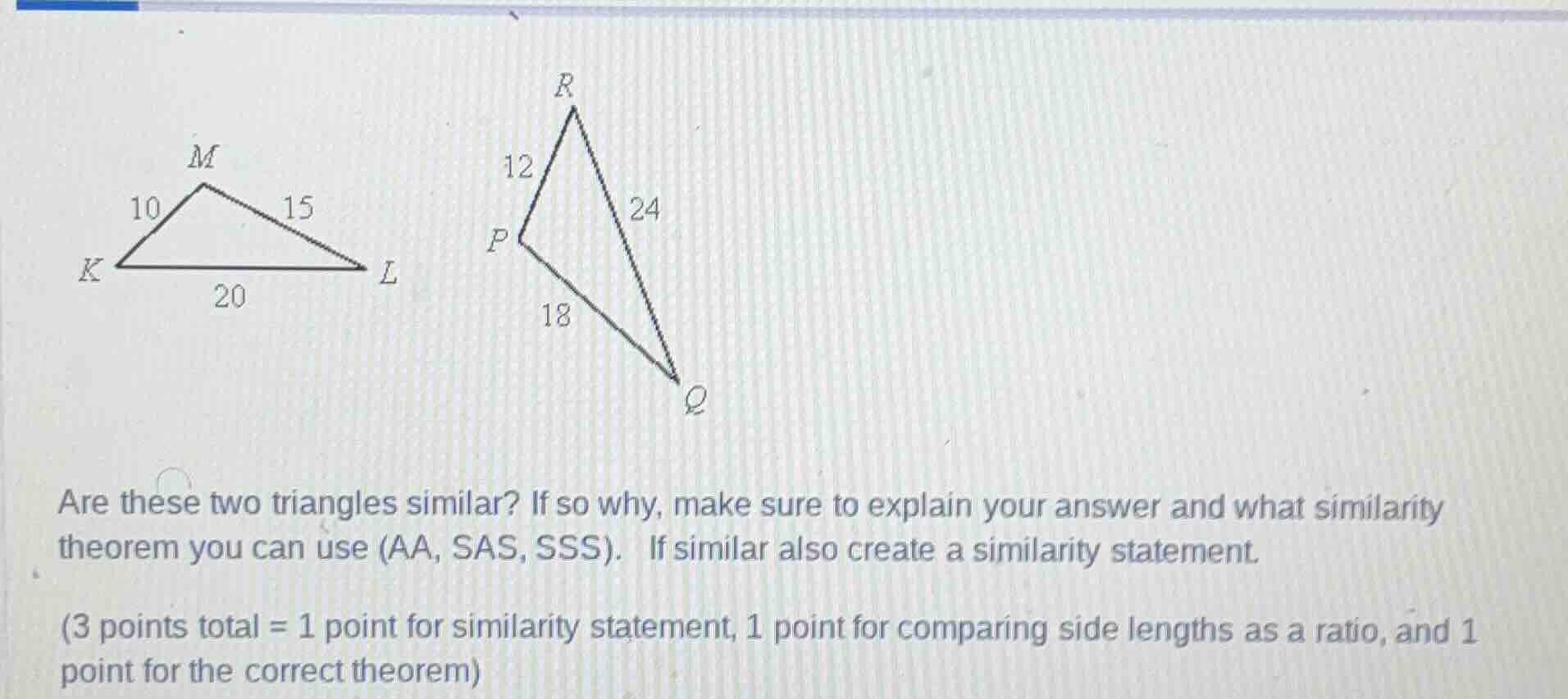
are these two triangles similar? if so why, make sure to explain your answer and what similarity theorem you can use (aa, sas, sss). if similar also create a similarity statement.
(3 points total = 1 point for similarity statement, 1 point for comparing side lengths as a ratio, and 1 point for the correct theorem)
Step1: Order the sides of each triangle
First, we order the side lengths of each triangle from smallest to largest. For $\triangle KLM$: the sides are $10$, $15$, $20$. For $\triangle PQR$: the sides are $12$, $18$, $24$.
Step2: Calculate the ratios of corresponding sides
Now we find the ratios of the corresponding sides.
- Ratio of the smallest sides: $\frac{10}{12}=\frac{5}{6}$
- Ratio of the middle sides: $\frac{15}{18}=\frac{5}{6}$
- Ratio of the largest sides: $\frac{20}{24}=\frac{5}{6}$
Since all three pairs of corresponding sides are in proportion (the ratio is the same for all pairs), by the SSS (Side - Side - Side) similarity theorem, the two triangles are similar.
Step3: Write the similarity statement
To write the similarity statement, we match the vertices in the order of the corresponding sides. So $\triangle KLM \sim \triangle PQR$ (because the order of the sides we considered was from smallest to largest, and the ratios correspond to the order of the vertices $K - P$, $L - Q$, $M - R$? Wait, actually, let's check the correspondence again. Wait, when we ordered the sides:
For $\triangle KLM$: $K$ to $M = 10$, $M$ to $L = 15$, $K$ to $L = 20$
For $\triangle PQR$: $P$ to $R = 12$, $P$ to $Q = 18$, $R$ to $Q = 24$
Wait, maybe a better way: Let's list the sides with their lengths:
$\triangle KLM$: $KL = 20$, $KM = 10$, $LM = 15$
$\triangle PQR$: $QR = 24$, $PR = 12$, $PQ = 18$
So if we match $KM$ (length 10) with $PR$ (length 12), $LM$ (length 15) with $PQ$ (length 18), and $KL$ (length 20) with $QR$ (length 24), then the correspondence is $K
ightarrow P$, $M
ightarrow R$, $L
ightarrow Q$. So the similarity statement is $\triangle KML \sim \triangle PRQ$? Wait, no, let's do it properly. Since the ratios are $\frac{KM}{PR}=\frac{10}{12}=\frac{5}{6}$, $\frac{LM}{PQ}=\frac{15}{18}=\frac{5}{6}$, $\frac{KL}{QR}=\frac{20}{24}=\frac{5}{6}$. So the vertices: $K$ corresponds to $P$, $M$ corresponds to $R$, $L$ corresponds to $Q$. So the similarity statement is $\triangle KML \sim \triangle PRQ$? Wait, maybe I mixed up the labels. Alternatively, since the sides are in proportion as we calculated, the correct similarity statement is $\triangle KLM \sim \triangle PQR$ (if we consider the order of the sides as $KM = 10$, $LM = 15$, $KL = 20$ and $PR = 12$, $PQ = 18$, $QR = 24$). The key is that the order of the letters should correspond to the proportional sides. Since all three sides are proportional, by SSS similarity, $\triangle KLM \sim \triangle PQR$ (or the correct vertex - matching based on the side lengths).

Snap & solve any problem in the app
Get step-by-step solutions on Sovi AI
Photo-based solutions with guided steps
Explore more problems and detailed explanations
The two triangles are similar.
- Similarity Statement: $\boldsymbol{\triangle KLM \sim \triangle PQR}$ (or the appropriate vertex - matched statement based on side correspondence)
- Ratio of Sides: The ratios of corresponding sides are $\frac{10}{12}=\frac{15}{18}=\frac{20}{24}=\frac{5}{6}$ (all three pairs of corresponding sides are in proportion).
- Similarity Theorem: We use the SSS (Side - Side - Side) similarity theorem, which states that if the corresponding sides of two triangles are in proportion, then the triangles are similar.