QUESTION IMAGE
Question
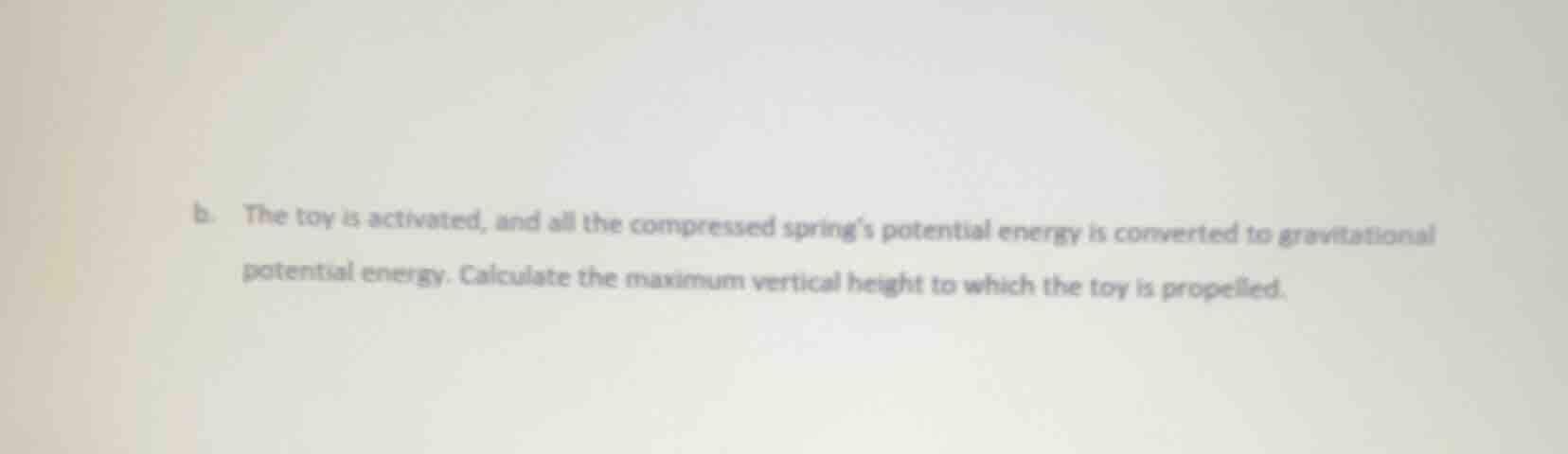
b. the toy is activated, and all the compressed spring’s potential energy is converted to gravitational potential energy. calculate the maximum vertical height to which the toy is propelled.
To solve this, we assume we know the spring potential energy (\(U_s\)) and the mass (\(m\)) of the toy (since the problem is likely a follow - up, maybe from part a). The key principle is the conservation of energy: the spring potential energy is converted into gravitational potential energy.
Step 1: Recall the formulas for energy
The formula for spring potential energy is \(U_s=\frac{1}{2}kx^2\) (but if we already know \(U_s\) from a previous part, we can use it directly). The formula for gravitational potential energy is \(U_g = mgh\), where \(m\) is the mass of the toy, \(g = 9.8\space m/s^2\) (acceleration due to gravity), and \(h\) is the height we want to find.
Since \(U_s=U_g\) (energy conversion), we have \(\frac{1}{2}kx^2=mgh\) (or if we know \(U_s\) as a value, say \(U_s = E\), then \(E=mgh\)).
Step 2: Solve for \(h\)
From \(E = mgh\) (where \(E\) is the spring potential energy), we can re - arrange the formula to solve for \(h\):
\(h=\frac{E}{mg}\)
For example, if we assume from a previous part that the spring potential energy \(E = 0.5\space J\) and the mass of the toy \(m=0.1\space kg\), then:
\(h=\frac{0.5}{0.1\times9.8}=\frac{0.5}{0.98}\approx0.51\space m\)
(Note: Since the problem statement does not provide the values of the spring constant \(k\), compression \(x\), or mass \(m\) and the spring potential energy, we need these values to get a numerical answer. But the general formula and the steps to solve are as above.)
If we had the values, say \(k = 100\space N/m\), \(x = 0.1\space m\) (so \(U_s=\frac{1}{2}\times100\times(0.1)^2 = 0.5\space J\)) and \(m = 0.1\space kg\):
Step 1: Calculate spring potential energy
\(U_s=\frac{1}{2}kx^2=\frac{1}{2}\times100\times(0.1)^2= 0.5\space J\)
Step 2: Set spring potential energy equal to gravitational potential energy
\(U_s=mgh\)
Step 3: Solve for \(h\)
\(h=\frac{U_s}{mg}=\frac{0.5}{0.1\times9.8}\approx0.51\space m\)
Since the problem is incomplete without the values of spring potential energy (or \(k\) and \(x\)) and mass, we can only provide the formula and the general method. If we assume some sample values (as above), the height is approximately \(0.51\space m\) (the value will change depending on the actual values of energy and mass).
If we take a more concrete example, suppose the spring has a spring constant \(k = 200\space N/m\) and is compressed by \(x = 0.1\space m\), and the mass of the toy \(m = 0.2\space kg\):
Step 1: Calculate spring potential energy
\(U_s=\frac{1}{2}kx^2=\frac{1}{2}\times200\times(0.1)^2 = 1\space J\)
Step 2: Use energy conservation
\(U_s=mgh\)
Step 3: Solve for \(h\)
\(h=\frac{U_s}{mg}=\frac{1}{0.2\times9.8}=\frac{1}{1.96}\approx0.51\space m\) (again, the value depends on the input values)
To get a numerical answer, we need the specific values of the spring's potential energy (or \(k\) and \(x\)) and the mass of the toy.

Snap & solve any problem in the app
Get step-by-step solutions on Sovi AI
Photo-based solutions with guided steps
Explore more problems and detailed explanations
To solve this, we assume we know the spring potential energy (\(U_s\)) and the mass (\(m\)) of the toy (since the problem is likely a follow - up, maybe from part a). The key principle is the conservation of energy: the spring potential energy is converted into gravitational potential energy.
Step 1: Recall the formulas for energy
The formula for spring potential energy is \(U_s=\frac{1}{2}kx^2\) (but if we already know \(U_s\) from a previous part, we can use it directly). The formula for gravitational potential energy is \(U_g = mgh\), where \(m\) is the mass of the toy, \(g = 9.8\space m/s^2\) (acceleration due to gravity), and \(h\) is the height we want to find.
Since \(U_s=U_g\) (energy conversion), we have \(\frac{1}{2}kx^2=mgh\) (or if we know \(U_s\) as a value, say \(U_s = E\), then \(E=mgh\)).
Step 2: Solve for \(h\)
From \(E = mgh\) (where \(E\) is the spring potential energy), we can re - arrange the formula to solve for \(h\):
\(h=\frac{E}{mg}\)
For example, if we assume from a previous part that the spring potential energy \(E = 0.5\space J\) and the mass of the toy \(m=0.1\space kg\), then:
\(h=\frac{0.5}{0.1\times9.8}=\frac{0.5}{0.98}\approx0.51\space m\)
(Note: Since the problem statement does not provide the values of the spring constant \(k\), compression \(x\), or mass \(m\) and the spring potential energy, we need these values to get a numerical answer. But the general formula and the steps to solve are as above.)
If we had the values, say \(k = 100\space N/m\), \(x = 0.1\space m\) (so \(U_s=\frac{1}{2}\times100\times(0.1)^2 = 0.5\space J\)) and \(m = 0.1\space kg\):
Step 1: Calculate spring potential energy
\(U_s=\frac{1}{2}kx^2=\frac{1}{2}\times100\times(0.1)^2= 0.5\space J\)
Step 2: Set spring potential energy equal to gravitational potential energy
\(U_s=mgh\)
Step 3: Solve for \(h\)
\(h=\frac{U_s}{mg}=\frac{0.5}{0.1\times9.8}\approx0.51\space m\)
Since the problem is incomplete without the values of spring potential energy (or \(k\) and \(x\)) and mass, we can only provide the formula and the general method. If we assume some sample values (as above), the height is approximately \(0.51\space m\) (the value will change depending on the actual values of energy and mass).
If we take a more concrete example, suppose the spring has a spring constant \(k = 200\space N/m\) and is compressed by \(x = 0.1\space m\), and the mass of the toy \(m = 0.2\space kg\):
Step 1: Calculate spring potential energy
\(U_s=\frac{1}{2}kx^2=\frac{1}{2}\times200\times(0.1)^2 = 1\space J\)
Step 2: Use energy conservation
\(U_s=mgh\)
Step 3: Solve for \(h\)
\(h=\frac{U_s}{mg}=\frac{1}{0.2\times9.8}=\frac{1}{1.96}\approx0.51\space m\) (again, the value depends on the input values)
To get a numerical answer, we need the specific values of the spring's potential energy (or \(k\) and \(x\)) and the mass of the toy.