QUESTION IMAGE
Question
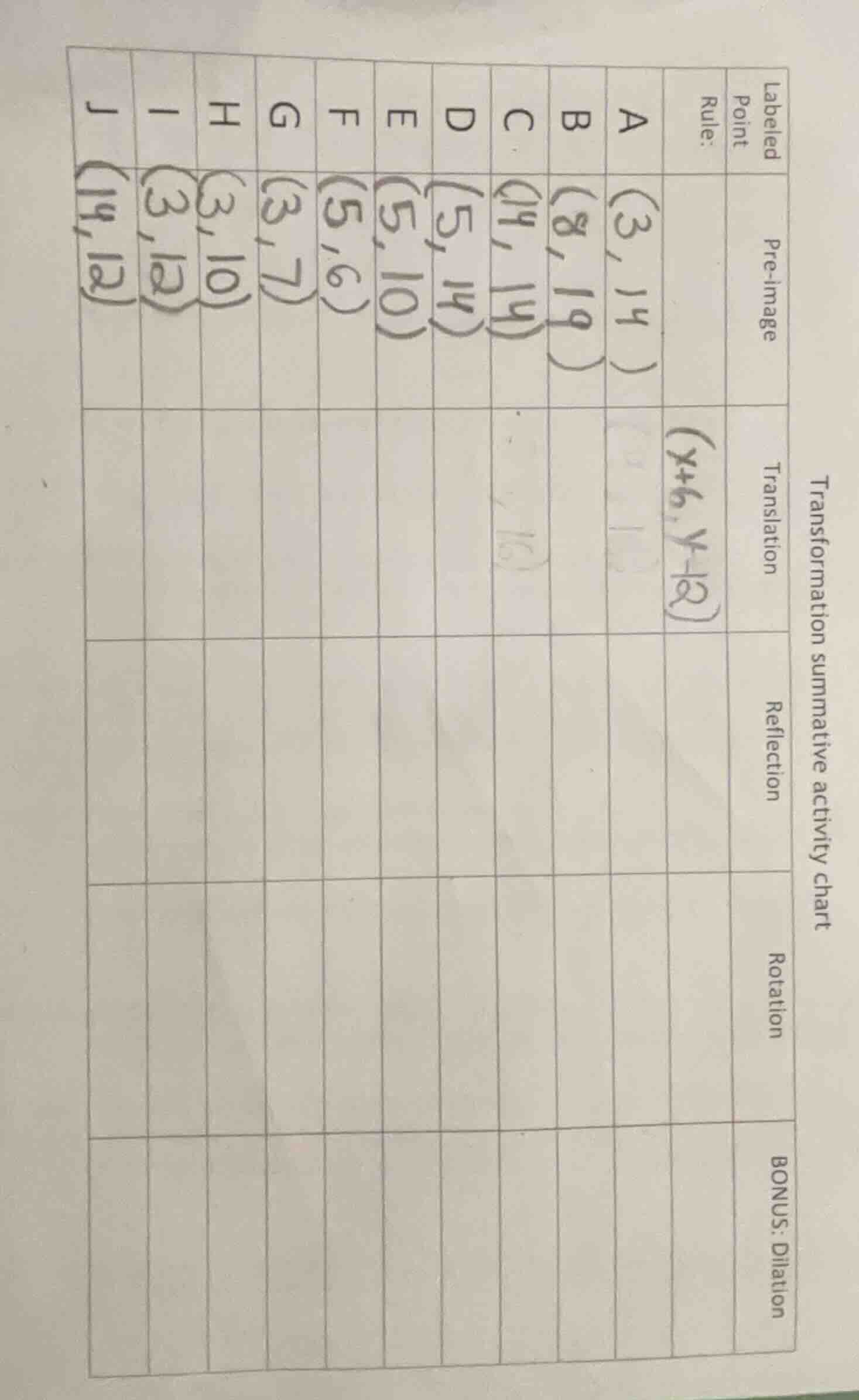
transformation summative activity chart
labeled point\trule:
pre - image\ttranslation\treflection\trotation\tbonus: dilation
a\t(3,14)\t(x + 6,y - 8)\t\t\t
b\t(8,19)\t\t\t\t
c\t(14,14)\t\t\t\t
d\t(5,14)\t\t\t\t
e\t(5,10)\t\t\t\t
f\t(5,6)\t\t\t\t
g\t(3,7)\t\t\t\t
h\t(3,10)\t\t\t\t
i\t(3,12)\t\t\t\t
j\t(14,12)\t\t\t\t
To solve the translation for each pre - image point \((x,y)\) using the rule \((x + 6,y-8)\), we follow these steps for each point:
Point A: \((3,14)\)
Step 1: Calculate the new \(x\) - coordinate
We know that for the \(x\) - coordinate, we use the formula \(x_{new}=x + 6\). Substituting \(x = 3\) into the formula, we get \(x_{new}=3 + 6=9\).
Step 2: Calculate the new \(y\) - coordinate
For the \(y\) - coordinate, we use the formula \(y_{new}=y - 8\). Substituting \(y = 14\) into the formula, we get \(y_{new}=14-8 = 6\).
So, the image of point A is \((9,6)\).
Point B: \((8,19)\)
Step 1: Calculate the new \(x\) - coordinate
Using \(x_{new}=x + 6\) and substituting \(x = 8\), we have \(x_{new}=8 + 6 = 14\).
Step 2: Calculate the new \(y\) - coordinate
Using \(y_{new}=y - 8\) and substituting \(y = 19\), we have \(y_{new}=19-8=11\).
So, the image of point B is \((14,11)\).
Point C: \((14,14)\)
Step 1: Calculate the new \(x\) - coordinate
Using \(x_{new}=x + 6\) and substituting \(x = 14\), we get \(x_{new}=14 + 6=20\).
Step 2: Calculate the new \(y\) - coordinate
Using \(y_{new}=y - 8\) and substituting \(y = 14\), we get \(y_{new}=14 - 8=6\).
So, the image of point C is \((20,6)\).
Point D: \((5,14)\)
Step 1: Calculate the new \(x\) - coordinate
Using \(x_{new}=x + 6\) and substituting \(x = 5\), we get \(x_{new}=5+6 = 11\).
Step 2: Calculate the new \(y\) - coordinate
Using \(y_{new}=y - 8\) and substituting \(y = 14\), we get \(y_{new}=14-8 = 6\).
So, the image of point D is \((11,6)\).
Point E: \((5,10)\)
Step 1: Calculate the new \(x\) - coordinate
Using \(x_{new}=x + 6\) and substituting \(x = 5\), we get \(x_{new}=5 + 6=11\).
Step 2: Calculate the new \(y\) - coordinate
Using \(y_{new}=y - 8\) and substituting \(y = 10\), we get \(y_{new}=10-8 = 2\).
So, the image of point E is \((11,2)\).
Point F: \((5,6)\)
Step 1: Calculate the new \(x\) - coordinate
Using \(x_{new}=x + 6\) and substituting \(x = 5\), we get \(x_{new}=5+6 = 11\).
Step 2: Calculate the new \(y\) - coordinate
Using \(y_{new}=y - 8\) and substituting \(y = 6\), we get \(y_{new}=6-8=- 2\).
So, the image of point F is \((11,-2)\).
Point G: \((3,7)\)
Step 1: Calculate the new \(x\) - coordinate
Using \(x_{new}=x + 6\) and substituting \(x = 3\), we get \(x_{new}=3 + 6=9\).
Step 2: Calculate the new \(y\) - coordinate
Using \(y_{new}=y - 8\) and substituting \(y = 7\), we get \(y_{new}=7-8=-1\).
So, the image of point G is \((9,-1)\).
Point H: \((3,10)\)
Step 1: Calculate the new \(x\) - coordinate
Using \(x_{new}=x + 6\) and substituting \(x = 3\), we get \(x_{new}=3 + 6=9\).
Step 2: Calculate the new \(y\) - coordinate
Using \(y_{new}=y - 8\) and substituting \(y = 10\), we get \(y_{new}=10-8 = 2\).
So, the image of point H is \((9,2)\).
Point I: \((3,12)\)
Step 1: Calculate the new \(x\) - coordinate
Using \(x_{new}=x + 6\) and substituting \(x = 3\), we get \(x_{new}=3 + 6=9\).
Step 2: Calculate the new \(y\) - coordinate
Using \(y_{new}=y - 8\) and substituting \(y = 12\), we get \(y_{new}=12-8 = 4\).
So, the image of point I is \((9,4)\).
Point J: \((14,12)\)
Step 1: Calculate the new \(x\) - coordinate
Using \(x_{new}=x + 6\) and substituting \(x = 14\), we get \(x_{new}=14 + 6=20\).
Step 2: Calculate the new \(y\) - coordinate
Using \(y_{new}=y - 8\) and substituting \(y = 12\), we get \(y_{new}=12-8 = 4\).
So, the image of point J is \((20,4)\).
If we were to present the results in a table:
| Labeled Point | Pre - image \((x,y)\) | Translation Rule… |

Snap & solve any problem in the app
Get step-by-step solutions on Sovi AI
Photo-based solutions with guided steps
Explore more problems and detailed explanations
To solve the translation for each pre - image point \((x,y)\) using the rule \((x + 6,y-8)\), we follow these steps for each point:
Point A: \((3,14)\)
Step 1: Calculate the new \(x\) - coordinate
We know that for the \(x\) - coordinate, we use the formula \(x_{new}=x + 6\). Substituting \(x = 3\) into the formula, we get \(x_{new}=3 + 6=9\).
Step 2: Calculate the new \(y\) - coordinate
For the \(y\) - coordinate, we use the formula \(y_{new}=y - 8\). Substituting \(y = 14\) into the formula, we get \(y_{new}=14-8 = 6\).
So, the image of point A is \((9,6)\).
Point B: \((8,19)\)
Step 1: Calculate the new \(x\) - coordinate
Using \(x_{new}=x + 6\) and substituting \(x = 8\), we have \(x_{new}=8 + 6 = 14\).
Step 2: Calculate the new \(y\) - coordinate
Using \(y_{new}=y - 8\) and substituting \(y = 19\), we have \(y_{new}=19-8=11\).
So, the image of point B is \((14,11)\).
Point C: \((14,14)\)
Step 1: Calculate the new \(x\) - coordinate
Using \(x_{new}=x + 6\) and substituting \(x = 14\), we get \(x_{new}=14 + 6=20\).
Step 2: Calculate the new \(y\) - coordinate
Using \(y_{new}=y - 8\) and substituting \(y = 14\), we get \(y_{new}=14 - 8=6\).
So, the image of point C is \((20,6)\).
Point D: \((5,14)\)
Step 1: Calculate the new \(x\) - coordinate
Using \(x_{new}=x + 6\) and substituting \(x = 5\), we get \(x_{new}=5+6 = 11\).
Step 2: Calculate the new \(y\) - coordinate
Using \(y_{new}=y - 8\) and substituting \(y = 14\), we get \(y_{new}=14-8 = 6\).
So, the image of point D is \((11,6)\).
Point E: \((5,10)\)
Step 1: Calculate the new \(x\) - coordinate
Using \(x_{new}=x + 6\) and substituting \(x = 5\), we get \(x_{new}=5 + 6=11\).
Step 2: Calculate the new \(y\) - coordinate
Using \(y_{new}=y - 8\) and substituting \(y = 10\), we get \(y_{new}=10-8 = 2\).
So, the image of point E is \((11,2)\).
Point F: \((5,6)\)
Step 1: Calculate the new \(x\) - coordinate
Using \(x_{new}=x + 6\) and substituting \(x = 5\), we get \(x_{new}=5+6 = 11\).
Step 2: Calculate the new \(y\) - coordinate
Using \(y_{new}=y - 8\) and substituting \(y = 6\), we get \(y_{new}=6-8=- 2\).
So, the image of point F is \((11,-2)\).
Point G: \((3,7)\)
Step 1: Calculate the new \(x\) - coordinate
Using \(x_{new}=x + 6\) and substituting \(x = 3\), we get \(x_{new}=3 + 6=9\).
Step 2: Calculate the new \(y\) - coordinate
Using \(y_{new}=y - 8\) and substituting \(y = 7\), we get \(y_{new}=7-8=-1\).
So, the image of point G is \((9,-1)\).
Point H: \((3,10)\)
Step 1: Calculate the new \(x\) - coordinate
Using \(x_{new}=x + 6\) and substituting \(x = 3\), we get \(x_{new}=3 + 6=9\).
Step 2: Calculate the new \(y\) - coordinate
Using \(y_{new}=y - 8\) and substituting \(y = 10\), we get \(y_{new}=10-8 = 2\).
So, the image of point H is \((9,2)\).
Point I: \((3,12)\)
Step 1: Calculate the new \(x\) - coordinate
Using \(x_{new}=x + 6\) and substituting \(x = 3\), we get \(x_{new}=3 + 6=9\).
Step 2: Calculate the new \(y\) - coordinate
Using \(y_{new}=y - 8\) and substituting \(y = 12\), we get \(y_{new}=12-8 = 4\).
So, the image of point I is \((9,4)\).
Point J: \((14,12)\)
Step 1: Calculate the new \(x\) - coordinate
Using \(x_{new}=x + 6\) and substituting \(x = 14\), we get \(x_{new}=14 + 6=20\).
Step 2: Calculate the new \(y\) - coordinate
Using \(y_{new}=y - 8\) and substituting \(y = 12\), we get \(y_{new}=12-8 = 4\).
So, the image of point J is \((20,4)\).
If we were to present the results in a table:
| Labeled Point | Pre - image \((x,y)\) | Translation Rule \((x + 6,y - 8)\) | Image \((x_{new},y_{new})\) |
|---|---|---|---|
| B | \((8,19)\) | \((x + 6,y - 8)\) | \((14,11)\) |
| C | \((14,14)\) | \((x + 6,y - 8)\) | \((20,6)\) |
| D | \((5,14)\) | \((x + 6,y - 8)\) | \((11,6)\) |
| E | \((5,10)\) | \((x + 6,y - 8)\) | \((11,2)\) |
| F | \((5,6)\) | \((x + 6,y - 8)\) | \((11,-2)\) |
| G | \((3,7)\) | \((x + 6,y - 8)\) | \((9,-1)\) |
| H | \((3,10)\) | \((x + 6,y - 8)\) | \((9,2)\) |
| I | \((3,12)\) | \((x + 6,y - 8)\) | \((9,4)\) |
| J | \((14,12)\) | \((x + 6,y - 8)\) | \((20,4)\) |