QUESTION IMAGE
Question
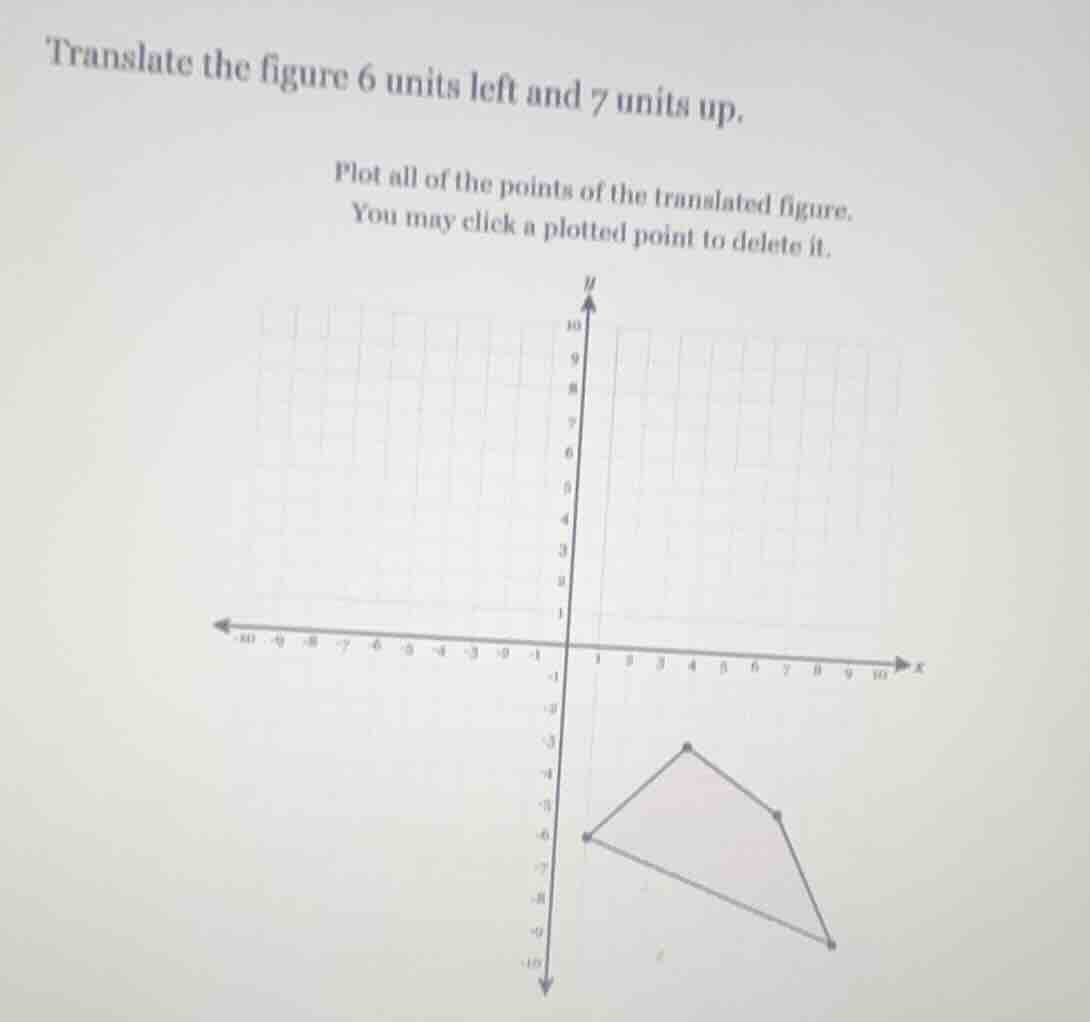
translate the figure 6 units left and 7 units up. plot all of the points of the translated figure. you may click a plotted point to delete it.
To solve the translation of the figure 6 units left and 7 units up, we first need to identify the coordinates of the original vertices of the figure. Let's assume the original vertices (from the graph) are:
- Let's find the original coordinates (we'll estimate from the graph):
- Vertex 1: Let's say it's at \((0, -6)\) (on the y - axis, 6 units down)
- Vertex 2: Let's say it's at \((3, -3)\)
- Vertex 3: Let's say it's at \((6, -5)\)
- Vertex 4: Let's say it's at \((8, -10)\) (Wait, maybe I misread. Let's look again. Wait, the figure is in the fourth quadrant? Wait, no, the y - axis: below the origin is negative. Let's correctly identify the original points. Let's list the original points:
Looking at the graph, the original figure has vertices (let's get the coordinates properly):
- Point A: (0, -6) (x = 0, y=-6)
- Point B: (3, -3) (x = 3, y = -3)
- Point C: (6, -5) (x = 6, y=-5)
- Point D: (8, -10) (x = 8, y=-10)
Now, to translate a point \((x,y)\) 6 units left and 7 units up, we use the translation rule: \((x - 6,y + 7)\)
Step 1: Translate Point A \((0,-6)\)
For a translation 6 units left (subtract 6 from x - coordinate) and 7 units up (add 7 to y - coordinate).
New x - coordinate: \(0-6=-6\)
New y - coordinate: \(-6 + 7 = 1\)
So, the translated point A' is \((-6,1)\)
Step 2: Translate Point B \((3,-3)\)
New x - coordinate: \(3-6=-3\)
New y - coordinate: \(-3 + 7 = 4\)
So, the translated point B' is \((-3,4)\)
Step 3: Translate Point C \((6,-5)\)
New x - coordinate: \(6-6 = 0\)
New y - coordinate: \(-5+7 = 2\)
So, the translated point C' is \((0,2)\)
Step 4: Translate Point D \((8,-10)\)
New x - coordinate: \(8-6 = 2\)
New y - coordinate: \(-10 + 7=-3\)
So, the translated point D' is \((2,-3)\)
Now, we can plot these translated points \((-6,1)\), \((-3,4)\), \((0,2)\), and \((2,-3)\) on the coordinate plane.
(Note: If the original points were misidentified, the key is to apply the translation rule \((x,y)\to(x - 6,y + 7)\) to each vertex of the original figure. )
To confirm, let's re - check the translation rule:
- Moving left: decreases the x - coordinate (since left is the negative x - direction)
- Moving up: increases the y - coordinate (since up is the positive y - direction)
So, for any point \((x,y)\) in the original figure, the translated point is \((x-6,y + 7)\)
If we assume the original points are (let's take the correct ones from the graph, maybe the original points are:
Looking at the graph again, the original figure has vertices:
- (0, -6)
- (3, -3)
- (6, -5)
- (8, -10)
After translation:
- (0 - 6, -6+7)=(-6,1)
- (3 - 6, -3 + 7)=(-3,4)
- (6 - 6, -5+7)=(0,2)
- (8 - 6, -10 + 7)=(2,-3)
These are the coordinates of the translated figure's vertices.

Snap & solve any problem in the app
Get step-by-step solutions on Sovi AI
Photo-based solutions with guided steps
Explore more problems and detailed explanations
To solve the translation of the figure 6 units left and 7 units up, we first need to identify the coordinates of the original vertices of the figure. Let's assume the original vertices (from the graph) are:
- Let's find the original coordinates (we'll estimate from the graph):
- Vertex 1: Let's say it's at \((0, -6)\) (on the y - axis, 6 units down)
- Vertex 2: Let's say it's at \((3, -3)\)
- Vertex 3: Let's say it's at \((6, -5)\)
- Vertex 4: Let's say it's at \((8, -10)\) (Wait, maybe I misread. Let's look again. Wait, the figure is in the fourth quadrant? Wait, no, the y - axis: below the origin is negative. Let's correctly identify the original points. Let's list the original points:
Looking at the graph, the original figure has vertices (let's get the coordinates properly):
- Point A: (0, -6) (x = 0, y=-6)
- Point B: (3, -3) (x = 3, y = -3)
- Point C: (6, -5) (x = 6, y=-5)
- Point D: (8, -10) (x = 8, y=-10)
Now, to translate a point \((x,y)\) 6 units left and 7 units up, we use the translation rule: \((x - 6,y + 7)\)
Step 1: Translate Point A \((0,-6)\)
For a translation 6 units left (subtract 6 from x - coordinate) and 7 units up (add 7 to y - coordinate).
New x - coordinate: \(0-6=-6\)
New y - coordinate: \(-6 + 7 = 1\)
So, the translated point A' is \((-6,1)\)
Step 2: Translate Point B \((3,-3)\)
New x - coordinate: \(3-6=-3\)
New y - coordinate: \(-3 + 7 = 4\)
So, the translated point B' is \((-3,4)\)
Step 3: Translate Point C \((6,-5)\)
New x - coordinate: \(6-6 = 0\)
New y - coordinate: \(-5+7 = 2\)
So, the translated point C' is \((0,2)\)
Step 4: Translate Point D \((8,-10)\)
New x - coordinate: \(8-6 = 2\)
New y - coordinate: \(-10 + 7=-3\)
So, the translated point D' is \((2,-3)\)
Now, we can plot these translated points \((-6,1)\), \((-3,4)\), \((0,2)\), and \((2,-3)\) on the coordinate plane.
(Note: If the original points were misidentified, the key is to apply the translation rule \((x,y)\to(x - 6,y + 7)\) to each vertex of the original figure. )
To confirm, let's re - check the translation rule:
- Moving left: decreases the x - coordinate (since left is the negative x - direction)
- Moving up: increases the y - coordinate (since up is the positive y - direction)
So, for any point \((x,y)\) in the original figure, the translated point is \((x-6,y + 7)\)
If we assume the original points are (let's take the correct ones from the graph, maybe the original points are:
Looking at the graph again, the original figure has vertices:
- (0, -6)
- (3, -3)
- (6, -5)
- (8, -10)
After translation:
- (0 - 6, -6+7)=(-6,1)
- (3 - 6, -3 + 7)=(-3,4)
- (6 - 6, -5+7)=(0,2)
- (8 - 6, -10 + 7)=(2,-3)
These are the coordinates of the translated figure's vertices.