QUESTION IMAGE
Question
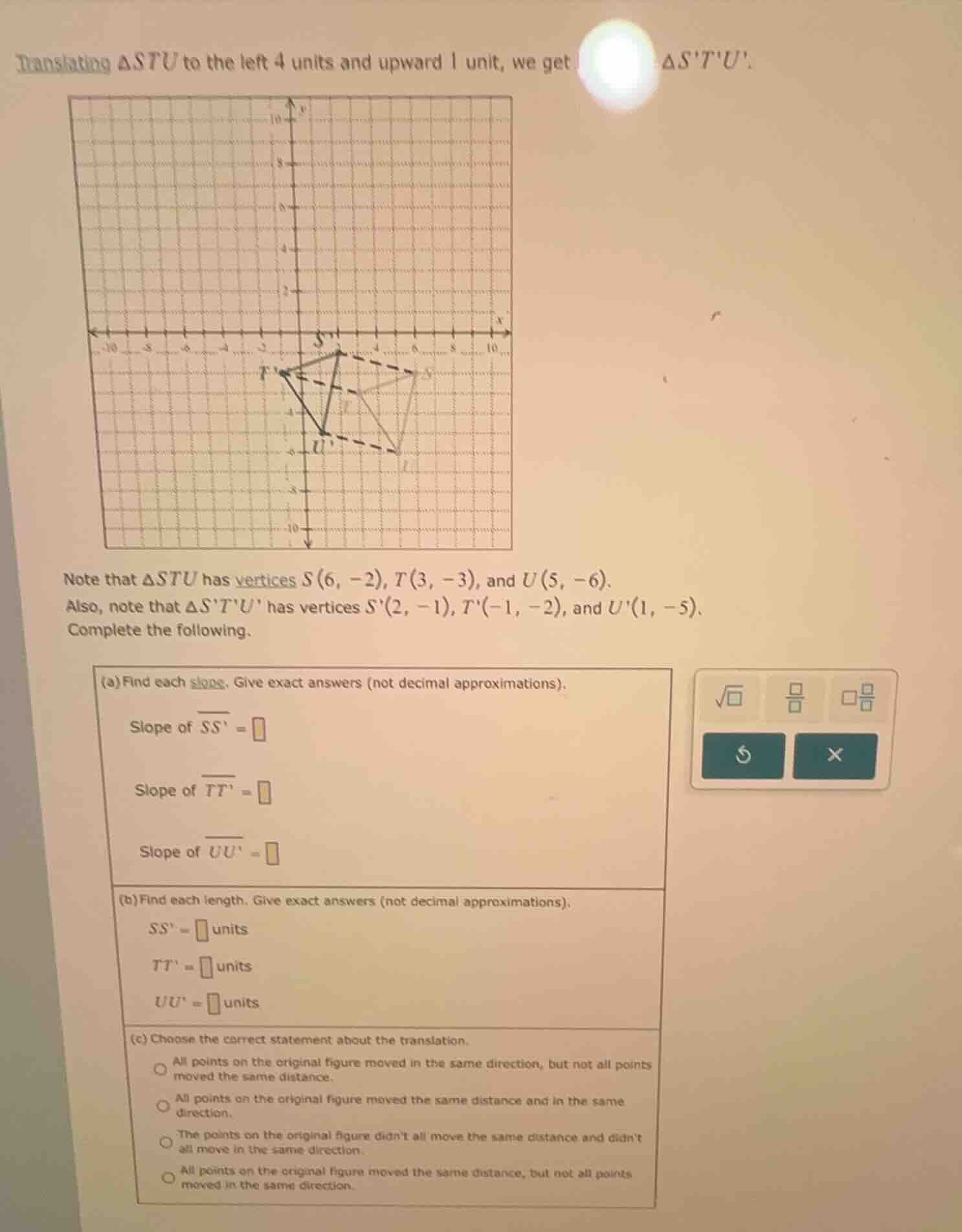
translating δstu to the left 4 units and upward 1 unit, we get δstu. note that δstu has vertices s(6, -2), t(3, -3), and u(5, -6). also, note that δstu has vertices s(2, -1), t(-1, -2), and u(1, -5). complete the following. (a) find each slope. give exact answers (not decimal approximations). slope of (overline{ss}) = slope of (overline{tt}) = slope of (overline{uu}) = (b) find each length. give exact answers (not decimal approximations). (ss = ) units (tt = ) units (uu = ) units (c) choose the correct statement about the translation. all points on the original figure moved in the same direction, but not all points moved the same distance. all points on the original figure moved the same distance and in the same direction. the points on the original figure didnt all move the same distance and didnt all move in the same direction. all points on the original figure moved the same distance, but not all points moved in the same direction.
Part (a)
Slope of \( \overline{SS'} \)
- Step 1: Identify coordinates of \( S \) and \( S' \). \( S(6, -2) \), \( S'(2, -1) \).
- Step 2: Use slope formula \( m = \frac{y_2 - y_1}{x_2 - x_1} \).
\[
m = \frac{-1 - (-2)}{2 - 6} = \frac{-1 + 2}{-4} = \frac{1}{-4} = -\frac{1}{4}
\]
Slope of \( \overline{TT'} \)
- Step 1: Identify coordinates of \( T \) and \( T' \). \( T(3, -3) \), \( T'(-1, -2) \).
- Step 2: Use slope formula.
\[
m = \frac{-2 - (-3)}{-1 - 3} = \frac{-2 + 3}{-4} = \frac{1}{-4} = -\frac{1}{4}
\]
Slope of \( \overline{UU'} \)
- Step 1: Identify coordinates of \( U \) and \( U' \). \( U(5, -6) \), \( U'(1, -5) \).
- Step 2: Use slope formula.
\[
m = \frac{-5 - (-6)}{1 - 5} = \frac{-5 + 6}{-4} = \frac{1}{-4} = -\frac{1}{4}
\]
Part (b)
Length of \( SS' \)
- Step 1: Use distance formula \( d = \sqrt{(x_2 - x_1)^2 + (y_2 - y_1)^2} \). For \( S(6, -2) \) and \( S'(2, -1) \):
\[
d = \sqrt{(2 - 6)^2 + (-1 - (-2))^2} = \sqrt{(-4)^2 + (1)^2} = \sqrt{16 + 1} = \sqrt{17}
\]
Length of \( TT' \)
- Step 1: For \( T(3, -3) \) and \( T'(-1, -2) \):
\[
d = \sqrt{(-1 - 3)^2 + (-2 - (-3))^2} = \sqrt{(-4)^2 + (1)^2} = \sqrt{16 + 1} = \sqrt{17}
\]
Length of \( UU' \)
- Step 1: For \( U(5, -6) \) and \( U'(1, -5) \):
\[
d = \sqrt{(1 - 5)^2 + (-5 - (-6))^2} = \sqrt{(-4)^2 + (1)^2} = \sqrt{16 + 1} = \sqrt{17}
\]
Part (c)
- Explanation: Translation is a rigid transformation where all points move the same distance (since \( SS' = TT' = UU' = \sqrt{17} \)) and same direction (all slopes are equal, so parallel vectors, meaning same direction).
- Correct option: "All points on the original figure moved the same distance and in the same direction."
Final Answers
(a)
- Slope of \( \overline{SS'} \): \( \boldsymbol{-\frac{1}{4}} \)
- Slope of \( \overline{TT'} \): \( \boldsymbol{-\frac{1}{4}} \)
- Slope of \( \overline{UU'} \): \( \boldsymbol{-\frac{1}{4}} \)
(b)
- \( SS' \): \( \boldsymbol{\sqrt{17}} \) units
- \( TT' \): \( \boldsymbol{\sqrt{17}} \) units
- \( UU' \): \( \boldsymbol{\sqrt{17}} \) units
(c)
- Correct statement: "All points on the original figure moved the same distance and in the same direction."

Snap & solve any problem in the app
Get step-by-step solutions on Sovi AI
Photo-based solutions with guided steps
Explore more problems and detailed explanations
Part (a)
Slope of \( \overline{SS'} \)
- Step 1: Identify coordinates of \( S \) and \( S' \). \( S(6, -2) \), \( S'(2, -1) \).
- Step 2: Use slope formula \( m = \frac{y_2 - y_1}{x_2 - x_1} \).
\[
m = \frac{-1 - (-2)}{2 - 6} = \frac{-1 + 2}{-4} = \frac{1}{-4} = -\frac{1}{4}
\]
Slope of \( \overline{TT'} \)
- Step 1: Identify coordinates of \( T \) and \( T' \). \( T(3, -3) \), \( T'(-1, -2) \).
- Step 2: Use slope formula.
\[
m = \frac{-2 - (-3)}{-1 - 3} = \frac{-2 + 3}{-4} = \frac{1}{-4} = -\frac{1}{4}
\]
Slope of \( \overline{UU'} \)
- Step 1: Identify coordinates of \( U \) and \( U' \). \( U(5, -6) \), \( U'(1, -5) \).
- Step 2: Use slope formula.
\[
m = \frac{-5 - (-6)}{1 - 5} = \frac{-5 + 6}{-4} = \frac{1}{-4} = -\frac{1}{4}
\]
Part (b)
Length of \( SS' \)
- Step 1: Use distance formula \( d = \sqrt{(x_2 - x_1)^2 + (y_2 - y_1)^2} \). For \( S(6, -2) \) and \( S'(2, -1) \):
\[
d = \sqrt{(2 - 6)^2 + (-1 - (-2))^2} = \sqrt{(-4)^2 + (1)^2} = \sqrt{16 + 1} = \sqrt{17}
\]
Length of \( TT' \)
- Step 1: For \( T(3, -3) \) and \( T'(-1, -2) \):
\[
d = \sqrt{(-1 - 3)^2 + (-2 - (-3))^2} = \sqrt{(-4)^2 + (1)^2} = \sqrt{16 + 1} = \sqrt{17}
\]
Length of \( UU' \)
- Step 1: For \( U(5, -6) \) and \( U'(1, -5) \):
\[
d = \sqrt{(1 - 5)^2 + (-5 - (-6))^2} = \sqrt{(-4)^2 + (1)^2} = \sqrt{16 + 1} = \sqrt{17}
\]
Part (c)
- Explanation: Translation is a rigid transformation where all points move the same distance (since \( SS' = TT' = UU' = \sqrt{17} \)) and same direction (all slopes are equal, so parallel vectors, meaning same direction).
- Correct option: "All points on the original figure moved the same distance and in the same direction."
Final Answers
(a)
- Slope of \( \overline{SS'} \): \( \boldsymbol{-\frac{1}{4}} \)
- Slope of \( \overline{TT'} \): \( \boldsymbol{-\frac{1}{4}} \)
- Slope of \( \overline{UU'} \): \( \boldsymbol{-\frac{1}{4}} \)
(b)
- \( SS' \): \( \boldsymbol{\sqrt{17}} \) units
- \( TT' \): \( \boldsymbol{\sqrt{17}} \) units
- \( UU' \): \( \boldsymbol{\sqrt{17}} \) units
(c)
- Correct statement: "All points on the original figure moved the same distance and in the same direction."