QUESTION IMAGE
Question
translations
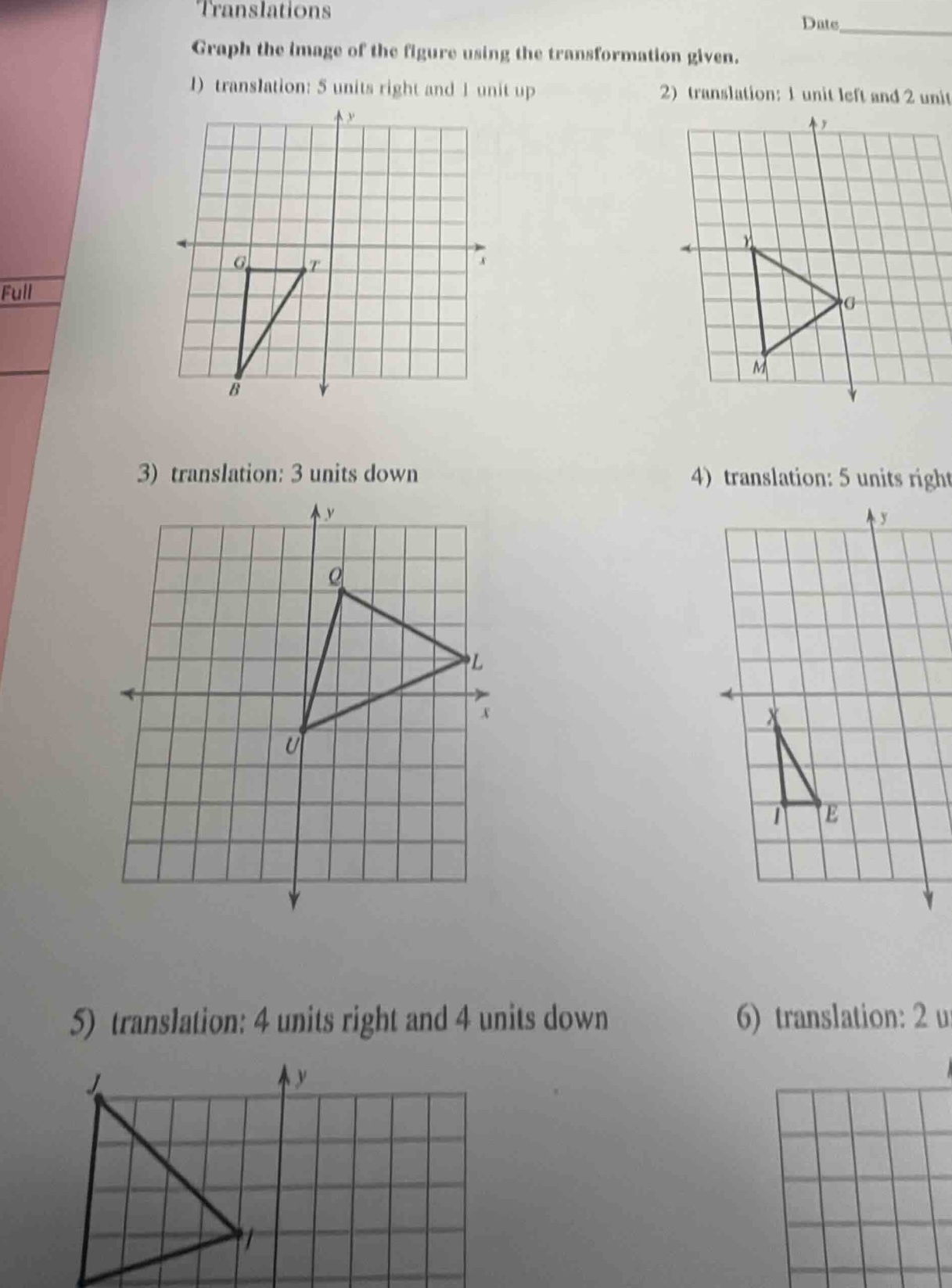
graph the image of the figure using the transformation given.
- translation: 5 units right and 1 unit up
- translation: 1 unit left and 2 unit
- translation: 3 units down
- translation: 5 units right
- translation: 4 units right and 4 units down
- translation: 2 u
Problem 1: Translation 5 units right and 1 unit up
Step 1: Identify coordinates of original points
Let's assume the coordinates of \( G \), \( T \), \( B \) (from the first graph):
- \( G \): Let's say \( G(-3, 0) \) (from the grid, left 3 on x, 0 on y)
- \( T(-1, 0) \) (left 1 on x, 0 on y)
- \( B(-3, -3) \) (left 3 on x, down 3 on y)
Step 2: Apply translation (right 5, up 1)
For a point \( (x, y) \), translation \( (x + 5, y + 1) \):
- \( G' \): \( (-3 + 5, 0 + 1) = (2, 1) \)
- \( T' \): \( (-1 + 5, 0 + 1) = (4, 1) \)
- \( B' \): \( (-3 + 5, -3 + 1) = (2, -2) \)
Step 3: Graph the new points
Plot \( G'(2,1) \), \( T'(4,1) \), \( B'(2,-2) \) and connect them to form the translated figure.
Problem 2: Translation 1 unit left and 2 units up (incomplete, but process similar)
Step 1: Identify coordinates of \( Y \), \( O \), \( M \) (second graph):
- \( Y(-4, 1) \), \( O(-1, -1) \), \( M(-4, -2) \) (example coordinates)
Step 2: Apply translation (left 1: \( x - 1 \), up 2: \( y + 2 \))
- \( Y' \): \( (-4 - 1, 1 + 2) = (-5, 3) \)
- \( O' \): \( (-1 - 1, -1 + 2) = (-2, 1) \)
- \( M' \): \( (-4 - 1, -2 + 2) = (-5, 0) \)
Step 3: Graph the new points
Problem 3: Translation 3 units down
Step 1: Identify coordinates of \( Q \), \( L \), \( U \) (third graph):
- \( Q(1, 3) \), \( L(4, 0) \), \( U(0, -1) \) (example coordinates)
Step 2: Apply translation (down 3: \( y - 3 \))
- \( Q' \): \( (1, 3 - 3) = (1, 0) \)
- \( L' \): \( (4, 0 - 3) = (4, -3) \)
- \( U' \): \( (0, -1 - 3) = (0, -4) \)
Step 3: Graph the new points
Problem 4: Translation 5 units right (incomplete, process similar)
Step 1: Identify coordinates of \( X \), \( I \), \( E \) (fourth graph):
- \( X(-3, -1) \), \( I(-3, -3) \), \( E(-2, -3) \) (example coordinates)
Step 2: Apply translation (right 5: \( x + 5 \))
- \( X' \): \( (-3 + 5, -1) = (2, -1) \)
- \( I' \): \( (-3 + 5, -3) = (2, -3) \)
- \( E' \): \( (-2 + 5, -3) = (3, -3) \)
Step 3: Graph the new points
Problem 5: Translation 4 units right and 4 units down
Step 1: Identify coordinates of \( J \), \( I \) (fifth graph, example):
- \( J(-5, 4) \), \( I(-1, 1) \) (and third vertex, say \( K(-5, 1) \))
Step 2: Apply translation (right 4: \( x + 4 \), down 4: \( y - 4 \))
- \( J' \): \( (-5 + 4, 4 - 4) = (-1, 0) \)
- \( I' \): \( (-1 + 4, 1 - 4) = (3, -3) \)
- \( K' \): \( (-5 + 4, 1 - 4) = (-1, -3) \)
Step 3: Graph the new points
Problem 6: Incomplete (translation: 2 units...), follow similar steps: identify coordinates, apply translation, graph.
(Note: For actual graphing, use the grid to find precise coordinates of each vertex, then apply the translation rule \( (x \pm a, y \pm b) \) where \( a, b \) are the translation units, then plot the new vertices and connect them.)
Final Answer (for Problem 1 as example translated coordinates):
Translated points for Problem 1: \( G'(2,1) \), \( T'(4,1) \), \( B'(2,-2) \) (graph these to see the image).
(For other problems, follow the same coordinate identification and translation process.)

Snap & solve any problem in the app
Get step-by-step solutions on Sovi AI
Photo-based solutions with guided steps
Explore more problems and detailed explanations
Problem 1: Translation 5 units right and 1 unit up
Step 1: Identify coordinates of original points
Let's assume the coordinates of \( G \), \( T \), \( B \) (from the first graph):
- \( G \): Let's say \( G(-3, 0) \) (from the grid, left 3 on x, 0 on y)
- \( T(-1, 0) \) (left 1 on x, 0 on y)
- \( B(-3, -3) \) (left 3 on x, down 3 on y)
Step 2: Apply translation (right 5, up 1)
For a point \( (x, y) \), translation \( (x + 5, y + 1) \):
- \( G' \): \( (-3 + 5, 0 + 1) = (2, 1) \)
- \( T' \): \( (-1 + 5, 0 + 1) = (4, 1) \)
- \( B' \): \( (-3 + 5, -3 + 1) = (2, -2) \)
Step 3: Graph the new points
Plot \( G'(2,1) \), \( T'(4,1) \), \( B'(2,-2) \) and connect them to form the translated figure.
Problem 2: Translation 1 unit left and 2 units up (incomplete, but process similar)
Step 1: Identify coordinates of \( Y \), \( O \), \( M \) (second graph):
- \( Y(-4, 1) \), \( O(-1, -1) \), \( M(-4, -2) \) (example coordinates)
Step 2: Apply translation (left 1: \( x - 1 \), up 2: \( y + 2 \))
- \( Y' \): \( (-4 - 1, 1 + 2) = (-5, 3) \)
- \( O' \): \( (-1 - 1, -1 + 2) = (-2, 1) \)
- \( M' \): \( (-4 - 1, -2 + 2) = (-5, 0) \)
Step 3: Graph the new points
Problem 3: Translation 3 units down
Step 1: Identify coordinates of \( Q \), \( L \), \( U \) (third graph):
- \( Q(1, 3) \), \( L(4, 0) \), \( U(0, -1) \) (example coordinates)
Step 2: Apply translation (down 3: \( y - 3 \))
- \( Q' \): \( (1, 3 - 3) = (1, 0) \)
- \( L' \): \( (4, 0 - 3) = (4, -3) \)
- \( U' \): \( (0, -1 - 3) = (0, -4) \)
Step 3: Graph the new points
Problem 4: Translation 5 units right (incomplete, process similar)
Step 1: Identify coordinates of \( X \), \( I \), \( E \) (fourth graph):
- \( X(-3, -1) \), \( I(-3, -3) \), \( E(-2, -3) \) (example coordinates)
Step 2: Apply translation (right 5: \( x + 5 \))
- \( X' \): \( (-3 + 5, -1) = (2, -1) \)
- \( I' \): \( (-3 + 5, -3) = (2, -3) \)
- \( E' \): \( (-2 + 5, -3) = (3, -3) \)
Step 3: Graph the new points
Problem 5: Translation 4 units right and 4 units down
Step 1: Identify coordinates of \( J \), \( I \) (fifth graph, example):
- \( J(-5, 4) \), \( I(-1, 1) \) (and third vertex, say \( K(-5, 1) \))
Step 2: Apply translation (right 4: \( x + 4 \), down 4: \( y - 4 \))
- \( J' \): \( (-5 + 4, 4 - 4) = (-1, 0) \)
- \( I' \): \( (-1 + 4, 1 - 4) = (3, -3) \)
- \( K' \): \( (-5 + 4, 1 - 4) = (-1, -3) \)
Step 3: Graph the new points
Problem 6: Incomplete (translation: 2 units...), follow similar steps: identify coordinates, apply translation, graph.
(Note: For actual graphing, use the grid to find precise coordinates of each vertex, then apply the translation rule \( (x \pm a, y \pm b) \) where \( a, b \) are the translation units, then plot the new vertices and connect them.)
Final Answer (for Problem 1 as example translated coordinates):
Translated points for Problem 1: \( G'(2,1) \), \( T'(4,1) \), \( B'(2,-2) \) (graph these to see the image).
(For other problems, follow the same coordinate identification and translation process.)