QUESTION IMAGE
Question
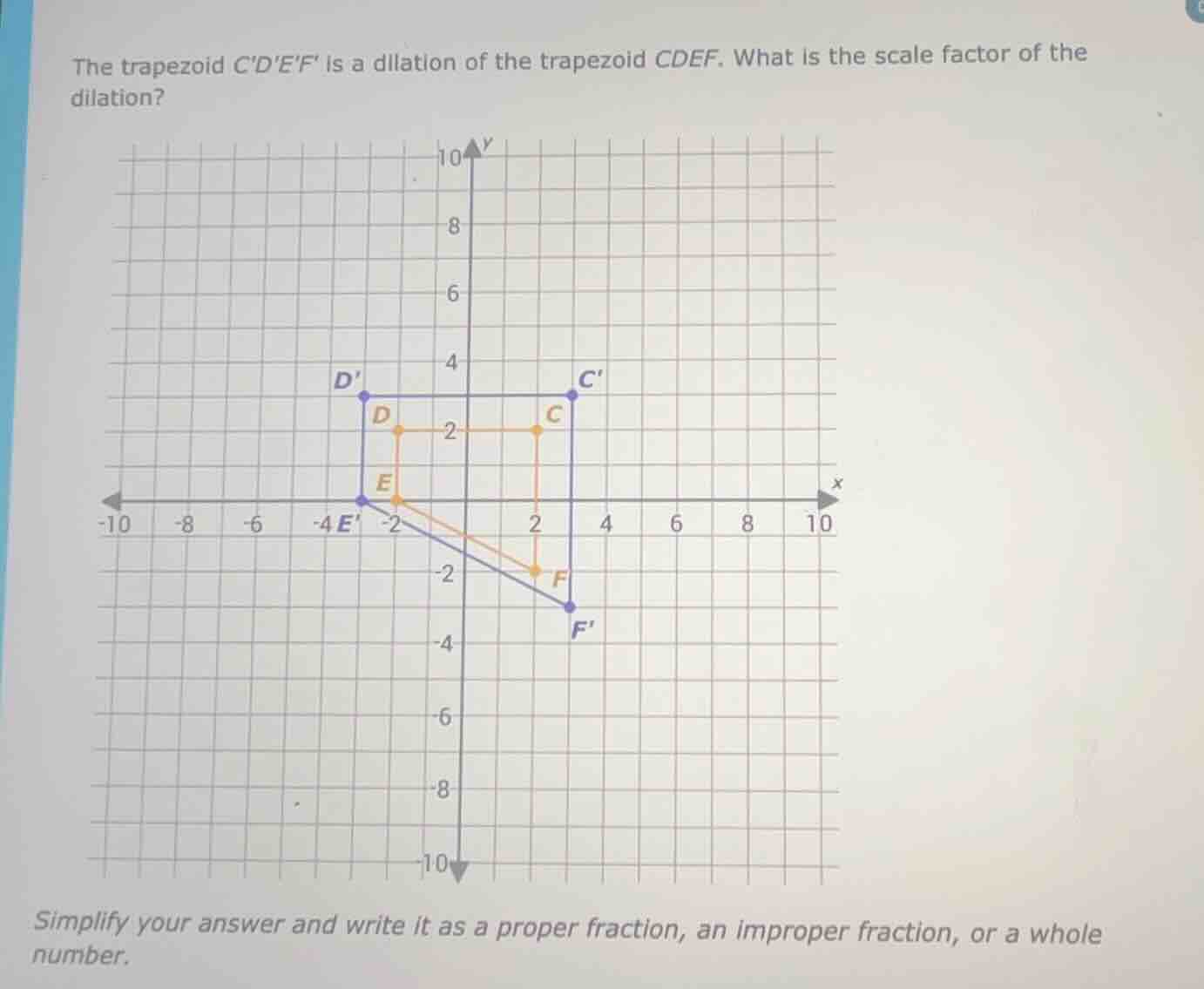
the trapezoid cdef is a dilation of the trapezoid cdef. what is the scale factor of the dilation?
simplify your answer and write it as a proper fraction, an improper fraction, or a whole number.
Step1: Identify coordinates of corresponding points
Let's take point \( C \) and \( C' \). From the graph, \( C \) has coordinates \( (2, 2) \) and \( C' \) has coordinates \( (3, 3) \)? Wait, no, looking again. Wait, \( C \) is at \( (2, 2) \), \( C' \) is at \( (3, 3) \)? Wait, no, let's check the grid. Wait, \( E \) is at \( (-2, 0) \), \( E' \) is at \( (-3, 0) \)? Wait, no, let's take \( D \) and \( D' \). \( D \) is at \( (-2, 2) \), \( D' \) is at \( (-3, 3) \)? Wait, no, maybe better to take the length of a side. Let's take \( E \) to \( D \): \( E \) is \( (-2, 0) \), \( D \) is \( (-2, 2) \), so length is \( 2 - 0 = 2 \). \( E' \) is \( (-3, 0) \), \( D' \) is \( (-3, 3) \), so length is \( 3 - 0 = 3 \)? Wait, no, wait the original trapezoid CDEF: let's list coordinates. \( C(2, 2) \), \( D(-2, 2) \), \( E(-2, 0) \), \( F(2, -2) \)? Wait, no, \( F \) is at \( (2, -2) \)? Wait, \( F' \) is at \( (3, -3) \)? Wait, maybe I made a mistake. Wait, \( E \) is at \( (-2, 0) \), \( D \) is at \( (-2, 2) \), so vertical side \( ED \) has length \( 2 - 0 = 2 \). \( E' \) is at \( (-3, 0) \), \( D' \) is at \( (-3, 3) \), so vertical side \( E'D' \) has length \( 3 - 0 = 3 \)? Wait, no, wait the x-coordinate of \( D \) is -2, \( D' \) is -3? Wait, no, looking at the grid: \( E \) is at (-2, 0), \( E' \) is at (-3, 0)? Wait, no, the grid lines: each square is 1 unit. So \( E \) is at (-2, 0), \( E' \) is at (-3, 0)? Wait, no, \( E \) is at (-2, 0), \( E' \) is at (-3, 0)? Wait, no, the blue points: \( E' \) is at (-3, 0)? Wait, no, the x-axis: from -10 to 10, each grid is 1. So \( E \) is at (-2, 0), \( E' \) is at (-3, 0)? Wait, no, \( E \) is at (-2, 0), \( E' \) is at (-3, 0)? Wait, no, the original trapezoid CDEF: \( E(-2, 0) \), \( D(-2, 2) \), \( C(2, 2) \), \( F(2, -2) \). Then \( E'(-3, 0) \), \( D'(-3, 3) \), \( C'(3, 3) \), \( F'(3, -3) \). So the length of \( ED \) (vertical side) is \( 2 - 0 = 2 \), length of \( E'D' \) is \( 3 - 0 = 3 \)? Wait, no, \( D \) is at (-2, 2), \( E \) is at (-2, 0), so distance is \( 2 - 0 = 2 \). \( D' \) is at (-3, 3), \( E' \) is at (-3, 0), so distance is \( 3 - 0 = 3 \). Wait, but that would be scale factor \( 3/2 \)? Wait, no, maybe I mixed up. Wait, no, let's take \( E \) to \( C \): \( E(-2, 0) \), \( C(2, 2) \)? No, \( C \) is at (2, 2), \( D \) at (-2, 2), so \( CD \) is horizontal: from x=-2 to x=2, length 4. \( C'D' \) is from x=-3 to x=3, length 6. So scale factor is \( 6/4 = 3/2 \)? Wait, no, \( CD \) length: \( 2 - (-2) = 4 \), \( C'D' \) length: \( 3 - (-3) = 6 \), so \( 6/4 = 3/2 \)? Wait, but let's check \( E \) to \( F \): \( E(-2, 0) \), \( F(2, -2) \), distance? Wait, no, \( F \) is at (2, -2), \( F' \) is at (3, -3). So the vector from \( E \) to \( F \) is (4, -2), from \( E' \) to \( F' \) is (6, -3). So the scale factor is \( 6/4 = 3/2 \) or \( -3/-2 = 3/2 \). Wait, but let's take a vertical side: \( D \) to \( E \): \( D(-2, 2) \), \( E(-2, 0) \), length 2. \( D'(-3, 3) \), \( E'(-3, 0) \), length 3. So \( 3/2 \). Wait, but maybe I made a mistake. Wait, original trapezoid: \( E(-2, 0) \), \( D(-2, 2) \), \( C(2, 2) \), \( F(2, -2) \). Dilated trapezoid: \( E'(-3, 0) \), \( D'(-3, 3) \), \( C'(3, 3) \), \( F'(3, -3) \). So the x-coordinate of \( E \) is -2, \( E' \) is -3: so the scale factor is \( -3 / -2 = 3/2 \)? Wait, no, dilation scale factor is the ratio of the image length to the original length. So take \( ED \): length 2 (from y=0 to y=2), \( E'D' \): length 3 (from y=0 to y=3). So scale factor is \( 3/2 \)? Wait, but let's check another side. \( CD \): from x…

Snap & solve any problem in the app
Get step-by-step solutions on Sovi AI
Photo-based solutions with guided steps
Explore more problems and detailed explanations
\( \frac{3}{2} \)