QUESTION IMAGE
Question
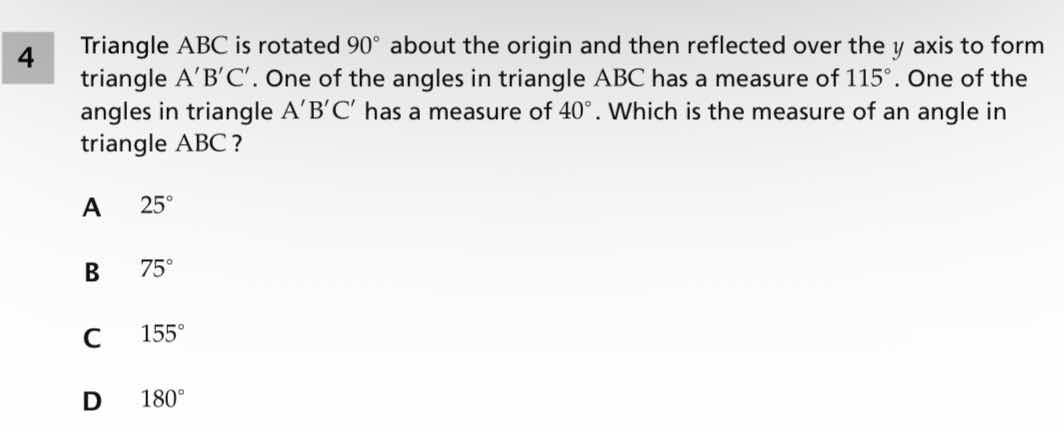
4 triangle abc is rotated $90^{circ}$ about the origin and then reflected over the $y$ axis to form triangle $abc$. one of the angles in triangle abc has a measure of $115^{circ}$. one of the angles in triangle $abc$ has a measure of $40^{circ}$. which is the measure of an angle in triangle abc?
a $25^{circ}$
b $75^{circ}$
c $155^{circ}$
d $180^{circ}$
Step1: Recall transformation properties
Rotations and reflections are rigid transformations, which means the shape and size of the triangle (including angle measures) remain unchanged. So, triangle \(ABC\) and triangle \(A'B'C'\) are congruent, and their corresponding angles are equal.
Step2: Use triangle angle sum property
The sum of the interior angles of a triangle is \(180^{\circ}\). Let the angles of triangle \(ABC\) be \(115^{\circ}\), \(x\), and \(y\). Since triangle \(A'B'C'\) is congruent to \(ABC\), one of its angles is \(40^{\circ}\), so one of \(x\) or \(y\) is \(40^{\circ}\).
Step3: Calculate the unknown angle
We know that \(115^{\circ}+ 40^{\circ}+ \text{third angle}= 180^{\circ}\). Let the third angle be \(z\). Then \(z = 180^{\circ}-(115^{\circ}+ 40^{\circ})\).
\[
z=180^{\circ}- 155^{\circ}=25^{\circ}
\]
Wait, no, wait. Wait, the angles in triangle \(ABC\) must satisfy the sum. Wait, the given angle in \(ABC\) is \(115^{\circ}\), and one angle in \(A'B'C'\) is \(40^{\circ}\), so since they are congruent, \(ABC\) also has a \(40^{\circ}\) angle? Wait, no, wait. Wait, rigid transformations preserve angle measures, so the angles of \(A'B'C'\) are the same as \(ABC\). So in \(ABC\), we have angles: let's say angle 1: \(115^{\circ}\), angle 2: \(40^{\circ}\) (since \(A'B'C'\) has \(40^{\circ}\)), then angle 3 is \(180 - 115 - 40 = 25^{\circ}\). Wait, but let's check the options. Option A is \(25^{\circ}\), but wait, maybe I made a mistake. Wait, no, wait. Wait, the problem says "one of the angles in triangle \(ABC\) has a measure of \(115^{\circ}\)", and "one of the angles in triangle \(A'B'C'\) has a measure of \(40^{\circ}\)". Since \(A'B'C'\) is congruent to \(ABC\), \(ABC\) also has a \(40^{\circ}\) angle? Wait, no, maybe the \(40^{\circ}\) is the other angle. Wait, let's recast:
Sum of angles in a triangle: \(180^{\circ}\). So if one angle is \(115^{\circ}\), and another angle (from the congruent triangle) is \(40^{\circ}\), then the third angle is \(180 - 115 - 40 = 25^{\circ}\). But wait, let's check the options. Option A is \(25^{\circ}\), but wait, maybe I messed up the congruence. Wait, rotations and reflections are rigid, so angle measures are preserved. So \(A'B'C'\) has the same angles as \(ABC\). So in \(ABC\), angles are \(115^{\circ}\), \(40^{\circ}\), and \(25^{\circ}\). So the possible angles in \(ABC\) are \(115^{\circ}\), \(40^{\circ}\), or \(25^{\circ}\). Looking at the options, A is \(25^{\circ}\), which is one of them. Wait, but let's check again.
Wait, the problem is asking "Which is the measure of an angle in triangle \(ABC\)?", and the options are A:25, B:75, C:155, D:180. Wait, 180 is impossible (triangle angles sum to 180, so no angle can be 180). 155: 155 + 115 would be more than 180, so no. 75: let's see, if we thought the other angle was 75, but 115 + 75 = 190, which is more than 180. Wait, no, my initial calculation: 115 + 40 = 155, 180 - 155 = 25. So the angles are 115, 40, 25. So 25 is an angle, which is option A. But wait, maybe I made a mistake in assuming the 40 is in \(ABC\). Wait, no, rigid transformations preserve angle measures, so \(A'B'C'\) angles are equal to \(ABC\) angles. So if \(A'B'C'\) has a 40, then \(ABC\) has a 40. Then 180 - 115 - 40 = 25. So the answer should be A.
Wait, but let's check again. Let's confirm the rigid transformations: rotation 90 degrees about origin, then reflection over y-axis. Both are rigid, so congruent triangles. So angle measures are preserved. So \(ABC \cong A'B'C'\), so their angles are equal. So in \(ABC\), angles are \(115^{\cir…

Snap & solve any problem in the app
Get step-by-step solutions on Sovi AI
Photo-based solutions with guided steps
Explore more problems and detailed explanations
A. \(25^{\circ}\)