QUESTION IMAGE
Question
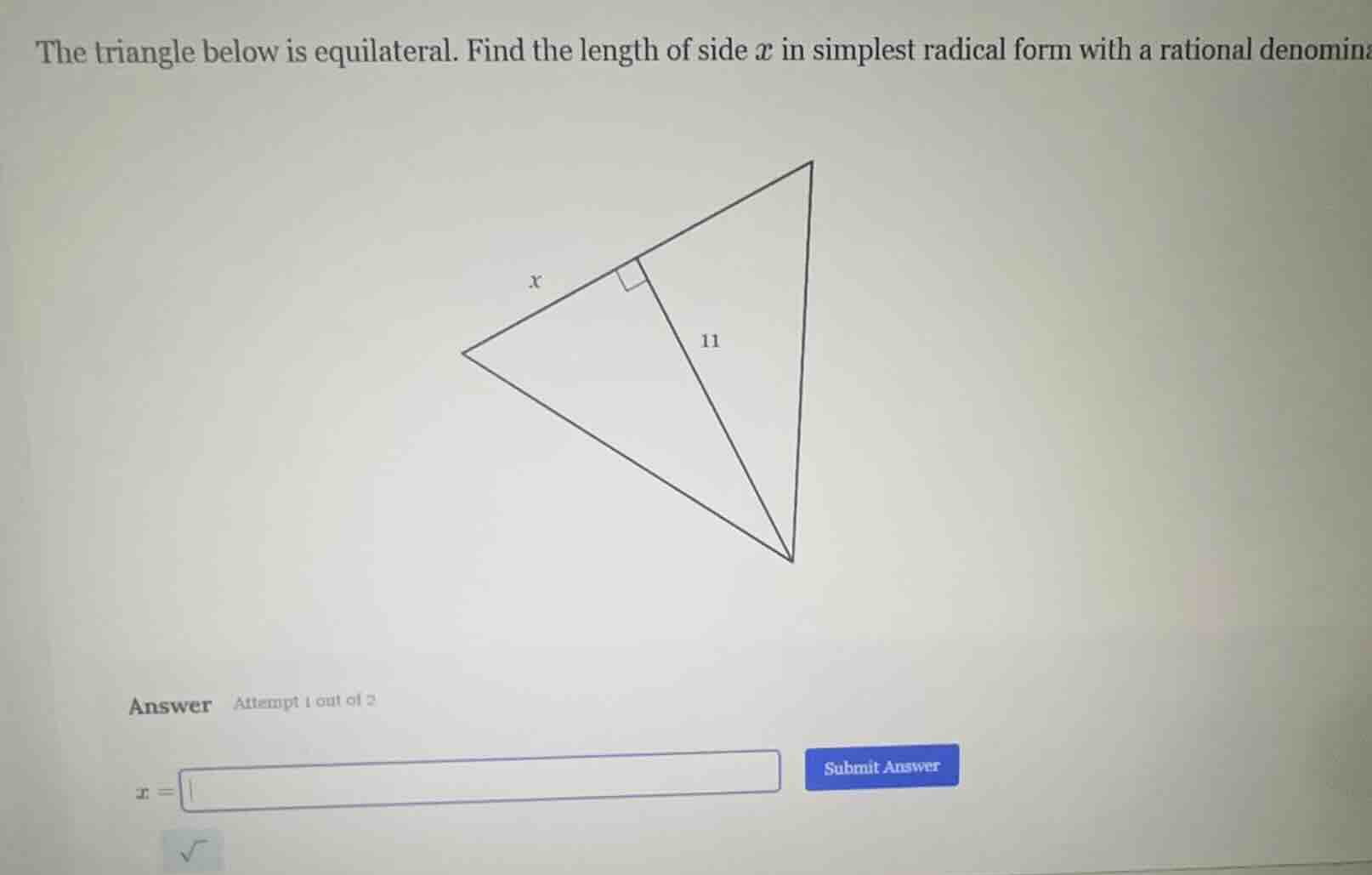
the triangle below is equilateral. find the length of side x in simplest radical form with a rational denomina
answer attempt 1 out of 2
x =
submit answer
Step1: Recall properties of equilateral triangle
In an equilateral triangle, all sides are equal, and the altitude (the perpendicular from a vertex to the opposite side) bisects the opposite side. Also, the altitude forms a 30 - 60 - 90 right triangle with half of the side and the side of the equilateral triangle. In a 30 - 60 - 90 triangle, the sides are in the ratio \(1:\sqrt{3}:2\), where the side opposite 30° is the shortest one, opposite 60° is \(\sqrt{3}\) times the shortest, and the hypotenuse is twice the shortest. Here, the altitude (length 11) is opposite the 60° angle, and \(x\) is adjacent to the 60° angle (or we can use trigonometry: \(\cos(60^{\circ})=\frac{x}{\text{side of equilateral triangle}}\), but also, in the right triangle formed, the angle at the vertex of the equilateral triangle is 60°, so the right triangle has angles 30°, 60°, 90°. Let the side of the equilateral triangle be \(s\). Then, the altitude \(h\) of an equilateral triangle with side \(s\) is given by \(h = \frac{\sqrt{3}}{2}s\). But also, in the right triangle, if we consider the angle 30°, the side adjacent to 30° is the altitude? Wait, no. Wait, when we drop an altitude from a vertex of an equilateral triangle to the opposite side, it splits the equilateral triangle into two 30 - 60 - 90 right triangles. The hypotenuse of each right triangle is the side of the equilateral triangle (\(s\)), the side opposite 30° is \(\frac{s}{2}\) (since the altitude bisects the base), and the side opposite 60° (the altitude) is \(\frac{\sqrt{3}}{2}s\). But in our problem, the length of the altitude is 11? Wait, no, the segment of length 11 is the altitude? Wait, the right angle is between \(x\) and the altitude. Wait, looking at the diagram, the right triangle has legs \(x\) and 11, and hypotenuse equal to the side of the equilateral triangle. Also, in an equilateral triangle, all angles are 60°, so the angle between the side \(x\) and the hypotenuse (side of equilateral triangle) is 60°. So in the right triangle, we can use trigonometry: \(\tan(60^{\circ})=\frac{11}{x}\), because \(\tan(\theta)=\frac{\text{opposite}}{\text{adjacent}}\), where \(\theta = 60^{\circ}\), opposite side is 11, adjacent side is \(x\). So \(\tan(60^{\circ})=\sqrt{3}=\frac{11}{x}\).
Step2: Solve for \(x\)
From \(\sqrt{3}=\frac{11}{x}\), we can solve for \(x\) by cross - multiplying: \(x=\frac{11}{\sqrt{3}}\). But we need to rationalize the denominator. Multiply numerator and denominator by \(\sqrt{3}\): \(x = \frac{11\sqrt{3}}{3}\)? Wait, no, wait, maybe I mixed up the opposite and adjacent sides. Wait, let's re - examine the angle. The angle at the vertex of the equilateral triangle is 60°, so in the right triangle, the angle between the side \(x\) and the hypotenuse is 60°, so the angle between the altitude (length 11) and the hypotenuse is 30°. So \(\cos(60^{\circ})=\frac{x}{s}\), and \(\sin(60^{\circ})=\frac{11}{s}\), where \(s\) is the side of the equilateral triangle. Since \(\sin(60^{\circ})=\frac{\sqrt{3}}{2}=\frac{11}{s}\), then \(s=\frac{22}{\sqrt{3}}\). Then \(\cos(60^{\circ})=\frac{1}{2}=\frac{x}{s}\), so \(x=\frac{s}{2}=\frac{11}{\sqrt{3}}\), which rationalized is \(\frac{11\sqrt{3}}{3}\)? Wait, no, that can't be. Wait, maybe the length of 11 is the side opposite 30°? Wait, in a 30 - 60 - 90 triangle, the sides are in the ratio \(1:\sqrt{3}:2\), where the side opposite 30° is the shortest one. So if the side opposite 30° is \(x\), then the side opposite 60° is \(x\sqrt{3}\), and the hypotenuse is \(2x\). But in our case, the side of length 11 is opposite 60°, so \(x\s…

Snap & solve any problem in the app
Get step-by-step solutions on Sovi AI
Photo-based solutions with guided steps
Explore more problems and detailed explanations
\(\frac{11\sqrt{3}}{3}\)