QUESTION IMAGE
Question
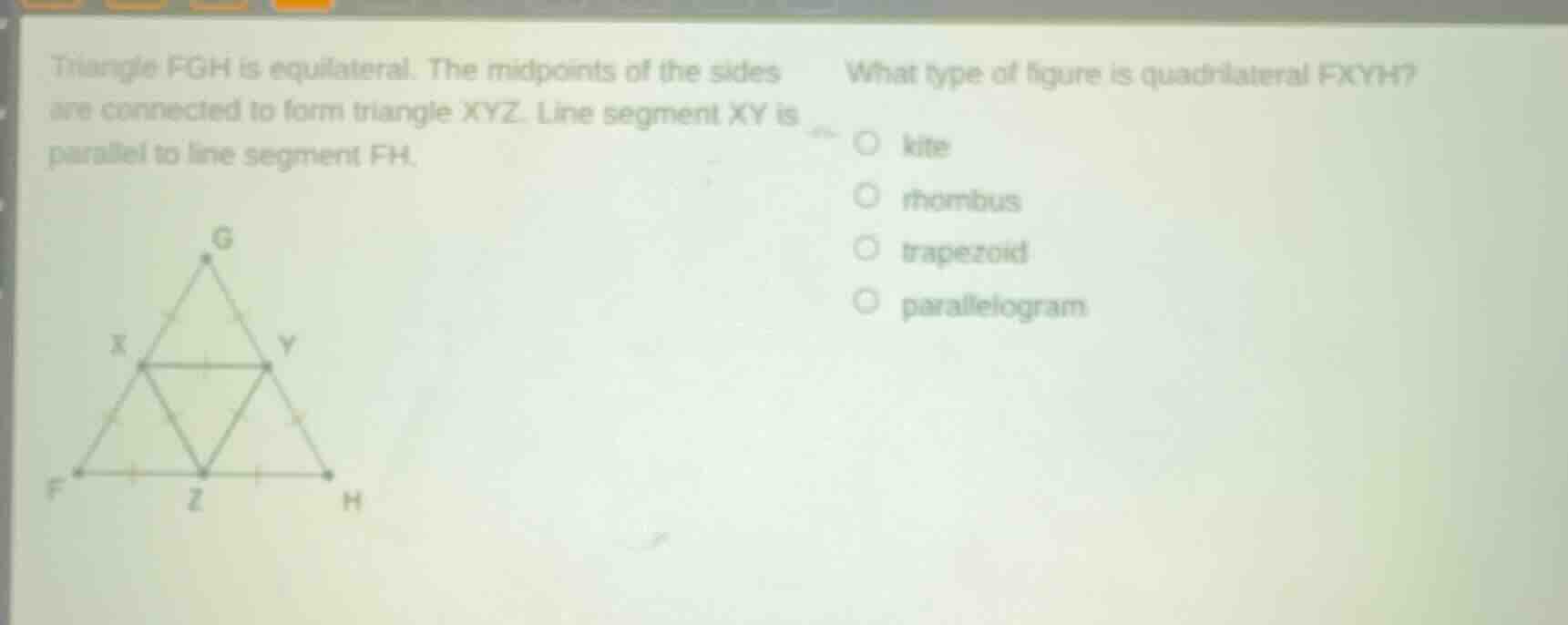
triangle fgh is equilateral. the midpoints of the sides are connected to form triangle xyz. line segment xy is parallel to line segment fh. what type of figure is quadrilateral fxyh?
○ kite
○ rhombus
○ trapezoid
○ parallelogram
Brief Explanations
- Recall the definition of a trapezoid: a quadrilateral with at least one pair of parallel sides.
- Given that \( XY \parallel FH \) (from the problem statement) in quadrilateral \( FXYH \).
- Check other options: A kite has two distinct pairs of adjacent equal sides (not applicable here). A rhombus has all sides equal and two pairs of parallel sides (we only know one pair here, and the figure is formed from midpoints of an equilateral triangle, but we don't have info to confirm it's a rhombus). A parallelogram requires two pairs of parallel sides (we only know \( XY \parallel FH \); we need to check the other sides. However, a trapezoid is defined as a quadrilateral with at least one pair of parallel sides. Since we know \( XY \parallel FH \), quadrilateral \( FXYH \) has one pair of parallel sides, so it is a trapezoid. Also, in the context of the midpoints of an equilateral triangle, the other sides (like \( FX \) and \( YH \)): since \( X \) and \( Y \) are midpoints, \( FX = \frac{1}{2}FG \) and \( YH=\frac{1}{2}GH \), and since \( FG = GH \) (equilateral triangle), \( FX = YH \), but more importantly, the key is the parallel side. Wait, actually, let's re - evaluate. Wait, in the figure, \( X \) is the midpoint of \( FG \), \( Y \) is the midpoint of \( GH \), \( Z \) is the midpoint of \( FH \). So \( XY \parallel FH \) (given) and \( XZ \parallel GH \), \( YZ \parallel FG \). Now, for quadrilateral \( FXYH \): sides \( XY \) and \( FH \) are parallel. What about \( FX \) and \( YH \)? Since \( X \) is the midpoint of \( FG \) and \( Y \) is the midpoint of \( GH \), and \( FG = GH \) (equilateral triangle), \( FX=\frac{1}{2}FG \), \( YH = \frac{1}{2}GH \), so \( FX = YH \), but are they parallel? Let's see, \( FG \) and \( GH \) are sides of the equilateral triangle, so \( \angle F=\angle H = 60^{\circ}\). The segment \( FX \) is part of \( FG \) and \( YH \) is part of \( GH \). Wait, maybe a better approach: the definition of a trapezoid is a quadrilateral with at least one pair of parallel sides. We know \( XY\parallel FH \), so it satisfies the trapezoid definition. The other options: kite (two pairs of adjacent equal sides, not indicated here), rhombus (all sides equal and two pairs of parallel sides, we can't confirm all sides are equal), parallelogram (needs two pairs of parallel sides, we only know one pair). So the correct answer is trapezoid.

Snap & solve any problem in the app
Get step-by-step solutions on Sovi AI
Photo-based solutions with guided steps
Explore more problems and detailed explanations
trapezoid (the option corresponding to trapezoid, e.g., if the option was C. trapezoid, then C. trapezoid)