QUESTION IMAGE
Question
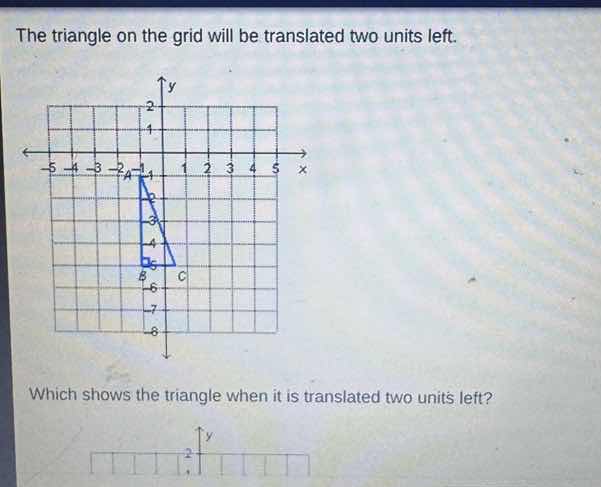
the triangle on the grid will be translated two units left.
which shows the triangle when it is translated two units left?
To solve the problem of translating the triangle two units left, we follow these steps:
Step 1: Identify the coordinates of the original triangle's vertices
First, we determine the coordinates of the vertices of the original triangle from the grid. Let's assume the original vertices are \( A(-1, -1) \), \( B(-1, -5) \), and \( C(1, -5) \) (we'll confirm these by looking at the grid: \( A \) is at \( x = -1 \), \( y = -1 \); \( B \) is at \( x = -1 \), \( y = -5 \); \( C \) is at \( x = 1 \), \( y = -5 \)).
Step 2: Apply the translation rule for a horizontal shift left
A translation of 2 units left means we subtract 2 from the \( x \)-coordinate of each vertex (since moving left on the \( x \)-axis decreases the \( x \)-value). The translation rule for a point \( (x, y) \) shifted \( h \) units left is \( (x - h, y) \), where \( h = 2 \).
- For vertex \( A(-1, -1) \):
New \( x \)-coordinate: \( -1 - 2 = -3 \)
New \( y \)-coordinate: \( -1 \) (remains the same)
So, the new coordinates for \( A \) are \( (-3, -1) \).
- For vertex \( B(-1, -5) \):
New \( x \)-coordinate: \( -1 - 2 = -3 \)
New \( y \)-coordinate: \( -5 \) (remains the same)
So, the new coordinates for \( B \) are \( (-3, -5) \).
- For vertex \( C(1, -5) \):
New \( x \)-coordinate: \( 1 - 2 = -1 \)
New \( y \)-coordinate: \( -5 \) (remains the same)
So, the new coordinates for \( C \) are \( (-1, -5) \).
Step 3: Plot the new vertices
Now, we plot the new vertices \( A(-3, -1) \), \( B(-3, -5) \), and \( C(-1, -5) \) on the grid. This will give us the triangle after a 2-unit left translation.
Step 4: Compare with the given options
We look at the provided options (the second grid) and find the triangle with vertices at \( (-3, -1) \), \( (-3, -5) \), and \( (-1, -5) \). This triangle will have the same shape and size as the original but shifted 2 units to the left.
Final Answer
The triangle with vertices at \( (-3, -1) \), \( (-3, -5) \), and \( (-1, -5) \) (the one shifted 2 units left from the original) is the correct translated triangle. When visualizing, this triangle will be 2 units to the left of the original, with the vertical side (from \( A \) to \( B \)) now at \( x = -3 \) and the horizontal side (from \( B \) to \( C \)) now from \( x = -3 \) to \( x = -1 \) at \( y = -5 \).

Snap & solve any problem in the app
Get step-by-step solutions on Sovi AI
Photo-based solutions with guided steps
Explore more problems and detailed explanations
To solve the problem of translating the triangle two units left, we follow these steps:
Step 1: Identify the coordinates of the original triangle's vertices
First, we determine the coordinates of the vertices of the original triangle from the grid. Let's assume the original vertices are \( A(-1, -1) \), \( B(-1, -5) \), and \( C(1, -5) \) (we'll confirm these by looking at the grid: \( A \) is at \( x = -1 \), \( y = -1 \); \( B \) is at \( x = -1 \), \( y = -5 \); \( C \) is at \( x = 1 \), \( y = -5 \)).
Step 2: Apply the translation rule for a horizontal shift left
A translation of 2 units left means we subtract 2 from the \( x \)-coordinate of each vertex (since moving left on the \( x \)-axis decreases the \( x \)-value). The translation rule for a point \( (x, y) \) shifted \( h \) units left is \( (x - h, y) \), where \( h = 2 \).
- For vertex \( A(-1, -1) \):
New \( x \)-coordinate: \( -1 - 2 = -3 \)
New \( y \)-coordinate: \( -1 \) (remains the same)
So, the new coordinates for \( A \) are \( (-3, -1) \).
- For vertex \( B(-1, -5) \):
New \( x \)-coordinate: \( -1 - 2 = -3 \)
New \( y \)-coordinate: \( -5 \) (remains the same)
So, the new coordinates for \( B \) are \( (-3, -5) \).
- For vertex \( C(1, -5) \):
New \( x \)-coordinate: \( 1 - 2 = -1 \)
New \( y \)-coordinate: \( -5 \) (remains the same)
So, the new coordinates for \( C \) are \( (-1, -5) \).
Step 3: Plot the new vertices
Now, we plot the new vertices \( A(-3, -1) \), \( B(-3, -5) \), and \( C(-1, -5) \) on the grid. This will give us the triangle after a 2-unit left translation.
Step 4: Compare with the given options
We look at the provided options (the second grid) and find the triangle with vertices at \( (-3, -1) \), \( (-3, -5) \), and \( (-1, -5) \). This triangle will have the same shape and size as the original but shifted 2 units to the left.
Final Answer
The triangle with vertices at \( (-3, -1) \), \( (-3, -5) \), and \( (-1, -5) \) (the one shifted 2 units left from the original) is the correct translated triangle. When visualizing, this triangle will be 2 units to the left of the original, with the vertical side (from \( A \) to \( B \)) now at \( x = -3 \) and the horizontal side (from \( B \) to \( C \)) now from \( x = -3 \) to \( x = -1 \) at \( y = -5 \).