QUESTION IMAGE
Question
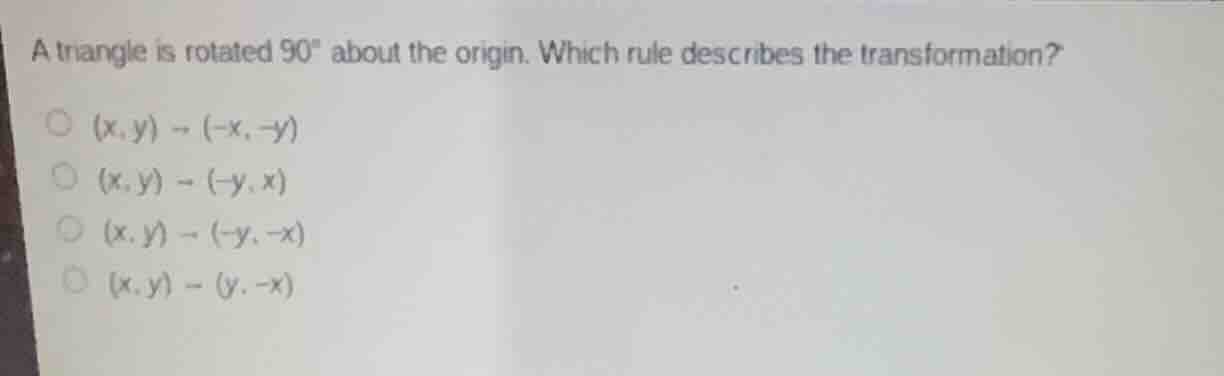
a triangle is rotated $90^{circ}$ about the origin. which rule describes the transformation?
$\bigcirc$ $(x,y) \to (-x,-y)$
$\bigcirc$ $(x,y) \to (-y,x)$
$\bigcirc$ $(x,y) \to (-y,-x)$
$\bigcirc$ $(x,y) \to (y,-x)$
A 90° counterclockwise rotation about the origin follows the rule that swaps the x and y-coordinates, then negates the new x-coordinate. A 90° clockwise rotation is equivalent to a 270° counterclockwise rotation, but the standard 90° rotation rule (counterclockwise, the most commonly referenced unless stated otherwise) is $(x,y) \to (-y,x)$. The other options correspond to different rotations: $(x,y) \to (-x,-y)$ is 180° rotation, $(x,y) \to (-y,-x)$ is not a standard 90° rotation, and $(x,y) \to (y,-x)$ is 90° clockwise rotation. Since the question does not specify clockwise, the default counterclockwise rule is the correct choice.

Snap & solve any problem in the app
Get step-by-step solutions on Sovi AI
Photo-based solutions with guided steps
Explore more problems and detailed explanations
B. $(x, y) \to (-y, x)$