QUESTION IMAGE
Question
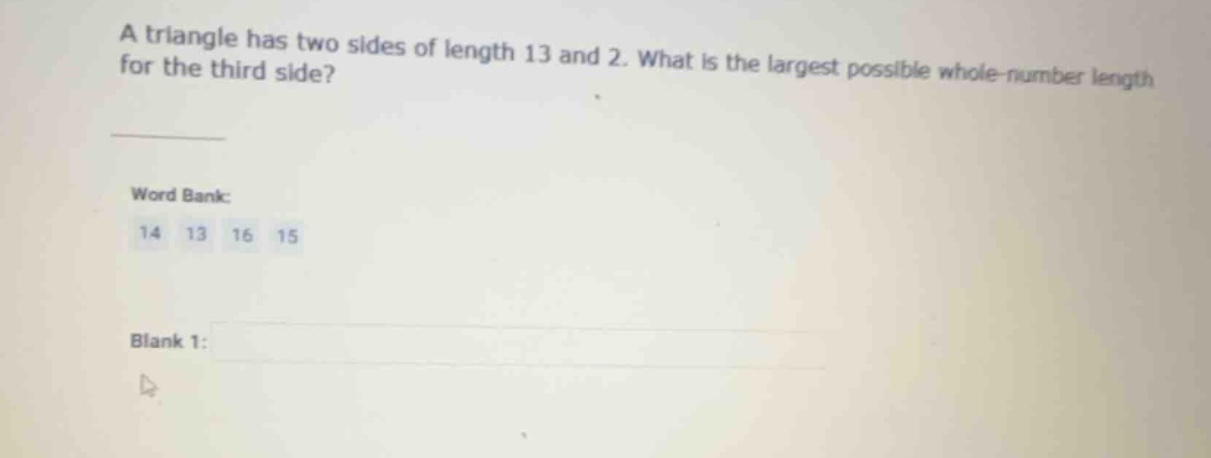
a triangle has two sides of length 13 and 2. what is the largest possible whole - number length for the third side?
word bank:
14 13 16 15
blank 1:
Step1: Recall triangle inequality theorem
The triangle inequality theorem states that the sum of the lengths of any two sides of a triangle must be greater than the length of the remaining side. For a triangle with sides \(a\), \(b\), and \(c\), we have \(a + b>c\), \(a + c>b\), and \(b + c>a\). In this case, let the two given sides be \(a = 13\) and \(b = 2\), and the third side be \(c\).
Step2: Apply the triangle inequality for the third side
First, from \(a + b>c\), we substitute the values: \(13+2>c\), which simplifies to \(15>c\) or \(c < 15\).
Second, from \(a + c>b\), substituting the values: \(13 + c>2\). Since \(c\) is a positive length (as it's a side of a triangle), this inequality will always hold for positive \(c\) (because \(13>2 - c\) and \(c>0\) implies \(13 + c>13>2\)).
Third, from \(b + c>a\), substituting the values: \(2 + c>13\), which simplifies to \(c>13 - 2=11\). So combining the inequalities for \(c\), we have \(11 < c < 15\).
Step3: Find the largest whole - number length for \(c\)
Since \(c\) must be a whole number and \(c < 15\) and \(c>11\), the possible whole - number values of \(c\) are 12, 13, 14. The largest among these is 14.

Snap & solve any problem in the app
Get step-by-step solutions on Sovi AI
Photo-based solutions with guided steps
Explore more problems and detailed explanations
14