QUESTION IMAGE
Question
in this triangle, which angle is the largest?
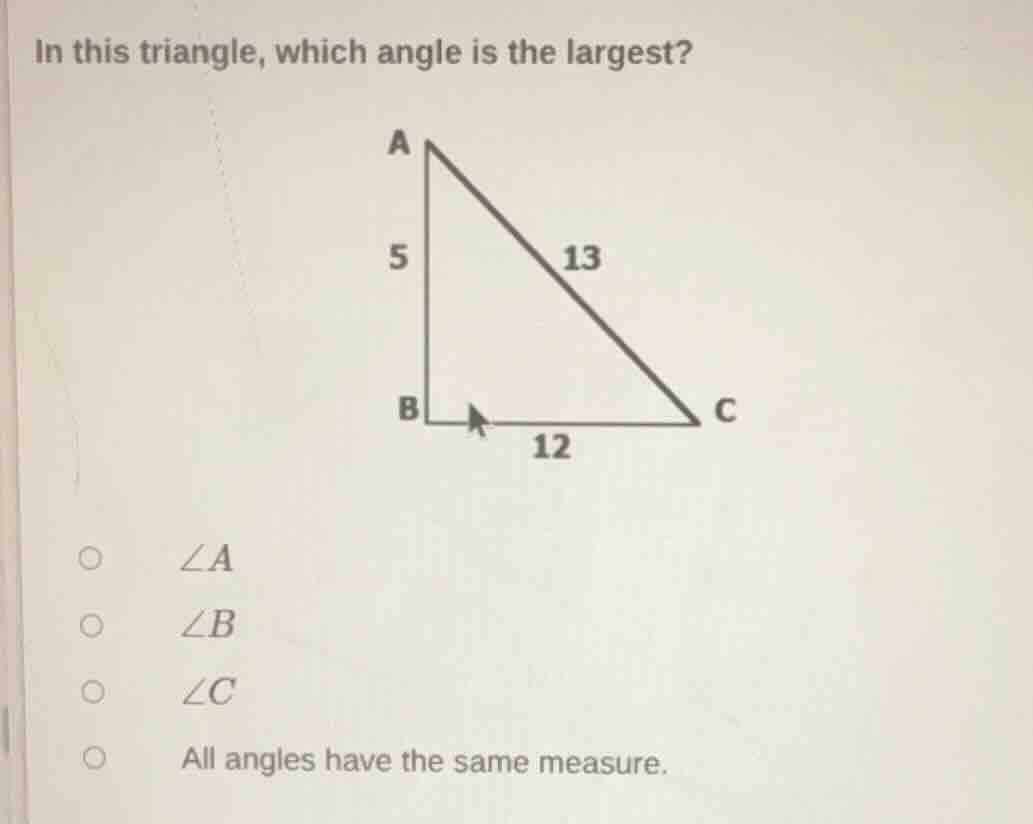
triangle with vertices a, b, c. ab = 5, bc = 12, ac = 13, angle at b is a right angle (implied by the diagram).
options:
- ∠a
- ∠b
- ∠c
- all angles have the same measure.
Step1: Recall the rule for triangle angles
In a triangle, the largest angle is opposite the longest side.
Step2: Identify the sides and their opposite angles
- Side \( AB = 5 \), opposite angle \( \angle C \)
- Side \( BC = 12 \), opposite angle \( \angle A \)
- Side \( AC = 13 \), opposite angle \( \angle B \)
Step3: Compare the side lengths
The longest side is \( AC = 13 \), so the angle opposite to it (\( \angle B \)) should be checked. Wait, no, wait: Wait, \( AB = 5 \) (opposite \( \angle C \)), \( BC = 12 \) (opposite \( \angle A \)), \( AC = 13 \) (opposite \( \angle B \)). Wait, but \( \angle B \) is a right angle? Wait, check \( 5^2 + 12^2 = 25 + 144 = 169 = 13^2 \), so it's a right triangle with right angle at \( B \). But in a right triangle, the right angle is the largest angle (since other angles are acute, less than \( 90^\circ \)). Wait, but let's confirm the opposite sides. Wait, maybe I mixed up. Let's list:
- Angle \( A \): opposite side \( BC = 12 \)
- Angle \( B \): opposite side \( AC = 13 \)
- Angle \( C \): opposite side \( AB = 5 \)
Since \( 13 > 12 > 5 \), the side opposite \( \angle B \) is the longest (13), so \( \angle B \) should be the largest? But wait, in a right triangle, the right angle is the largest. Wait, \( 5^2 + 12^2 = 13^2 \), so \( \angle B \) is \( 90^\circ \), and \( \angle A \) and \( \angle C \) are acute (sum to \( 90^\circ \)). So \( \angle B \) is the largest. Wait, but let's check again. Wait, maybe I made a mistake in opposite angles. Let's label the triangle: vertices \( A \), \( B \), \( C \). So side \( AB \) is between \( A \) and \( B \), length 5; side \( BC \) is between \( B \) and \( C \), length 12; side \( AC \) is between \( A \) and \( C \), length 13. So angle at \( A \): between \( AB \) and \( AC \), opposite side \( BC = 12 \). Angle at \( B \): between \( AB \) and \( BC \), opposite side \( AC = 13 \). Angle at \( C \): between \( BC \) and \( AC \), opposite side \( AB = 5 \). So since \( AC = 13 \) is the longest side, angle opposite to it (angle \( B \)) is the largest. And since \( 5^2 + 12^2 = 13^2 \), triangle is right-angled at \( B \), so \( \angle B = 90^\circ \), which is larger than \( \angle A \) and \( \angle C \) (both less than \( 90^\circ \)).

Snap & solve any problem in the app
Get step-by-step solutions on Sovi AI
Photo-based solutions with guided steps
Explore more problems and detailed explanations
\( \angle B \) (the option with \( \angle B \))