QUESTION IMAGE
Question
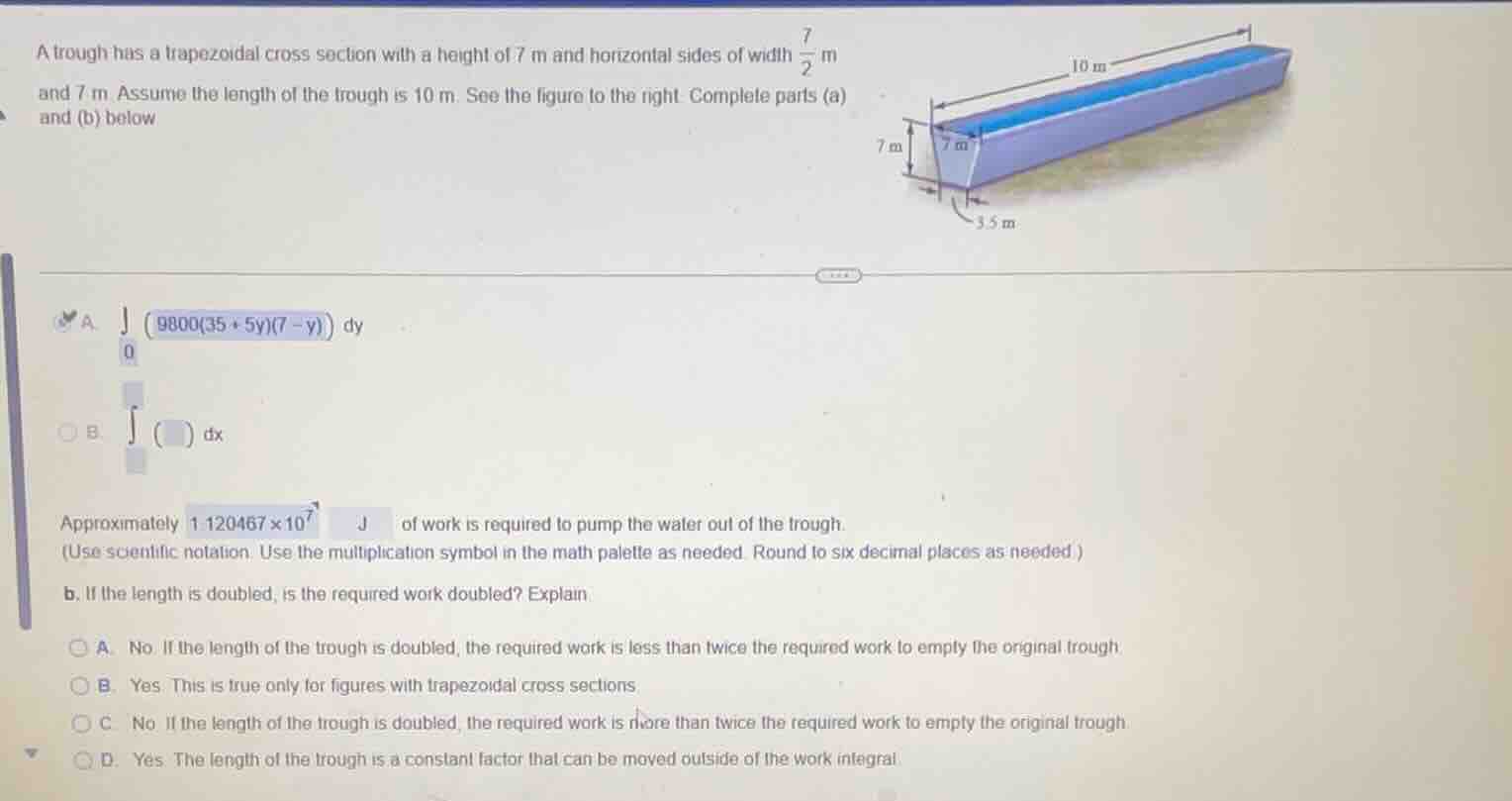
a trough has a trapezoidal cross section with a height of 7 m and horizontal sides of width \\(\frac{7}{2}\\) m and 7 m. assume the length of the trough is 10 m. see the figure to the right. complete parts (a) and (b) below
a. \\(\int_{0}^{7} \left(9800(35 + 5y)(7 - y)\
ight) dy\\)
b. \\(\int_{\square}^{\square} (\square) dx\\)
approximately \\(1.120467 \times 10^{7}\\) j of work is required to pump the water out of the trough.
(use scientific notation. use the multiplication symbol in the math palette as needed. round to six decimal places as needed.)
b. if the length is doubled, is the required work doubled? explain
a. no. if the length of the trough is doubled, the required work is less than twice the required work to empty the original trough.
b. yes. this is true only for figures with trapezoidal cross sections.
c. no. if the length of the trough is doubled, the required work is more than twice the required work to empty the original trough.
d. yes. the length of the trough is a constant factor that can be moved outside of the work integral.
Part (b)
To determine if doubling the length doubles the work, recall the work formula for pumping water. The work \( W \) involves integrating the weight of water slices (density \(
ho g \), volume of slice, and distance lifted). The volume of a water slice in the trough depends on the cross - sectional area (trapezoidal) and the length \( L \) of the trough. The work integral has the form \( W=\int(\text{weight - related terms})\times L\times(\text{distance - related terms})dy \) (or similar, depending on the setup). Since the length \( L \) is a constant factor in the integrand (it can be factored out of the integral), if we let the original length be \( L_1 \) and the new length be \( L_2 = 2L_1 \), the new work \( W_2=\int(\text{weight - related terms})\times L_2\times(\text{distance - related terms})dy=2\int(\text{weight - related terms})\times L_1\times(\text{distance - related terms})dy = 2W_1 \). This is because the length is a constant multiplier in the work integral and can be moved outside the integral. So, when the length is doubled, the required work is doubled.

Snap & solve any problem in the app
Get step-by-step solutions on Sovi AI
Photo-based solutions with guided steps
Explore more problems and detailed explanations
D. Yes. The length of the trough is a constant factor that can be moved outside of the work integral.