QUESTION IMAGE
Question
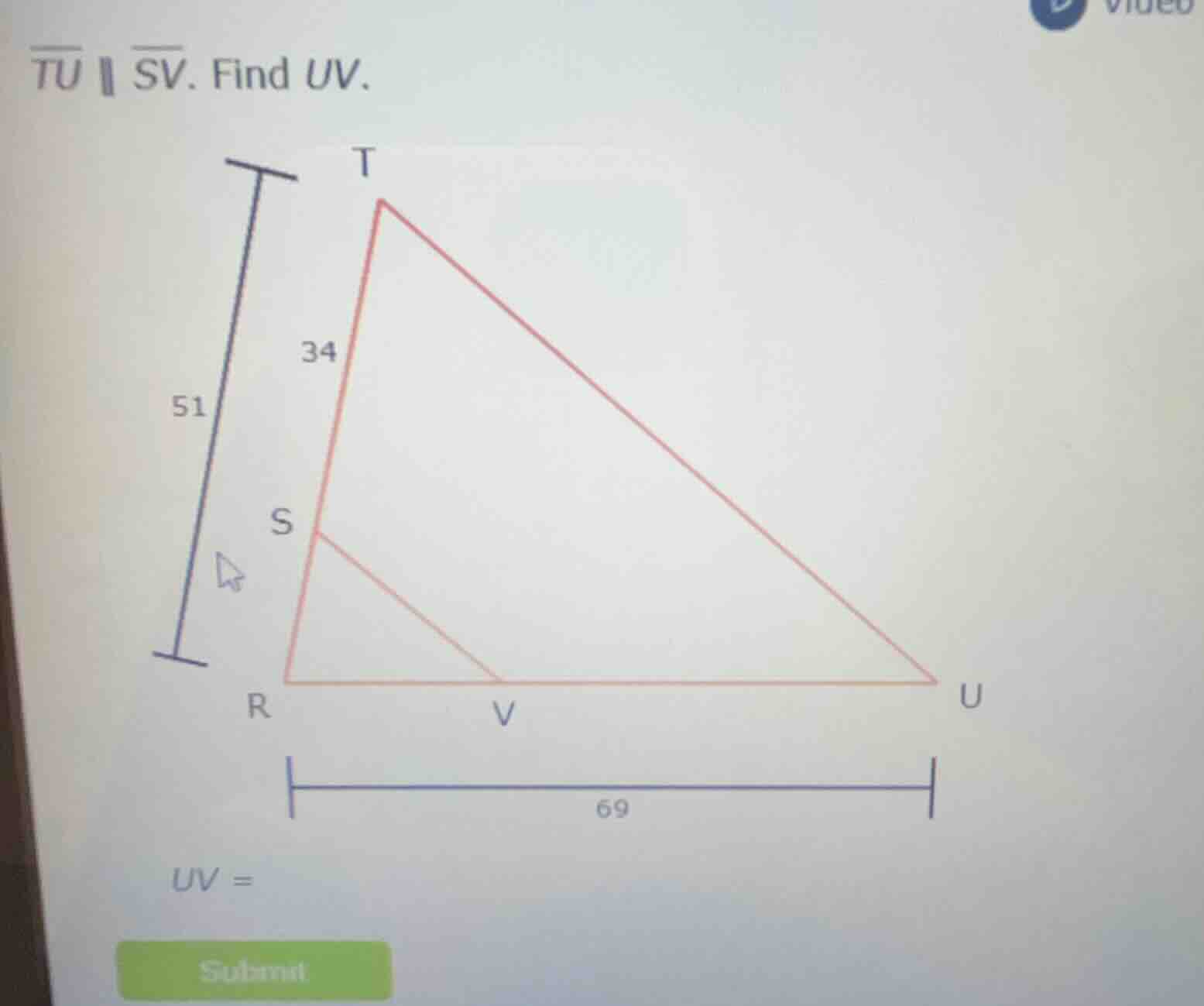
tu || sv. find uv.
Step1: Identify Similar Triangles
Since \(\overline{TU} \parallel \overline{SV}\), by the Basic Proportionality Theorem (Thales' theorem), \(\triangle RSV \sim \triangle RTU\). So, the ratios of corresponding sides are equal: \(\frac{RS}{RT}=\frac{RV}{RU}\).
First, find \(RS\) and \(RT\). Given \(RT = 51\), \(TS = 34\), so \(RS=RT - TS=51 - 34 = 17\)? Wait, no, wait. Wait, actually, looking at the diagram, \(RT\) is the entire side, and \(RS\) is a part? Wait, no, maybe I got it reversed. Wait, the length from \(R\) to \(T\) is \(51\)? Wait, no, the blue segment is \(RT\) with length \(51\), and \(TS\) is \(34\), so \(RS = RT - TS\)? Wait, no, maybe \(RT\) is \(51\), and \(RS\) is \(51 - 34 = 17\)? Wait, no, maybe \(RT\) is \(51\), and \(RS\) is \(34\)? Wait, no, the diagram: the red segment \(RT\) has \(TS = 34\), and the blue segment \(RT\) (the vertical one) has length \(51\). Wait, maybe the triangles are \(\triangle RSV\) and \(\triangle RTU\), so \(RS\) corresponds to \(RT\), and \(RV\) corresponds to \(RU\). Wait, let's re - examine.
Wait, the length of \(RT\) (the side from \(R\) to \(T\)): the blue segment is \(RT\) with length \(51\), and the red segment \(RT\) has \(TS = 34\), so \(RS=RT - TS\)? No, that can't be. Wait, maybe \(RT = 51\), and \(RS = 51 - 34=17\)? Wait, no, maybe the other way: \(RT\) is \(51\), and \(RS\) is \(34\), and \(ST\) is \(51 - 34 = 17\)? Wait, I think I made a mistake. Let's start over.
Wait, the two triangles: \(\triangle RSV\) and \(\triangle RTU\) are similar. So, \(\frac{RS}{RT}=\frac{RV}{RU}\). Let's denote \(RV = x\), \(RU = 69\) (since the length of \(RU\) is \(69\) as per the blue segment at the bottom). Wait, the bottom blue segment is \(RU = 69\), and \(RV\) is a part, \(UV=RU - RV\). Wait, no, we need to find \(UV\), so \(UV = RU - RV\).
First, find the ratio of \(RS\) to \(RT\). Wait, the length of \(RT\) (the vertical side) is \(51\), and \(RS\) is \(51 - 34 = 17\)? Wait, no, maybe \(RT = 51\), and \(RS = 34\), and \(ST = 51 - 34 = 17\)? No, that doesn't make sense. Wait, maybe the vertical side: \(RT = 51\), and \(RS = 34\), so the ratio \(\frac{RS}{RT}=\frac{34}{51}=\frac{2}{3}\).
Then, since \(\triangle RSV\sim\triangle RTU\), \(\frac{RV}{RU}=\frac{RS}{RT}\). We know \(RU = 69\), \(\frac{RS}{RT}=\frac{34}{51}=\frac{2}{3}\). So, \(\frac{RV}{69}=\frac{2}{3}\). Solving for \(RV\): \(RV=\frac{2}{3}\times69 = 46\). Then, \(UV=RU - RV=69 - 46 = 23\)? Wait, no, that's not right. Wait, maybe I mixed up the ratio.
Wait, let's correct the ratio. If \(\overline{SV}\parallel\overline{TU}\), then \(\triangle RSV\sim\triangle RTU\), so \(\frac{RS}{RT}=\frac{RV}{RU}\). Wait, \(RS\) is the length from \(R\) to \(S\), and \(RT\) is from \(R\) to \(T\). Given that \(RT = 51\), and \(TS = 34\), so \(RS=RT - TS = 51 - 34 = 17\). Then \(\frac{RS}{RT}=\frac{17}{51}=\frac{1}{3}\). Then, \(\frac{RV}{RU}=\frac{1}{3}\). Since \(RU = 69\), then \(RV=\frac{1}{3}\times69 = 23\). Then \(UV=RU - RV=69 - 23 = 46\)? Wait, now I'm confused. Wait, let's check the ratio again.
Wait, maybe the triangles are \(\triangle TUV\) and \(\triangle RSV\)? No, the lines are \(TU\parallel SV\), so the transversal is \(RU\) and \(RT\). So, the corresponding angles: \(\angle R\) is common, and \(\angle RSV=\angle RTU\) (corresponding angles, since \(SV\parallel TU\)), so \(\triangle RSV\sim\triangle RTU\) by AA similarity.
So, \(\frac{RS}{RT}=\frac{RV}{RU}\). Let's find \(RS\) and \(RT\). From the diagram, \(RT\) (the side from \(R\) to \(T\)) has length \(51\), and \(RS\) (the side from \(R\) to \(S\)): since \(TS =…

Snap & solve any problem in the app
Get step-by-step solutions on Sovi AI
Photo-based solutions with guided steps
Explore more problems and detailed explanations
\(46\)