QUESTION IMAGE
Question
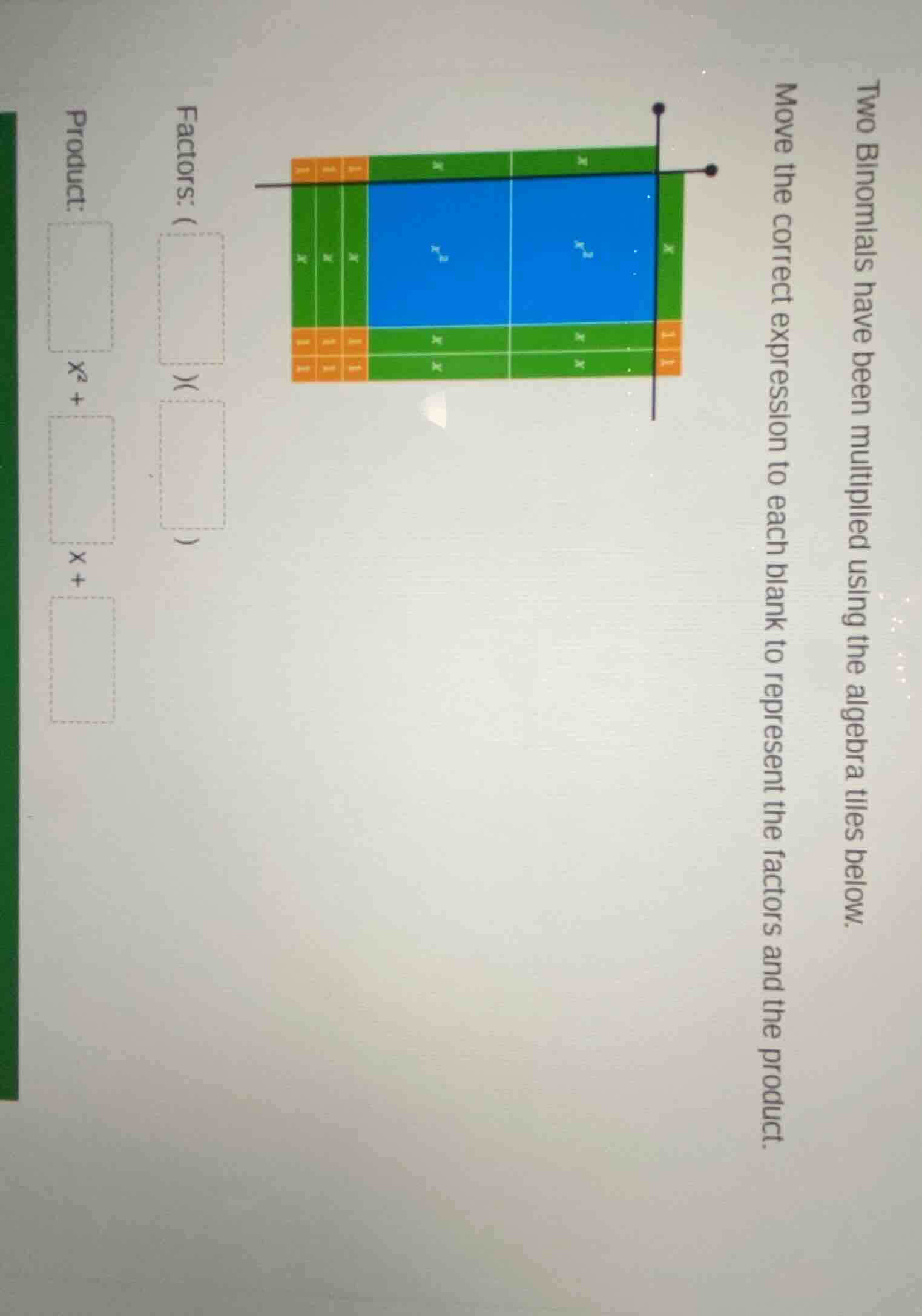
two binomials have been multiplied using the algebra tiles below. move the correct expression to each blank to represent the factors and the product. factors: ( )( ) product: $x^2$ + +
Step1: Analyze the length of the binomial factors
Looking at the algebra tile model, the horizontal side (one binomial) has \(2x\) (from the two \(x^2\) tiles' horizontal length? Wait, no, let's count the tiles. Wait, the vertical side: let's see the number of \(x\) tiles and unit tiles. Wait, the first binomial (let's say horizontal) has \(2x + 3\)? Wait, no, let's look at the columns. Wait, the horizontal direction: the blue area is \(2x^2\), then the green \(x\) tiles: on the top, there are 2 \(x\) tiles (horizontal), and on the bottom, 2 \(x\) tiles? Wait, maybe better to count the length of each binomial.
Wait, the vertical binomial (left side): let's count the number of \(x\) tiles and unit tiles. The vertical side has \(x + 3\) (since there are 3 unit tiles at the bottom and 1 \(x\) tile? Wait, no, the left side: the green \(x\) tiles are 3? Wait, maybe I made a mistake. Wait, the algebra tile method for \((ax + b)(cx + d)\) where the area is \(acx^2+(ad + bc)x+bd\).
Looking at the blue tiles: \(2x^2\), so \(ac = 2\), so possible \(a = 2, c = 1\) or \(a = 1, c = 2\). Then the green \(x\) tiles: let's count the number of \(x\) tiles. The horizontal \(x\) tiles: top row has 2 \(x\) tiles, bottom row has 2 \(x\) tiles? Wait, no, the green \(x\) tiles: on the right side, there's 1 \(x\) tile (vertical), and on the left, 3 \(x\) tiles? Wait, maybe the two binomials are \((2x + 3)\) and \((x + 2)\)? Wait, no, let's calculate the product. Wait, the unit tiles (orange) are \(3\times2 = 6\)? Wait, the bottom left has 3 unit tiles (vertical) and the top right has 2 unit tiles? Wait, no, the orange tiles: bottom left has 3 (3 unit tiles) and top right has 2? Wait, no, the total unit tiles are \(3\times2 = 6\)? Wait, maybe I need to re - examine.
Wait, the correct way: the length of the first binomial (let's say horizontal) is \(2x+3\)? No, wait, the number of \(x\) tiles in the horizontal direction: the blue area is \(2x^2\), so the number of \(x\) tiles in the horizontal binomial (for the \(x^2\) terms) is 2 (since \(2x\times x=2x^2\)). Then the unit tiles: on the horizontal binomial, the number of unit tiles is 3? Wait, no, the vertical binomial: the number of \(x\) tiles is \(x\) (1 \(x\) tile) and 2 unit tiles? Wait, I think I messed up. Let's do it properly.
The area (product) is made up of:
- \(2x^2\) (blue tiles)
- Let's count the \(x\) tiles: the green \(x\) tiles. On the top, there are 2 \(x\) tiles (horizontal), on the bottom, 2 \(x\) tiles? Wait, no, the left side has 3 \(x\) tiles (vertical) and the right side has 2 \(x\) tiles? Wait, maybe the two binomials are \((2x + 3)\) and \((x + 2)\). Wait, no, let's multiply \((2x + 3)(x + 2)=2x^2+4x + 3x+6 = 2x^2+7x + 6\). But maybe the correct binomials are \((2x + 3)\) and \((x + 2)\), and the product is \(2x^2+7x + 6\). Wait, but let's check the tile counts.
Wait, the blue tiles: 2 \(x^2\) (so \(2x\times x\) or \(x\times2x\)). The green \(x\) tiles: let's count the number of \(x\) tiles. If one binomial is \(2x + 3\) and the other is \(x + 2\), then the \(x\) terms: \(2x\times2+x\times3 = 4x+3x = 7x\), and the unit terms: \(3\times2 = 6\). So the factors are \((2x + 3)\) and \((x + 2)\), and the product is \(2x^2+7x + 6\). Wait, but maybe I made a mistake in counting. Wait, the left side (vertical) has 3 unit tiles (orange) and 1 \(x\) tile? No, the left side has 3 \(x\) tiles (green) and 3 unit tiles (orange) at the bottom? Wait, no, the vertical binomial: the number of \(x\) tiles is \(x\) (1 \(x\) tile) and 3 unit tiles? No, I think I need to re - express.
Wait, the co…

Snap & solve any problem in the app
Get step-by-step solutions on Sovi AI
Photo-based solutions with guided steps
Explore more problems and detailed explanations
Factors: \((2x + 3)(x + 2)\)
Product: \(2x^2+7x + 6\)