QUESTION IMAGE
Question
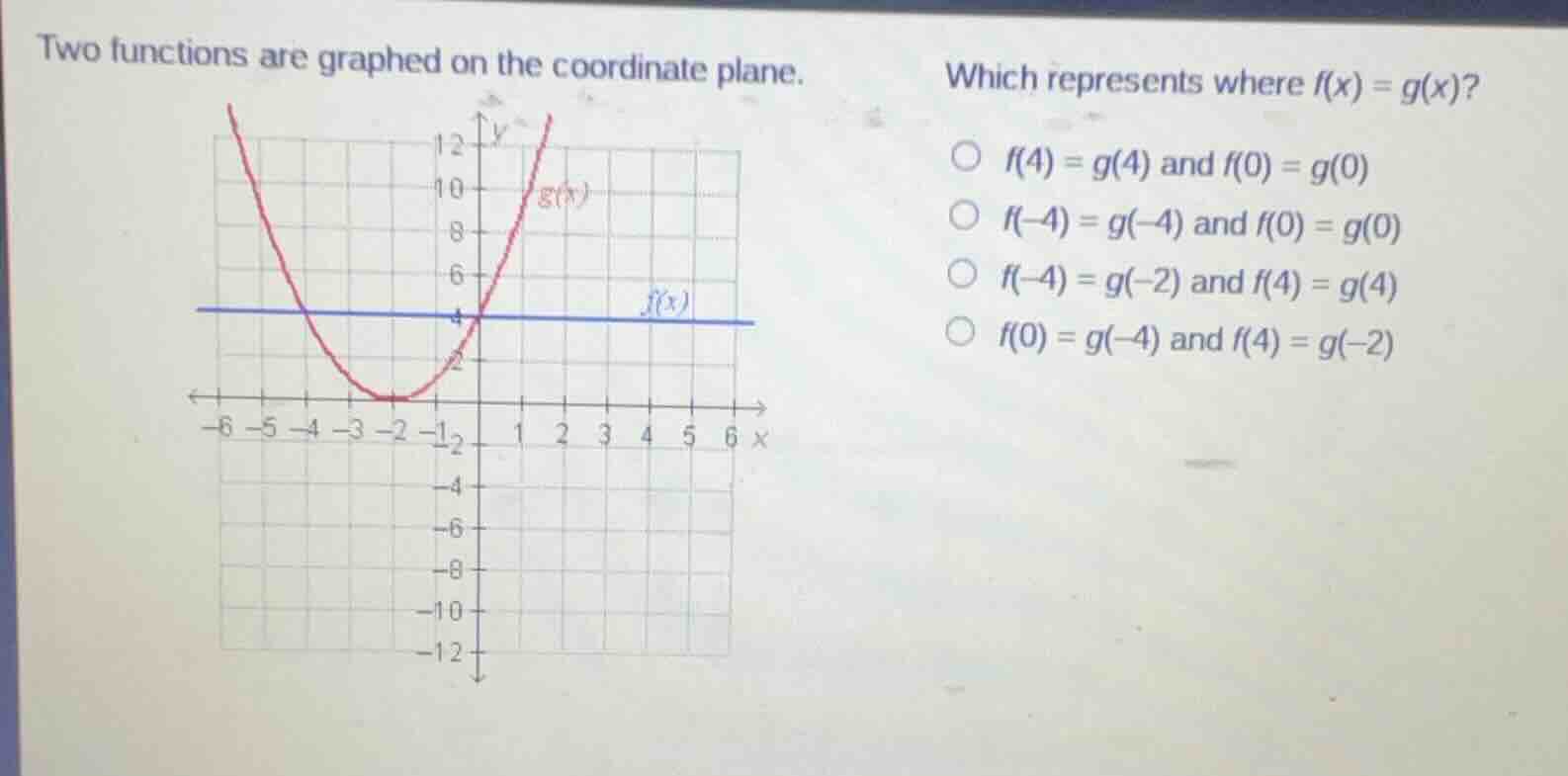
two functions are graphed on the coordinate plane. which represents where $f(x) = g(x)$? $\bigcirc$ $f(4) = g(4)$ and $f(0) = g(0)$ $\bigcirc$ $f(-4) = g(-4)$ and $f(0) = g(0)$ $\bigcirc$ $f(-4) = g(-2)$ and $f(4) = g(4)$ $\bigcirc$ $f(0) = g(-4)$ and $f(4) = g(-2)$
Step1: Analyze intersection points
To find where \( f(x) = g(x) \), we look for the \( x \)-values where the graphs of \( f(x) \) and \( g(x) \) intersect. From the graph, we observe the intersection points.
- For \( f(x) \) (the horizontal line \( y = 4 \)) and \( g(x) \) (the parabola), we check the \( x \)-coordinates of intersection.
- At \( x = - 4 \), does \( f(-4)=g(-4) \)? Wait, no, let's re - examine. Wait, the horizontal line \( f(x) \) has \( y = 4 \). The parabola \( g(x) \): when \( x=-4 \), what's \( g(-4) \)? Wait, no, let's look at the intersection points. The horizontal line \( f(x) \) (blue line) and the parabola \( g(x) \) (red line) intersect at \( x=-4 \) (since at \( x = - 4 \), the blue line and red line meet) and at \( x = 0 \)? Wait, no, at \( x = 0 \), the parabola \( g(x) \) passes through \( (0,4) \) (since the blue line is \( y = 4 \)), and also, when \( x = 0 \), \( f(0)=4 \) and \( g(0) = 4 \). Also, when \( x=-4 \), \( f(-4)=4 \) and \( g(-4) \): let's see the parabola. The vertex of the parabola is at \( x=-2 \), \( y = 0 \)? Wait, no, the red parabola: when \( x=-4 \), let's calculate. The parabola seems to have a vertex at \( x=-2 \), \( y = 0 \)? Wait, no, the graph: the blue line is \( y = 4 \). The red parabola intersects the blue line at \( x=-4 \) (since at \( x=-4 \), the blue line and red line are at the same \( y \)-value, 4) and at \( x = 0 \) (since at \( x = 0 \), the red parabola is at \( y = 4 \), same as the blue line). Also, wait, the options: let's check each option.
- Option 1: \( f(4)=g(4) \) and \( f(0)=g(0) \). \( f(4) = 4 \) (since \( f(x) \) is horizontal line \( y = 4 \)). What's \( g(4) \)? The parabola at \( x = 4 \): since the parabola is symmetric about \( x=-2 \), the value at \( x = 4 \) is \( g(4)= (4 + 2)^2+0=36\)? No, that can't be. Wait, no, the graph: the red parabola at \( x = 0 \) is at \( y = 4 \), at \( x=-4 \) is at \( y = 4 \), and the vertex is at \( x=-2 \), \( y = 0 \). So \( g(x)=(x + 2)^2\)? Wait, when \( x=-2 \), \( g(-2)=0 \), when \( x = 0 \), \( g(0)=(0 + 2)^2=4 \), when \( x=-4 \), \( g(-4)=(-4 + 2)^2=4 \). And \( f(x)=4 \) for all \( x \). So \( f(x)=4 \), \( g(x)=(x + 2)^2 \).
- So \( f(x)=g(x) \) when \( 4=(x + 2)^2 \), solving \( (x + 2)^2=4 \), \( x+2=\pm2 \), \( x=0 \) or \( x=-4 \). So \( f(0)=g(0) \) (since \( f(0)=4 \), \( g(0)=(0 + 2)^2 = 4 \)) and \( f(-4)=g(-4) \) (since \( f(-4)=4 \), \( g(-4)=(-4 + 2)^2=4 \)). Also, \( f(4)=4 \), \( g(4)=(4 + 2)^2 = 36
eq4 \), so \( f(4)
eq g(4) \).
- Now check the options:
- Option 2: \( f(-4)=g(-4) \) and \( f(0)=g(0) \). Since \( f(-4) = 4 \), \( g(-4)=(-4 + 2)^2=4 \), so \( f(-4)=g(-4) \). And \( f(0)=4 \), \( g(0)=(0 + 2)^2 = 4 \), so \( f(0)=g(0) \).
- Option 1: \( f(4)=g(4) \) is false because \( f(4) = 4 \), \( g(4)=36 \).
- Option 3: \( f(-4)=g(-2) \): \( f(-4)=4 \), \( g(-2)=0
eq4 \); \( f(4)=g(4) \) is false.
- Option 4: \( f(0)=g(-4) \): \( f(0)=4 \), \( g(-4)=4 \), but \( f(4)=4 \), \( g(-2)=0
eq4 \), so this is false.

Snap & solve any problem in the app
Get step-by-step solutions on Sovi AI
Photo-based solutions with guided steps
Explore more problems and detailed explanations
\( f(-4) = g(-4) \) and \( f(0) = g(0) \) (the second option: \( f(-4) = g(-4) \) and \( f(0) = g(0) \))