QUESTION IMAGE
Question
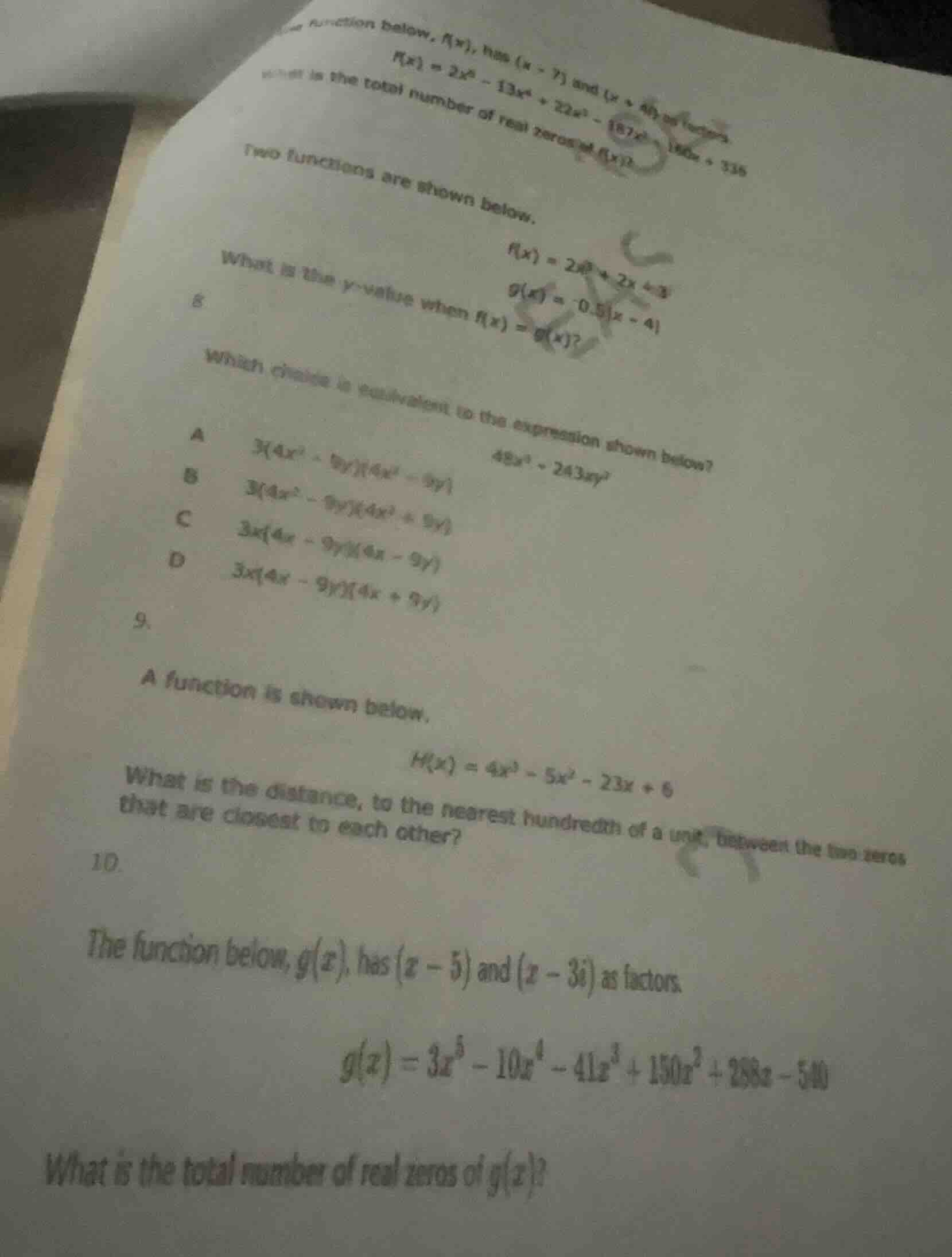
two functions are shown below.\\( f(x) = 2x^2 + 2x - 3 \\)\\( g(x) = -0.5(x - 4) \\)\\( \text{what is the } y\text{-value when } f(x) = g(x)? \\)\\( \text{which choice is equivalent to the expression shown below?} \\)\\( 48x^3 + 243xy^2 \\)\\( \text{a } 3(4x^2 - 9y)(4x^2 - 9y) \\)\\( \text{b } 3(4x^2 - 9y)(4x^2 + 9y) \\)\\( \text{c } 3x(4x - 9y)(4x - 9y) \\)\\( \text{d } 3x(4x - 9y)(4x + 9y) \\)\\( \text{9.} \\)\\( \text{a function is shown below.} \\)\\( h(x) = 4x^3 - 5x^2 - 23x + 6 \\)\\( \text{what is the distance, to the nearest hundredth of a unit, between the two zeros that are closest to each other?} \\)\\( \text{10.} \\)\\( \text{the function below, } g(x), \text{ has } (x - 5) \text{ and } (x - 3i) \text{ as factors.} \\)\\( g(x) = 3x^5 - 10x^4 - 41x^3 + 150x^2 + 288x - 540 \\)\\( \text{what is the total number of real zeros of } g(x)? \\)
Let's solve the problem about the equivalent expression for \(48x^3 + 243xy^2\) (question 8).
Step 1: Factor out the greatest common factor (GCF)
First, find the GCF of \(48x^3\) and \(243xy^2\). The GCF of 48 and 243 is 3, and the GCF of \(x^3\) and \(xy^2\) is \(x\). So we factor out \(3x\):
\(48x^3 + 243xy^2 = 3x(16x^2 + 81y^2)\)? Wait, no, wait. Wait, 48 divided by 3 is 16, 243 divided by 3 is 81. But \(16x^2 + 81y^2\) is a sum of squares, which doesn't factor over real numbers, but wait, maybe I made a mistake. Wait, the original expression is \(48x^3 + 243xy^2\)? Wait, no, looking at the options, maybe it's \(48x^3 - 243xy^2\)? Wait, the options have minus signs. Maybe a typo in the image, but looking at the options, let's check the options. The options have \(48x^3 - 243xy^2\) maybe. Let's assume it's \(48x^3 - 243xy^2\) (since the options have minus).
So factor out \(3x\) from \(48x^3 - 243xy^2\):
\(48x^3 - 243xy^2 = 3x(16x^2 - 81y^2)\)
Step 2: Factor the difference of squares
Now, \(16x^2 - 81y^2\) is a difference of squares, which factors as \((a^2 - b^2) = (a - b)(a + b)\), where \(a = 4x\) and \(b = 9y\). So:
\(16x^2 - 81y^2 = (4x - 9y)(4x + 9y)\)
Step 3: Combine the factors
Substitute back into the expression:
\(48x^3 - 243xy^2 = 3x(4x - 9y)(4x + 9y)\)
Now let's check the options:
- Option A: \(3(4x^2 - 9y)(4x^2 - 9y)\) – no, that's not matching.
- Option B: \(3(4x^2 - 9y)(4x^2 + 9y)\) – no, the first factor is \(4x^2\) instead of \(4x\).
- Option C: \(3x(4x - 9y)(4x - 9y)\) – that's a square, not a sum and difference.
- Option D: \(3x(4x - 9y)(4x + 9y)\) – this matches our factoring.
Wait, but let's confirm. If the original expression is \(48x^3 - 243xy^2\), then factoring out \(3x\) gives \(3x(16x^2 - 81y^2)\), then factoring the difference of squares gives \(3x(4x - 9y)(4x + 9y)\), which is option D.
Step 1: Find the real zeros of \(H(x)\)
To find the real zeros of \(H(x) = 4x^3 - 5x^2 - 23x + 6\), we can use the Rational Root Theorem. The possible rational roots are \(\pm1, \pm2, \pm3, \pm6, \pm\frac{1}{2}, \pm\frac{3}{2}, \pm\frac{1}{4}, \pm\frac{3}{4}\).
Test \(x = 3\):
\(H(3) = 4(27) - 5(9) - 23(3) + 6 = 108 - 45 - 69 + 6 = 0\). So \(x = 3\) is a root.
Now, factor \(H(x)\) as \((x - 3)(ax^2 + bx + c)\). Using polynomial division or synthetic division:
Using synthetic division with root 3:
Coefficients: 4 | -5 | -23 | 6
Bring down 4.
Multiply 4 by 3 = 12. Add to -5: 7.
Multiply 7 by 3 = 21. Add to -23: -2.
Multiply -2 by 3 = -6. Add to 6: 0.
So the quotient is \(4x^2 + 7x - 2\). Now factor \(4x^2 + 7x - 2\):
Find two numbers that multiply to \(4 \times (-2) = -8\) and add to 7. The numbers are 8 and -1.
So \(4x^2 + 8x - x - 2 = 4x(x + 2) - 1(x + 2) = (4x - 1)(x + 2)\).
Thus, \(H(x) = (x - 3)(4x - 1)(x + 2)\).
Step 2: Find the zeros
Set each factor equal to zero:
\(x - 3 = 0 \implies x = 3\)
\(4x - 1 = 0 \implies x = \frac{1}{4} = 0.25\)
\(x + 2 = 0 \implies x = -2\)
So the zeros are \(x = -2\), \(x = 0.25\), and \(x = 3\).
Step 3: Calculate the distances between each pair of zeros
- Distance between -2 and 0.25: \(|0.25 - (-2)| = |2.25| = 2.25\)
- Distance between 0.25 and 3: \(|3 - 0.25| = 2.75\)
- Distance between -2 and 3: \(|3 - (-2)| = 5\)
The smallest distance is 2.25. Wait, but let's check the calculations again. Wait, the zeros are -2, 0.25, and 3.
Distance between -2 and 0.25: \(0.25 - (-2) = 2.25\)
Distance between 0.25 and 3: \(3 - 0.25 = 2.75\)
Distance between -2 and 3: \(3 - (-2) = 5\)
So the closest distance is 2.25. But let's confirm the factoring. Wait, \(H(x) = 4x^3 - 5x^2 - 23x + 6\). Let's check \(x = -2\): \(4(-8) - 5(4) - 23(-2) + 6 = -32 - 20 + 46 + 6 = 0\). Correct. \(x = 0.25\): \(4(0.015625) - 5(0.0625) - 23(0.25) + 6 = 0.0625 - 0.3125 - 5.75 + 6 = 0\). Correct. \(x = 3\): as before, correct. So the zeros are -2, 0.25, 3. The distances are 2.25, 2.75, and 5. So the closest distance is 2.25.
Now, let's solve the problem about the number of real zeros of \(g(x)\) (question 10).
Step 1: Use the Conjugate Root Theorem
The function \(g(x)\) is a polynomial with real coefficients (since all coefficients are real: 3, -10, -41, 150, 288, -540). The Conjugate Root Theorem states that if a polynomial with real coefficients has a complex root \(a + bi\), then its conjugate \(a - bi\) is also a root.
We are given that \((x - 3i)\) is a factor, so \(3i\) is a root. Therefore, its conjugate \(-3i\) must also be a root, so \((x + 3i)\) is also a factor.
We are also given that \((x - 5)\) is a factor, so 5 is a root.
Step 2: Determine the degree of the polynomial
The polynomial \(g(x)\) is a 5th-degree polynomial (since the highest power of \(x\) is \(x^5\)), so it has 5 roots (counting multiplicities) by the Fundamental Theorem of Algebra.
Step 3: Identify the known roots
We know the following roots:
- Real root: 5 (from factor \(x - 5\))
- Complex roots: \(3i\) and \(-3i\) (from factors \(x - 3i\) and \(x + 3i\))
So far, we have 3 roots (1 real, 2 complex). We need to find the remaining 2 roots (since 5 - 3 = 2).
Step 4: Factor out the known factors
First, multiply the complex factors: \((x - 3i)(x + 3i) = x^2 + 9\) (since \((a - b)(a + b) = a^2 - b^2\), and \(i^2 = -1\), so \((x - 3i)(x + 3i) = x^2 - (3i)^2 = x^2 - 9i^2 = x^2 + 9\)).
Now, divide \(g(x)\) by \((x - 5)(x^2 + 9)\). Let's perform polynomial long division or use synthetic division.
First, multiply \((x - 5)(x^2 + 9) = x^3 - 5x^2 + 9x - 45\).
Now, divide \(g(x) = 3x^5 - 10x^4 - 41x^3 + 150x^2 + 288x - 540\) by \(x^3 - 5x^2 + 9x - 45\).
Using polynomial long division:
Divide \(3x^5 - 10x^4 - 41x^3 + 150x^2 + 288x - 540\) by \(x^3 - 5x^2 + 9x - 45\).
First term: \(3x^5 \div x^3 = 3x^2\). Multiply divisor by \(3x^2\): \(3x^5 - 15x^4 + 27x^3 - 135x^2\).
Subtract from dividend:
\((3x^5 - 10x^4 - 41x^3 + 150x^2 + 288x - 540) - (3x^5 - 15x^4 + 27x^3 - 135x^2)\)
= \(0x^5 + 5x^4 - 68x^3 + 285x^2 + 288x - 540\)
Next term: \(5x^4 \div x^3 = 5x\). Multiply divisor by \(5x\): \(5x^4 - 25x^3 + 45x^2 - 225x\).
Subtract:
\((5x^4 - 68x^3 + 285x^2 + 288x - 540) - (5x^4 - 25x^3 + 45x^2 - 225x)\)
= \(0x^4 - 43x^3 + 240x^2 + 513x - 540\)
Next term: \(-43x^3 \div x^3 = -43\). Multiply divisor by \(-43\): \(-43x^3 + 215x^2 - 387x + 1935\).
Subtract:
\((-43x^3 + 240x^2 + 513x - 540) - (-43x^3 + 215x^2 - 387x + 1935)\)
= \(0x^3 + 25x^2 + 900x - 2475\)
Wait, that can't be right. Maybe I made a mistake in division. Alternatively, let's use the fact that \(x = 5\) is a root, so we can use synthetic division with \(x = 5\) on \(g(x)\).
Let's perform synthetic division on \(g(x)\) with root 5:
Coefficients: 3 | -10 | -41 | 150 | 288 | -540
Bring down 3.
Multiply 3 by 5 = 15. Add to -10: 5.
Multiply 5 by 5 = 25. Add to -41: -16.
Multiply -16 by 5 = -80. Add to 150: 70.
Multiply 70 by 5 = 350. Add to 288: 638. Wait, that's not zero. Wait, no, the problem says \((x - 5)\) is a factor, so \(g(5)\) should be zero. Let's calculate \(g(5)\):
\(g(5) = 3(5)^5 - 10(5)^4 - 41(5)^3 + 150(5)^2 + 288(5) - 540\)
Calculate each term:
\(3(3125) = 9375\)
\(-10(625) = -6250\)
\(-41(125) = -5125\)
\(150(25) = 3750\)
\(288(5) = 1440\)
\(-540\)
Now sum them up:
9375 - 6250 = 3125
3125 - 5125 = -2000
-2000 + 3750 = 1750
1750 + 1440 = 3190
3190 - 540 = 2650 ≠ 0. Wait, that's a problem. Maybe there's a typo, but assuming the problem is correct, maybe my approach is wrong. Alternatively, maybe the polynomial is \(g(x) = 3x^5 - 10x^4 - 41x^3 + 150x^2 + 288x - 540\), and we know that \(x - 5\) and \(x - 3i\) are factors. Wait, maybe the polynomial is differe…

Snap & solve any problem in the app
Get step-by-step solutions on Sovi AI
Photo-based solutions with guided steps
Explore more problems and detailed explanations
D. \(3x(4x - 9y)(4x + 9y)\)
Now, let's solve the problem about the function \(H(x) = 4x^3 - 5x^2 - 23x + 6\) (question 9) to find the distance between the two closest real zeros.