QUESTION IMAGE
Question
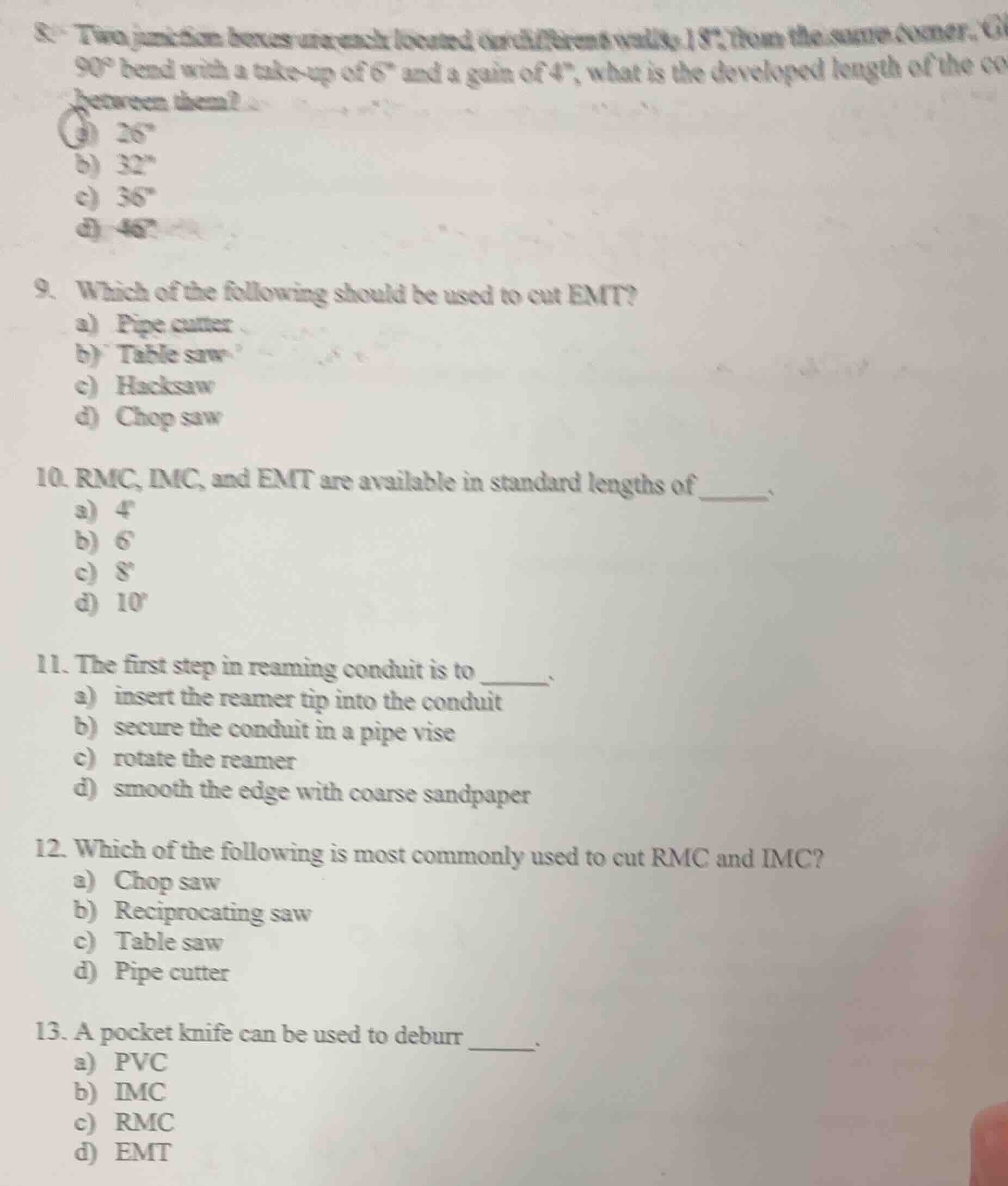
- two junction boxes are each located on different walls, 18\ from the same corner. given a 90° bend with a take - up of 6\ and a gain of 4\, what is the developed length of the conduit between them?
a) 26\
b) 32\
c) 36\
d) 46\
- which of the following should be used to cut emt?
a) pipe cutter
b) table saw
c) hacksaw
d) chop saw
- rmc, imc, and emt are available in standard lengths of ______.
a) 4
b) 6
c) 8
d) 10
- the first step in reaming conduit is to ______.
a) insert the reamer tip into the conduit
b) secure the conduit in a pipe vise
c) rotate the reamer
d) smooth the edge with coarse sandpaper
- which of the following is most commonly used to cut rmc and imc?
a) chop saw
b) reciprocating saw
c) table saw
d) pipe cutter
- a pocket knife can be used to deburr ______.
a) pvc
b) imc
c) rmc
d) emt
Brief Explanations
- Calculate total straight length, adjust for bend take-up/gain: sum distances from corner, subtract take-up, add gain.
- EMT (thin-walled metal conduit) is properly cut with a hacksaw for clean, controlled cuts.
- RMC, IMC, and EMT are standardized to 10-foot stock lengths.
- Reaming conduit requires first securing the conduit to prevent movement during the process.
- RMC and IMC (thick-walled metal conduits) are most commonly cut with a pipe cutter for precise, clean results.
- PVC (plastic conduit) can be safely deburred with a pocket knife without damaging the material or tool.

Snap & solve any problem in the app
Get step-by-step solutions on Sovi AI
Photo-based solutions with guided steps
Explore more problems and detailed explanations
- b) 32"
- c) Hacksaw
- d) 10'
- b) secure the conduit in a pipe vise
- d) Pipe cutter
- a) PVC