QUESTION IMAGE
Question
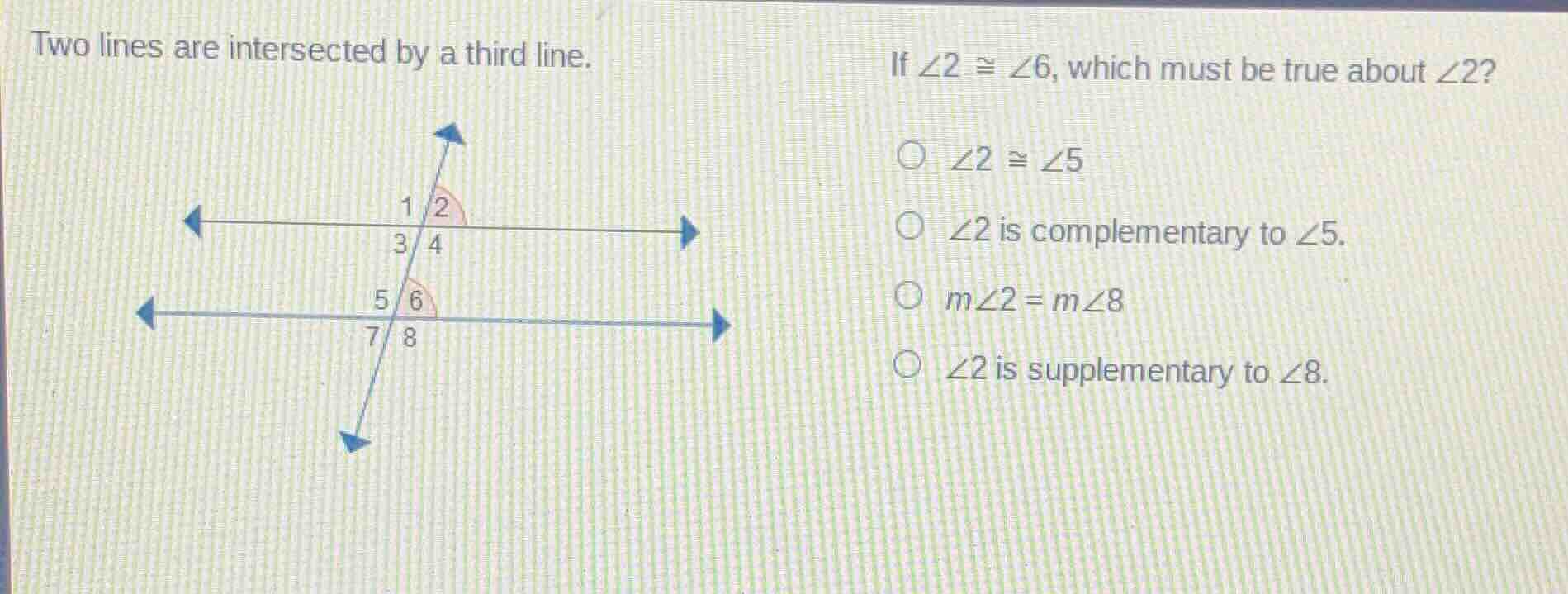
two lines are intersected by a third line. if $\angle 2 \cong \angle 6$, which must be true about $\angle 2$? $\bigcirc$ $\angle 2 \cong \angle 5$ $\bigcirc$ $\angle 2$ is complementary to $\angle 5$. $\bigcirc$ $m\angle 2 = m\angle 8$ $\bigcirc$ $\angle 2$ is supplementary to $\angle 8$.
Step1: Recall Corresponding Angles Postulate
If two parallel lines are cut by a transversal, corresponding angles are congruent. Given \( \angle 2 \cong \angle 6 \), this implies the two lines are parallel (by converse of corresponding angles postulate).
Step2: Analyze Vertical Angles and Alternate Angles
- \( \angle 6 \) and \( \angle 8 \) are vertical angles? No, \( \angle 6 \) and \( \angle 8 \) are supplementary? Wait, no. Wait, \( \angle 6 \) and \( \angle 8 \) are adjacent supplementary? No, \( \angle 6 \) and \( \angle 8 \) are vertical angles? Wait, no, \( \angle 6 \) and \( \angle 8 \) are actually vertical angles? Wait, no, \( \angle 5 \) and \( \angle 7 \) are vertical, \( \angle 6 \) and \( \angle 8 \) are vertical. Wait, no, when two lines intersect, vertical angles are equal. So \( \angle 6 \cong \angle 8 \)? No, \( \angle 6 \) and \( \angle 8 \) are vertical angles? Wait, no, \( \angle 6 \) and \( \angle 8 \) are adjacent to a straight line, so they are supplementary? Wait, no, let's correct. When two lines intersect, the vertical angles are equal. So \( \angle 5 \cong \angle 7 \), \( \angle 6 \cong \angle 8 \). Wait, no, \( \angle 6 \) and \( \angle 8 \) are vertical angles? Wait, the two lines (the horizontal ones) are intersected by the transversal. So the upper horizontal line and lower horizontal line, intersected by the transversal (the blue line with arrows). So \( \angle 2 \) and \( \angle 6 \) are corresponding angles, so lines are parallel. Then, \( \angle 2 \) and \( \angle 8 \): since lines are parallel, \( \angle 2 \) and \( \angle 8 \) are alternate exterior? Wait, no. Wait, \( \angle 6 \cong \angle 8 \) (vertical angles). Since \( \angle 2 \cong \angle 6 \), then \( \angle 2 \cong \angle 8 \)? Wait, no, the options: \( m\angle 2 = m\angle 8 \). Wait, let's check each option:
- Option 1: \( \angle 2 \cong \angle 5 \). \( \angle 5 \) and \( \angle 2 \): if lines are parallel, \( \angle 2 \) and \( \angle 5 \) are same - side interior? No, \( \angle 2 \) and \( \angle 5 \) would be same - side interior, which are supplementary, not congruent. So option 1 is wrong.
- Option 2: \( \angle 2 \) is complementary to \( \angle 5 \). There's no reason for them to be complementary, since we know they are supplementary (if lines are parallel, same - side interior angles are supplementary). So option 2 is wrong.
- Option 3: \( m\angle 2 = m\angle 8 \). Since \( \angle 2 \cong \angle 6 \) (given) and \( \angle 6 \cong \angle 8 \) (vertical angles), by transitive property, \( \angle 2 \cong \angle 8 \), so \( m\angle 2 = m\angle 8 \). This is correct.
- Option 4: \( \angle 2 \) is supplementary to \( \angle 8 \). But we just saw \( \angle 2 \cong \angle 8 \), so they can't be supplementary unless they are right angles, which we don't know. So option 4 is wrong.

Snap & solve any problem in the app
Get step-by-step solutions on Sovi AI
Photo-based solutions with guided steps
Explore more problems and detailed explanations
\( m\angle 2 = m\angle 8 \) (the third option: \( m\angle 2 = m\angle 8 \))