QUESTION IMAGE
Question
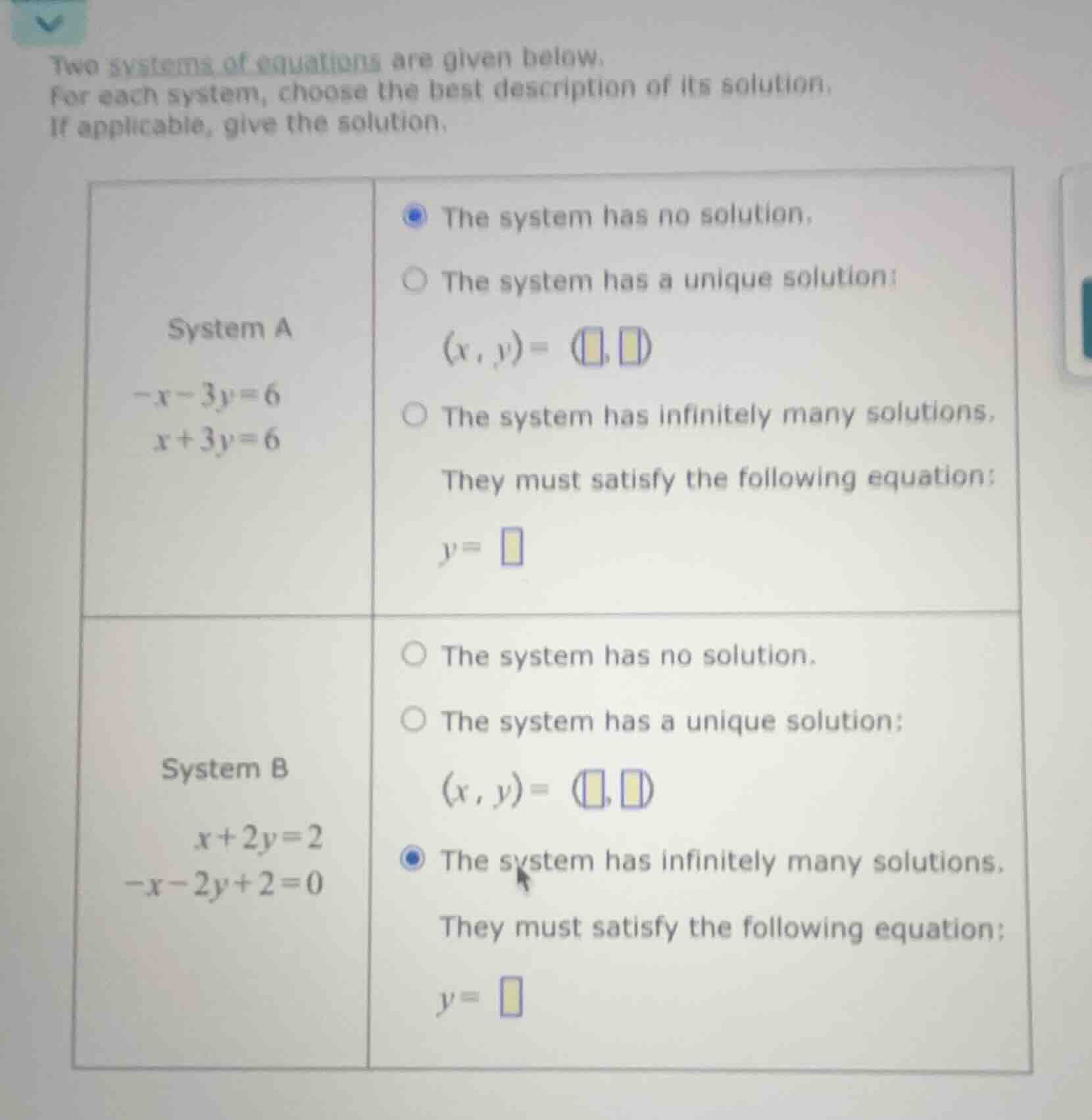
two systems of equations are given below.
for each system, choose the best description of its solution.
if applicable, give the solution.
system a
$-x-3y=6$
$x+3y=6$
$odot$ the system has no solution.
$\bigcirc$ the system has a unique solution:
$(x, y)= (\square, \square)$
$\bigcirc$ the system has infinitely many solutions.
they must satisfy the following equation:
$y= \square$
system b
$x+2y=2$
$-x-2y+2=0$
$\bigcirc$ the system has no solution.
$\bigcirc$ the system has a unique solution:
$(x, y)= (\square, \square)$
$odot$ the system has infinitely many solutions.
they must satisfy the following equation:
$y= \square$
Step1: Analyze System A
Add the two equations:
$$(-x - 3y) + (x + 3y) = 6 + 6$$
$$0 = 12$$
Step2: Analyze System B
Rewrite the second equation:
$$-x - 2y + 2 = 0 \implies -x - 2y = -2 \implies x + 2y = 2$$
This matches the first equation. Solve for $y$:
$$x + 2y = 2 \implies 2y = 2 - x \implies y = \frac{2 - x}{2} = 1 - \frac{x}{2}$$

Snap & solve any problem in the app
Get step-by-step solutions on Sovi AI
Photo-based solutions with guided steps
Explore more problems and detailed explanations
System A:
The system has no solution.
System B:
The system has infinitely many solutions.
They must satisfy the following equation:
$y = 1 - \frac{x}{2}$ (or equivalent $\frac{2-x}{2}$)