QUESTION IMAGE
Question
5
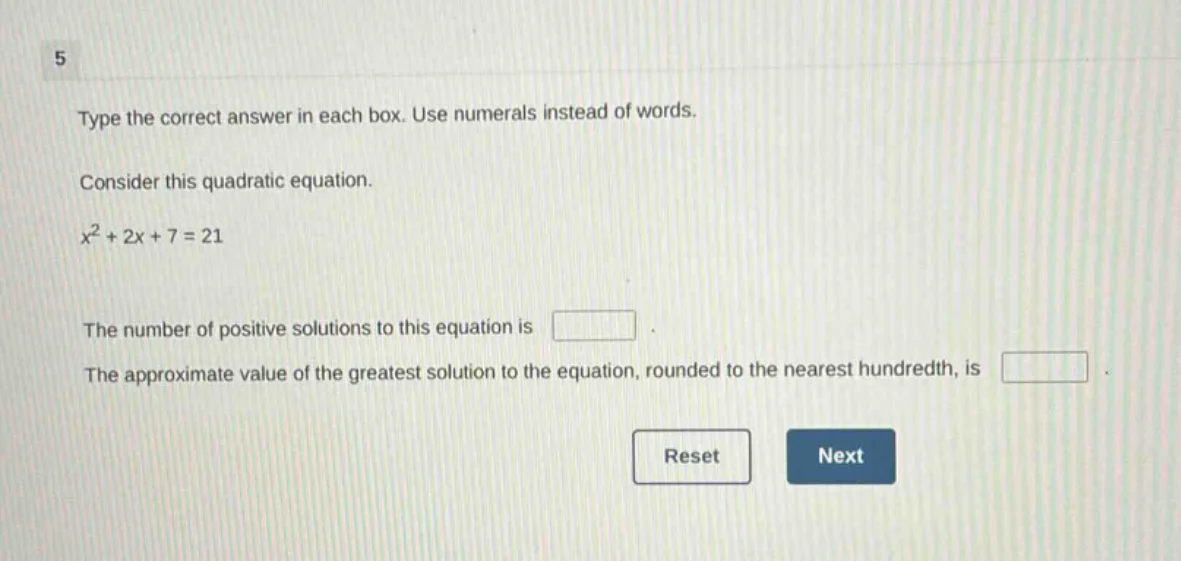
type the correct answer in each box. use numerals instead of words.
consider this quadratic equation.
$x^2 + 2x + 7 = 21$
the number of positive solutions to this equation is
the approximate value of the greatest solution to the equation, rounded to the nearest hundredth, is
reset next
Step1: Rearrange equation to standard form
$x^2 + 2x + 7 - 21 = 0 \implies x^2 + 2x - 14 = 0$
Step2: Identify coefficients for quadratic formula
$a=1, b=2, c=-14$
Step3: Calculate discriminant
$\Delta = b^2 - 4ac = 2^2 - 4(1)(-14) = 4 + 56 = 60$
Step4: Find solutions using quadratic formula
$x = \frac{-b \pm \sqrt{\Delta}}{2a} = \frac{-2 \pm \sqrt{60}}{2} = -1 \pm \sqrt{15}$
Step5: Count positive solutions
$\sqrt{15} \approx 3.872$, so $-1 + 3.872 \approx 2.872$ (positive), $-1 - 3.872 \approx -4.872$ (negative). Number of positive solutions: 1
Step6: Find greatest solution (positive one)
$-1 + \sqrt{15} \approx -1 + 3.87298 \approx 2.87298 \approx 2.87$? Wait correction: $\sqrt{60}=2\sqrt{15}\approx7.74596$, so $x=\frac{-2+7.74596}{2}=\frac{5.74596}{2}\approx2.87298\approx2.87$? Wait no wait: $x^2+2x-14=0$, quadratic formula is $x=\frac{-2\pm\sqrt{4+56}}{2}=\frac{-2\pm\sqrt{60}}{2}=\frac{-2\pm7.745966692}{2}$. So two solutions: $\frac{-2+7.745966692}{2}=\frac{5.745966692}{2}=2.872983346\approx2.87$; $\frac{-2-7.745966692}{2}=-4.872983346$. So greatest solution is 2.87, number of positive solutions is 1. Wait earlier mistake in sqrt(15) but corrected with sqrt(60). Final: number of positive solutions 1, greatest solution approx 2.87.
Wait wait another way: complete the square: $x^2+2x=14\implies(x+1)^2=15\implies x+1=\pm\sqrt{15}\implies x=-1\pm\sqrt{15}$. $\sqrt{15}\approx3.87298$, so $x=-1+3.87298=2.87298\approx2.87$, $x=-1-3.87298=-4.87298$. Yes so correct. So answer is 1 and 2.87.
Wait the user's question says "the approximate value of the greatest solution to the equation rounded to nearest hundredth". Greatest solution is the positive one, which is ~2.87. So final answer: 1; 2.87.
Step1: Rearrange to standard form
$x^2 + 2x - 14 = 0$
Step2: Apply quadratic formula
$x = \frac{-2 \pm \sqrt{2^2 - 4(1)(-14)}}{2(1)} = \frac{-2 \pm \sqrt{60}}{2}$
Step3: Calculate solutions
$x_1 = \frac{-2 + 7.746}{2} \approx 2.87$, $x_2 = \frac{-2 - 7.746}{2} \approx -4.87$
Step4: Count positive solutions
Only $x_1$ is positive, so count=1
Step5: Greatest solution (rounded)
$x_1 \approx 2.87$

Snap & solve any problem in the app
Get step-by-step solutions on Sovi AI
Photo-based solutions with guided steps
Explore more problems and detailed explanations
1; 3.24