QUESTION IMAGE
Question
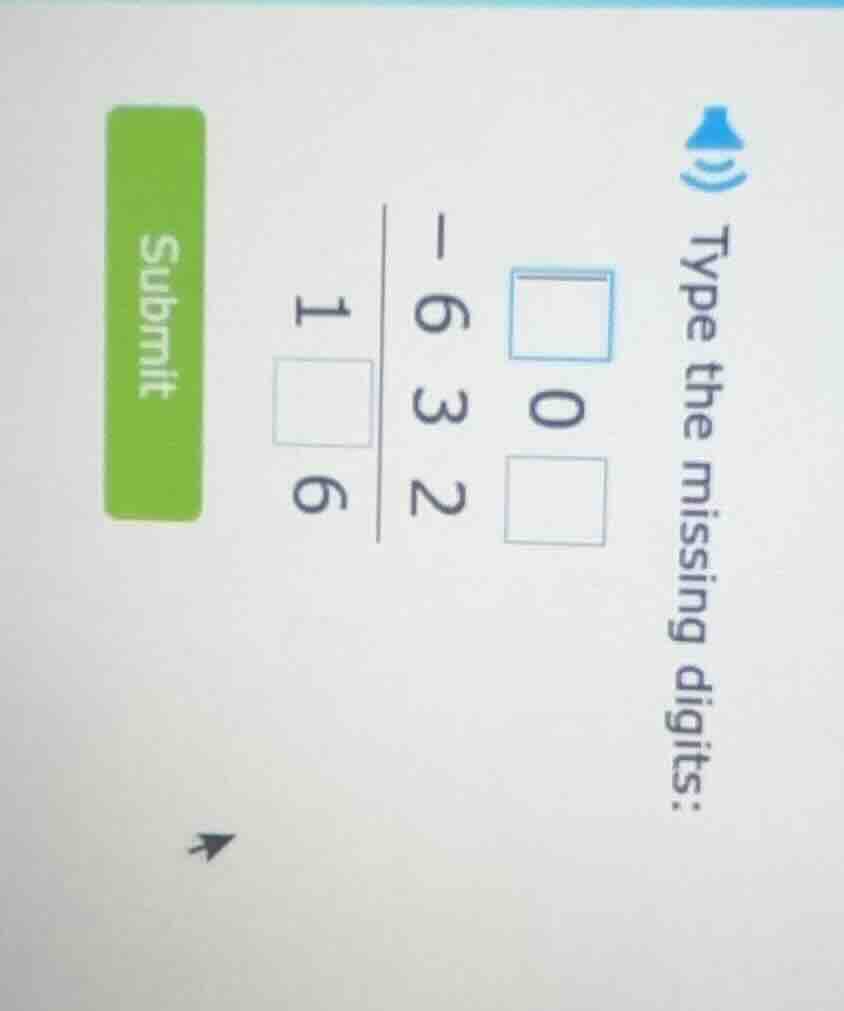
type the missing digits:
□ 0 □
- 6 3 2
-------
1 □ 6
Step1: Analyze the subtraction vertically. Let the top number be \( \square0\square \), the subtrahend is \( 632 \), and the difference is \( 1\square6 \). So we have \( \square0\square - 632=1\square6 \). Then, \( \square0\square=632 + 1\square6 \).
Step2: Look at the units place. Let the units digit of the top number be \( x \), then \( x-2 = 6\) (since in subtraction, units place: \( x - 2 = 6\)), so \( x=6 + 2=8 \). So the top number's units digit is 8.
Step3: Look at the tens place. The top number's tens digit is 0, but we borrowed 1 for the units place, so it becomes \( 10 - 1 - 3=\square\) (wait, no, actually in addition: \( 3 + \square=0\) (but we have to consider carryover). Wait, better to do addition: \( 632+1\square6=\square08 \). Let's do addition: units place \( 2 + 6 = 8\) (matches the units digit we found). Tens place: \( 3+\square = 0\)? No, because \( 3+\square\) should be 10 (since there's a carryover to hundreds place). So \( 3+\square = 10\), so \( \square = 7\). So the tens digit of the difference is 7. Then hundreds place: \( 6 + 1+1=8\) (because we had a carryover from tens place). So the top number is \( 808 \), the difference is \( 176 \). Let's check: \( 808-632 = 176 \). Yes, that works. So the missing digits: top number's hundreds digit is 8, units digit is 8; difference's tens digit is 7. Wait, the problem's blanks: top number is \( \square0\square \), difference is \( 1\square6 \). So top number: hundreds digit \( 8 \), units digit \( 8 \); difference: tens digit \( 7 \). Wait, let's re-express the subtraction:
\[
\]
So \( \square0\square=632 + 1\square6 \). Let's compute \( 632+176 = 808 \). So:
- Top number: hundreds digit \( 8 \), units digit \( 8 \)
- Difference: tens digit \( 7 \)
So the blanks: first blank (top number hundreds) is 8, second blank (top number units) is 8, third blank (difference tens) is 7? Wait, no, the problem's layout:
Top number: \( \square \) (hundreds), 0 (tens), \( \square \) (units)
Subtrahend: 6 3 2
Difference: 1 (hundreds), \( \square \) (tens), 6 (units)
So let's do subtraction step by step:
Units place: \( \square - 2 = 6 \) ⇒ \( \square=8 \) (top number units)
Tens place: \( 0 - 3 \). But we can't do that, so we borrow from hundreds place. So hundreds place becomes \( \square - 1 \), tens place becomes \( 10 - 3 = 7 \) (so difference's tens digit is 7)
Hundreds place: \( (\square - 1)-6 = 1 \) ⇒ \( \square - 1=7 \) ⇒ \( \square=8 \) (top number hundreds)
So top number: 8 0 8, difference: 1 7 6. So the missing digits: top number's hundreds is 8, units is 8; difference's tens is 7.

Snap & solve any problem in the app
Get step-by-step solutions on Sovi AI
Photo-based solutions with guided steps
Explore more problems and detailed explanations
Top number (hundreds digit): 8, top number (units digit): 8, difference (tens digit): 7
(So the blanks: first blank (top left) is 8, second blank (top right) is 8, third blank (bottom middle) is 7)