QUESTION IMAGE
Question
under 45 years
45 to 55 years
55 to 75 years
55 to 65 years
75+ years
less than 2 children per woman
6.5+ children per woman
3.5 to 5 children per woman
5 to 6.5 children per woman
2 to 3.5 children per woman
stage 1
high stationary
very low growth
the crude birth and death rates are so high they cancel each other out
stage 2
early expanding
very rapid growth
the crude death rate falls but while the crude birth rate remains high
stage 3
late expanding
slower growth
the br begins to slow as the crude birth and death rates continue to fall
stage 4
low stationary
very low growth
the crude birth and death rates are both low so the population growth is low
stage 5?
declining?
decreasing growth
the crude birth rate falls below the crude death rate due to an older population
fully industrial, few farmers, service industry
mostly farming with early industry
a mix of farming and industry
service industry & mass consumers
farming (pre - industrial)
drag & drop the life expectancy
drag & drop the fertility rates
drag & drop the type of economy
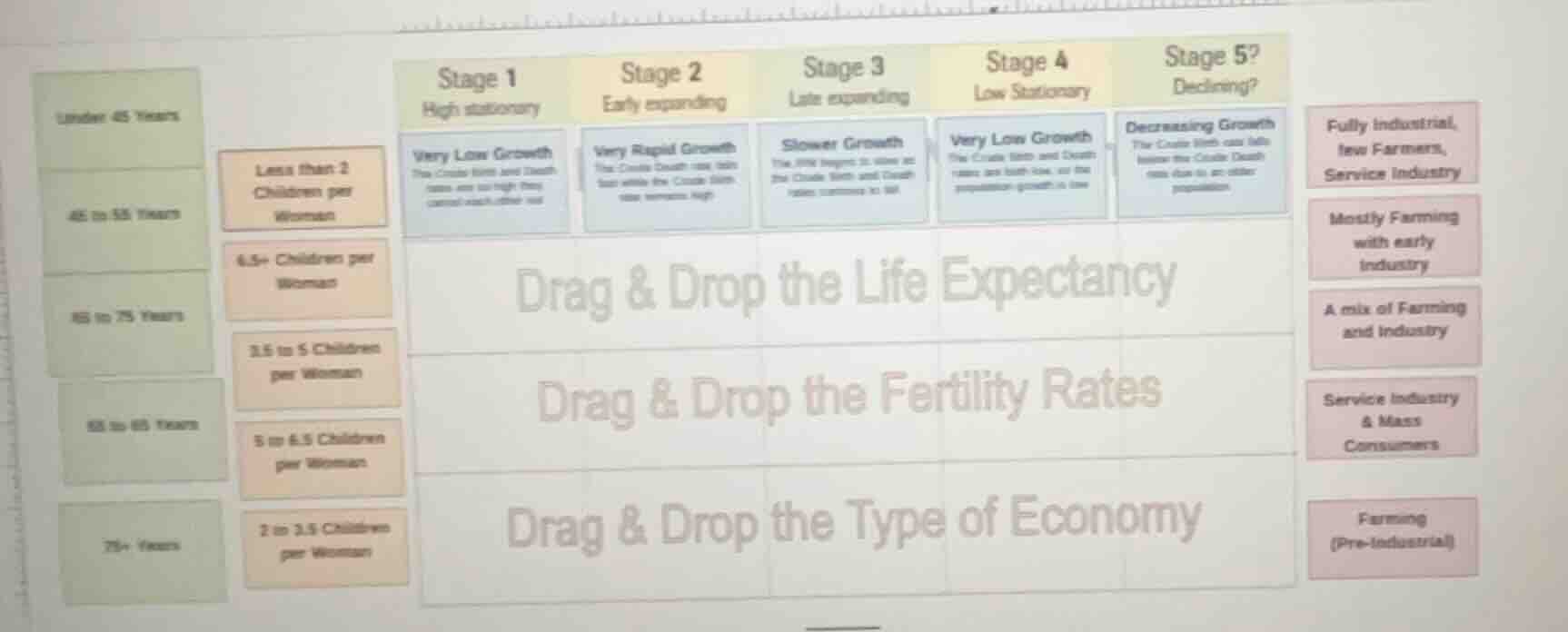
To solve this, we analyze the Demographic Transition Model (DTM) stages, life expectancy, fertility rates, and economic types:
Life Expectancy (Left Column: Age Groups)
- Stage 1 (High Stationary): Pre - industrial, high death rates. Life expectancy is lowest (e.g., Under 45 Years).
- Stage 2 (Early Expanding): Improving health, but still lower life expectancy (e.g., 45 to 55 Years).
- Stage 3 (Late Expanding): Further health improvements (e.g., 55 to 65 Years).
- Stage 4 (Low Stationary): Higher life expectancy (e.g., 65 to 75 Years).
- Stage 5? (Declining?): Highest life expectancy (e.g., 75+ Years).
Fertility Rates (Middle Column: Children per Woman)
- Stage 1: High fertility (6.5+ Children per Woman, as death rates are high, so high birth rates to sustain population).
- Stage 2: Still high fertility (5 to 6.5 Children per Woman, rapid growth as death rates fall).
- Stage 3: Declining fertility (3.5 to 5 Children per Woman, growth slows).
- Stage 4: Lower fertility (2 to 3.5 Children per Woman, low growth).
- Stage 5?: Very low fertility (Less than 2 Children per Woman, declining growth).
Type of Economy (Right Column)
- Stage 1: Farming (Pre - Industrial) (no industrialization, subsistence farming).
- Stage 2: Mostly Farming with early Industry (initial industrialization, still agrarian - dominant).
- Stage 3: A mix of Farming and Industry (industrialization progresses, balanced economy).
- Stage 4: Service Industry & Mass Consumers (post - industrial, service - dominant).
- Stage 5?: Fully Industrial, few Farmers, Service Industry (advanced service economy, minimal farming).
Drag - and - Drop Matches (Example for Each Row):
- Life Expectancy:
- Stage 1 → Under 45 Years
- Stage 2 → 45 to 55 Years
- Stage 3 → 55 to 65 Years
- Stage 4 → 65 to 75 Years
- Stage 5? → 75+ Years
- Fertility Rates:
- Stage 1 → 6.5+ Children per Woman
- Stage 2 → 5 to 6.5 Children per Woman
- Stage 3 → 3.5 to 5 Children per Woman
- Stage 4 → 2 to 3.5 Children per Woman
- Stage 5? → Less than 2 Children per Woman
- Type of Economy:
- Stage 1 → Farming (Pre - Industrial)
- Stage 2 → Mostly Farming with early Industry
- Stage 3 → A mix of Farming and Industry
- Stage 4 → Service Industry & Mass Consumers
- Stage 5? → Fully Industrial, few Farmers, Service Industry
These matches align with the DTM’s progression: as economies industrialize, life expectancy rises, fertility rates fall, and the economy shifts from farming to services.
(Note: For drag - and - drop, physically move the left/right items to the corresponding stage columns based on these relationships.)

Snap & solve any problem in the app
Get step-by-step solutions on Sovi AI
Photo-based solutions with guided steps
Explore more problems and detailed explanations
To solve this, we analyze the Demographic Transition Model (DTM) stages, life expectancy, fertility rates, and economic types:
Life Expectancy (Left Column: Age Groups)
- Stage 1 (High Stationary): Pre - industrial, high death rates. Life expectancy is lowest (e.g., Under 45 Years).
- Stage 2 (Early Expanding): Improving health, but still lower life expectancy (e.g., 45 to 55 Years).
- Stage 3 (Late Expanding): Further health improvements (e.g., 55 to 65 Years).
- Stage 4 (Low Stationary): Higher life expectancy (e.g., 65 to 75 Years).
- Stage 5? (Declining?): Highest life expectancy (e.g., 75+ Years).
Fertility Rates (Middle Column: Children per Woman)
- Stage 1: High fertility (6.5+ Children per Woman, as death rates are high, so high birth rates to sustain population).
- Stage 2: Still high fertility (5 to 6.5 Children per Woman, rapid growth as death rates fall).
- Stage 3: Declining fertility (3.5 to 5 Children per Woman, growth slows).
- Stage 4: Lower fertility (2 to 3.5 Children per Woman, low growth).
- Stage 5?: Very low fertility (Less than 2 Children per Woman, declining growth).
Type of Economy (Right Column)
- Stage 1: Farming (Pre - Industrial) (no industrialization, subsistence farming).
- Stage 2: Mostly Farming with early Industry (initial industrialization, still agrarian - dominant).
- Stage 3: A mix of Farming and Industry (industrialization progresses, balanced economy).
- Stage 4: Service Industry & Mass Consumers (post - industrial, service - dominant).
- Stage 5?: Fully Industrial, few Farmers, Service Industry (advanced service economy, minimal farming).
Drag - and - Drop Matches (Example for Each Row):
- Life Expectancy:
- Stage 1 → Under 45 Years
- Stage 2 → 45 to 55 Years
- Stage 3 → 55 to 65 Years
- Stage 4 → 65 to 75 Years
- Stage 5? → 75+ Years
- Fertility Rates:
- Stage 1 → 6.5+ Children per Woman
- Stage 2 → 5 to 6.5 Children per Woman
- Stage 3 → 3.5 to 5 Children per Woman
- Stage 4 → 2 to 3.5 Children per Woman
- Stage 5? → Less than 2 Children per Woman
- Type of Economy:
- Stage 1 → Farming (Pre - Industrial)
- Stage 2 → Mostly Farming with early Industry
- Stage 3 → A mix of Farming and Industry
- Stage 4 → Service Industry & Mass Consumers
- Stage 5? → Fully Industrial, few Farmers, Service Industry
These matches align with the DTM’s progression: as economies industrialize, life expectancy rises, fertility rates fall, and the economy shifts from farming to services.
(Note: For drag - and - drop, physically move the left/right items to the corresponding stage columns based on these relationships.)