QUESTION IMAGE
Question
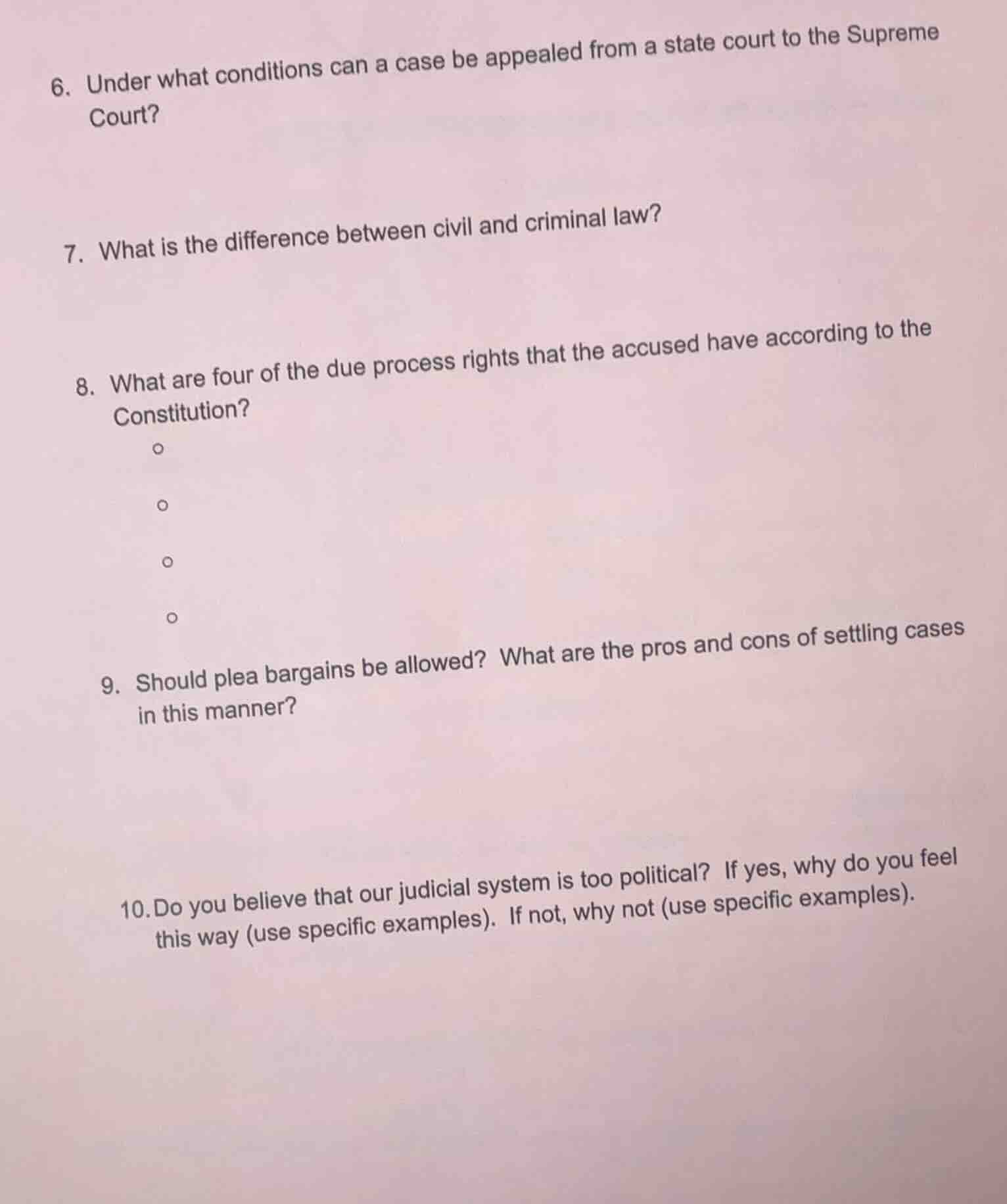
- under what conditions can a case be appealed from a state court to the supreme court?
- what is the difference between civil and criminal law?
- what are four of the due process rights that the accused have according to the constitution?
- should plea bargains be allowed? what are the pros and cons of settling cases in this manner?
- do you believe that our judicial system is too political? if yes, why do you feel this way (use specific examples). if not, why not (use specific examples).
Brief Explanations
- Explains the requirements for appealing a state court case to the U.S. Supreme Court, focusing on federal questions and certiorari.
- Distinguishes civil and criminal law by purpose, parties, and penalties.
- Lists key constitutional due process rights for the accused.
- Analyzes plea bargains with their advantages and disadvantages.
- Evaluates political influence in the judicial system with a specific example.

Snap & solve any problem in the app
Get step-by-step solutions on Sovi AI
Photo-based solutions with guided steps
Explore more problems and detailed explanations
- A case can be appealed from a state court to the Supreme Court if:
- The state's highest court has ruled on a question of federal law (such as a constitutional right, federal statute, or treaty).
- The Supreme Court grants a writ of certiorari, meaning the Court agrees to review the case because it involves a significant legal issue, conflicting rulings across lower courts, or a matter of national importance.
- The key differences are:
- Purpose: Civil law resolves disputes between private parties (individuals, businesses) to compensate harm or enforce contracts; criminal law punishes violations of public law that harm society.
- Parties: Civil cases are filed by a plaintiff (the harmed party) against a defendant; criminal cases are filed by the government (prosecutor) against a defendant.
- Penalties: Civil cases result in damages, injunctions, or court-ordered actions; criminal cases result in fines, probation, imprisonment, or in extreme cases, the death penalty.
- Four due process rights for the accused are:
- The right to a speedy and public trial (6th Amendment)
- The right to an attorney (6th Amendment; extended to state cases via Gideon v. Wainwright)
- The right to be informed of the charges against them (6th Amendment)
- Protection against self-incrimination (5th Amendment)
- Plea bargains should be allowed with careful oversight.
- Pros: Reduces court backlogs, saves time and resources for all parties, gives defendants more control over their sentence, and can secure convictions in cases where proving guilt at trial would be difficult.
- Cons: Can pressure innocent defendants to plead guilty to avoid harsher sentences, may result in unequal outcomes based on a defendant's access to legal resources, and reduces transparency in the justice system.
- Yes, the U.S. judicial system can be overly political. A key example is the appointment of Supreme Court justices: Justices are nominated by the sitting president (a political figure) and confirmed by the Senate, which is often split along partisan lines. For instance, the 2017 confirmation of Justice Neil Gorsuch and 2020 confirmation of Justice Amy Coney Barrett faced intense partisan conflict, with senators prioritizing ideological alignment over judicial experience in their votes. These appointments shift the Court's ideological balance for decades, leading to rulings that reflect partisan priorities, such as the 2022 Dobbs v. Jackson Women's Health Organization decision that overturned Roe v. Wade, which aligned with the conservative majority appointed by Republican presidents.