QUESTION IMAGE
Question
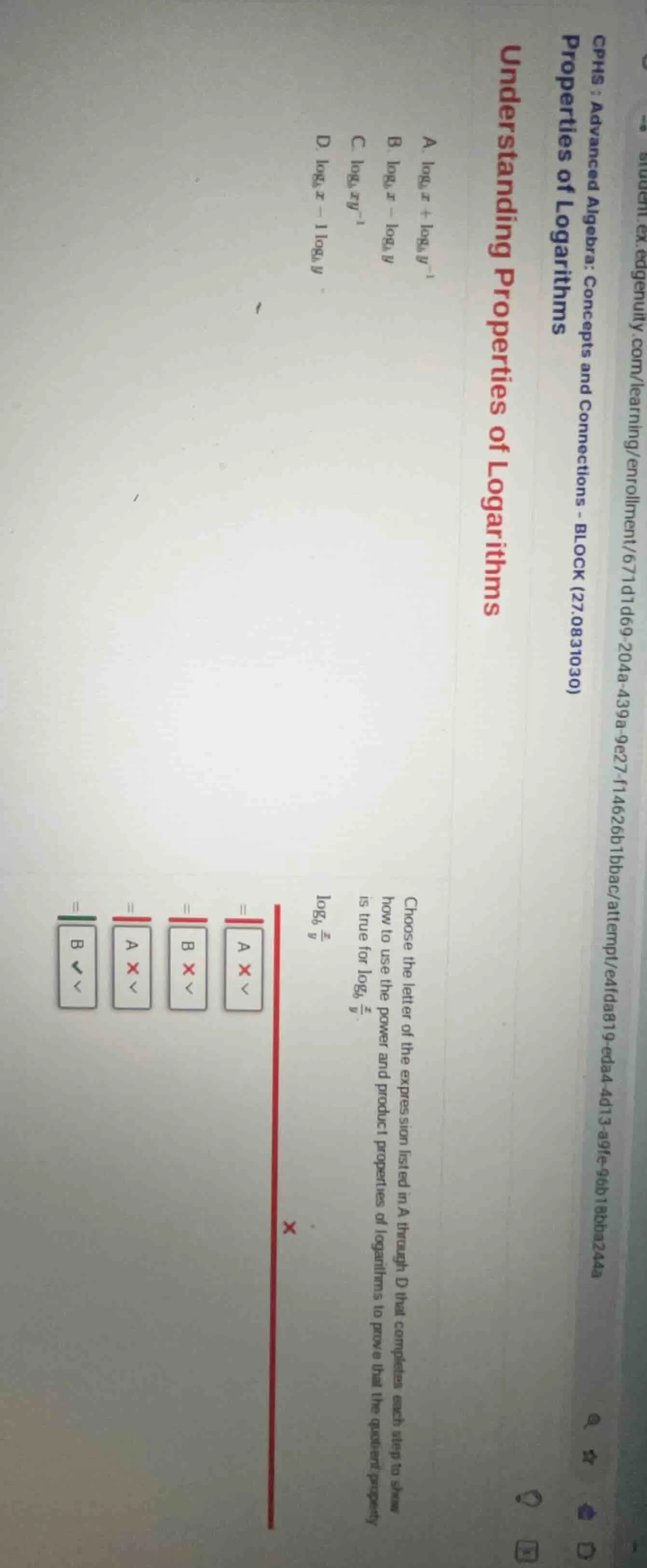
understanding properties of logarithms choose the letter of the expression listed in a through d that completes each step to show how to use the power and product properties of logarithms to prove that the quotient property (log_b \frac{x}{y}) is true for (log_b \frac{x}{y}). a. (log_b x + log_b y^{-1}) b. (log_b x - log_b y) c. (log_b x y^{-1}) d. (log_b x - 1 log_b y)
To solve this, we use the properties of logarithms. The quotient property of logarithms is \(\log_b \frac{x}{y}=\log_b x - \log_b y\). Let's analyze each option:
Step 1: Recall Logarithm Properties
The power property of logarithms is \(\log_b a^n = n\log_b a\), and the quotient property is \(\log_b \frac{x}{y}=\log_b x - \log_b y\).
Step 2: Analyze Option D
Option D is \(\log_b x - 1\log_b y\). We know that \(1\log_b y=\log_b y\) (by the identity \(n = n\times1\) and the power property with \(n = 1\)). So, \(\log_b x-\log_b y\) which is equal to \(\log_b \frac{x}{y}\) by the quotient property of logarithms.
Let's check other options:
- Option A: \(\log_b x+\log_b y^{-1}=\log_b x-\log_b y\) (since \(\log_b y^{-1}=- \log_b y\))? Wait, no, \(\log_b y^{-1}=-1\log_b y\), so \(\log_b x+\log_b y^{-1}=\log_b x-\log_b y\)? Wait, no, addition of logs is product: \(\log_b x+\log_b y^{-1}=\log_b (x\times y^{-1})=\log_b \frac{x}{y}\)? Wait, no, let's re - check. Wait, the problem is to get \(\log_b \frac{x}{y}\). Let's re - examine each option:
Option A: \(\log_b x+\log_b y^{-1}=\log_b(x\times y^{-1})=\log_b\frac{x}{y}\)? Wait, no, \(y^{-1}=\frac{1}{y}\), so \(x\times y^{-1}=\frac{x}{y}\), so \(\log_b(x\times y^{-1})=\log_b\frac{x}{y}\). Wait, but let's check the form. Wait, the question is to use the expression to show \(\log_b\frac{x}{y}\). Wait, maybe I made a mistake earlier. Wait, let's re - do:
We know that \(\log_b\frac{x}{y}=\log_b x-\log_b y\) (quotient property). Now, let's look at each option:
Option D: \(\log_b x - 1\log_b y=\log_b x-\log_b y\) (since \(1\log_b y = \log_b y\)) which is exactly the quotient property \(\log_b\frac{x}{y}=\log_b x-\log_b y\).
Option A: \(\log_b x+\log_b y^{-1}=\log_b x+\log_b y^{-1}\). Using the power property, \(\log_b y^{-1}=- \log_b y\), so \(\log_b x+\log_b y^{-1}=\log_b x-\log_b y\), but the form is addition of a log and a log with a negative exponent. But the standard way to derive \(\log_b\frac{x}{y}\) is using the difference of two logs. Option D is in the form of the difference of \(\log_b x\) and \(1\log_b y\) (which is \(\log_b y\)), so it directly gives \(\log_b x-\log_b y=\log_b\frac{x}{y}\).

Snap & solve any problem in the app
Get step-by-step solutions on Sovi AI
Photo-based solutions with guided steps
Explore more problems and detailed explanations
D. \(\log_b x - 1\log_b y\)