QUESTION IMAGE
Question
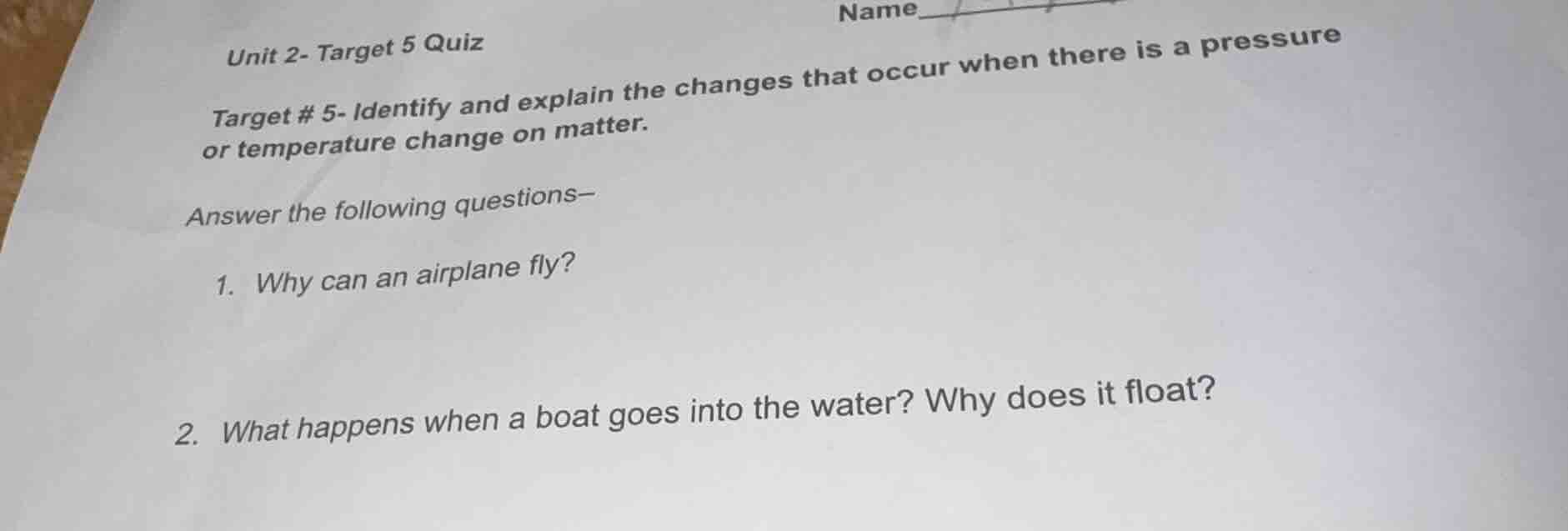
unit 2- target 5 quiz
target # 5- identify and explain the changes that occur when there is a pressure or temperature change on matter.
answer the following questions—
- why can an airplane fly?
- what happens when a boat goes into the water? why does it float?
Question 1: Why can an airplane fly?
An airplane flies due to Bernoulli's principle and lift generation. The wings have an airfoil shape: air moves faster over the curved top surface (lower pressure) and slower under the flatter bottom (higher pressure). This pressure difference creates an upward lift force. Also, thrust (from engines) overcomes drag, and lift exceeds weight, enabling flight.
When a boat enters water, it displaces a volume of water. Floating is due to Archimedes’ principle: the buoyant force (upward) equals the weight of displaced water. A boat’s hull is hollow, so its average density (mass/volume) is less than water’s density. The buoyant force from displaced water balances the boat’s weight, keeping it afloat.

Snap & solve any problem in the app
Get step-by-step solutions on Sovi AI
Photo-based solutions with guided steps
Explore more problems and detailed explanations
An airplane flies because of lift (from pressure differences via Bernoulli’s principle), thrust (overcoming drag), and lift exceeding weight. Wings’ airfoil shape makes air speed faster above (low pressure) and slower below (high pressure), creating upward lift. Thrust (engine power) overcomes drag, and lift > weight allows flight.