QUESTION IMAGE
Question
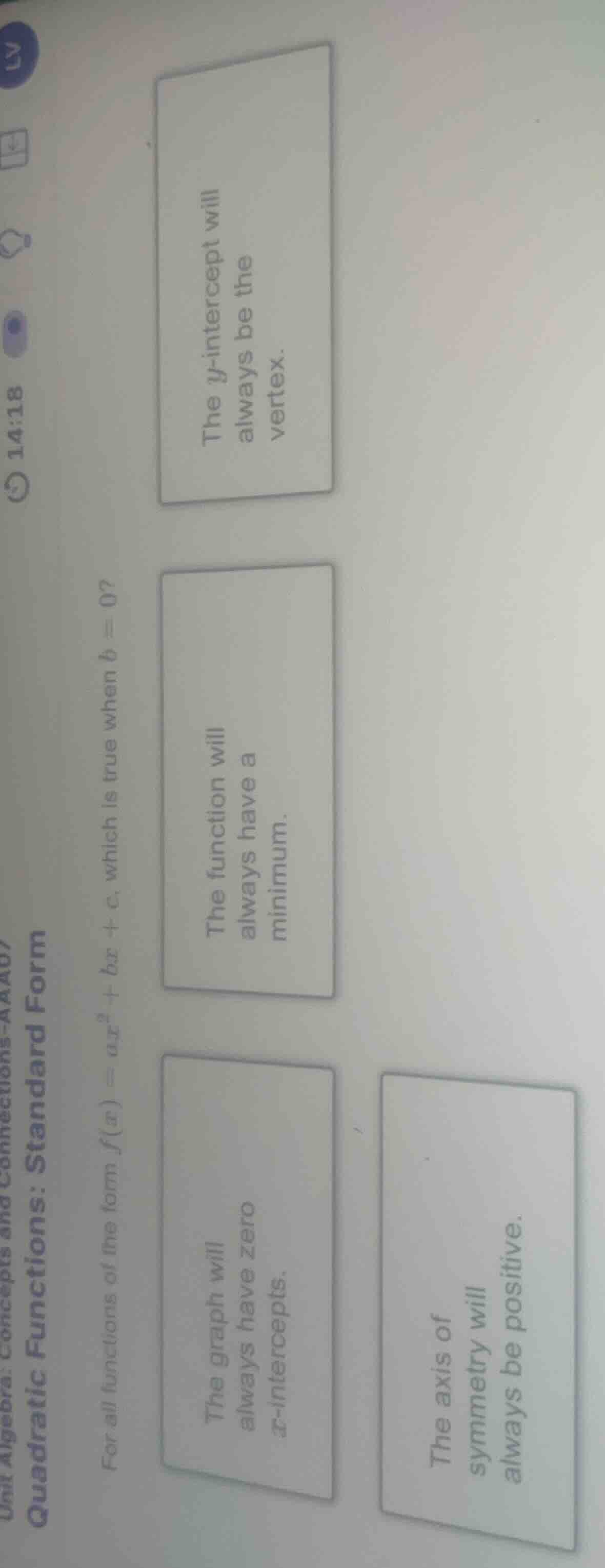
unit algebra: concepts and connections/ quadratic functions: standard form for all functions of the form $f(x)=ax^2 + bx + c$, which is true when $b = 0$? the graph will always have zero $x$-intercepts. the function will always have a minimum. the $y$-intercept will always be the vertex. the axis of symmetry will always be positive.
Step1: Substitute $b=0$ into function
The function becomes $f(x)=ax^2 + c$.
Step2: Analyze vertex and y-intercept
The x-coordinate of the vertex is $x=-\frac{b}{2a}=0$. Substitute $x=0$ into $f(x)$: $f(0)=c$, so the vertex is $(0,c)$. The y-intercept is found by setting $x=0$, which is also $y=c$.
Step3: Eliminate other options
- A function has a minimum only if $a>0$; if $a<0$, it has a maximum.
- The graph has x-intercepts only if $ax^2 + c=0$ has real solutions, i.e., $ac<0$; if $ac>0$, there are no real x-intercepts.
- The axis of symmetry is $x=-\frac{b}{2a}=0$, which is not positive.

Snap & solve any problem in the app
Get step-by-step solutions on Sovi AI
Photo-based solutions with guided steps
Explore more problems and detailed explanations
The y-intercept will always be the vertex.