QUESTION IMAGE
Question
unit exam - gravitational/electrostatic forces
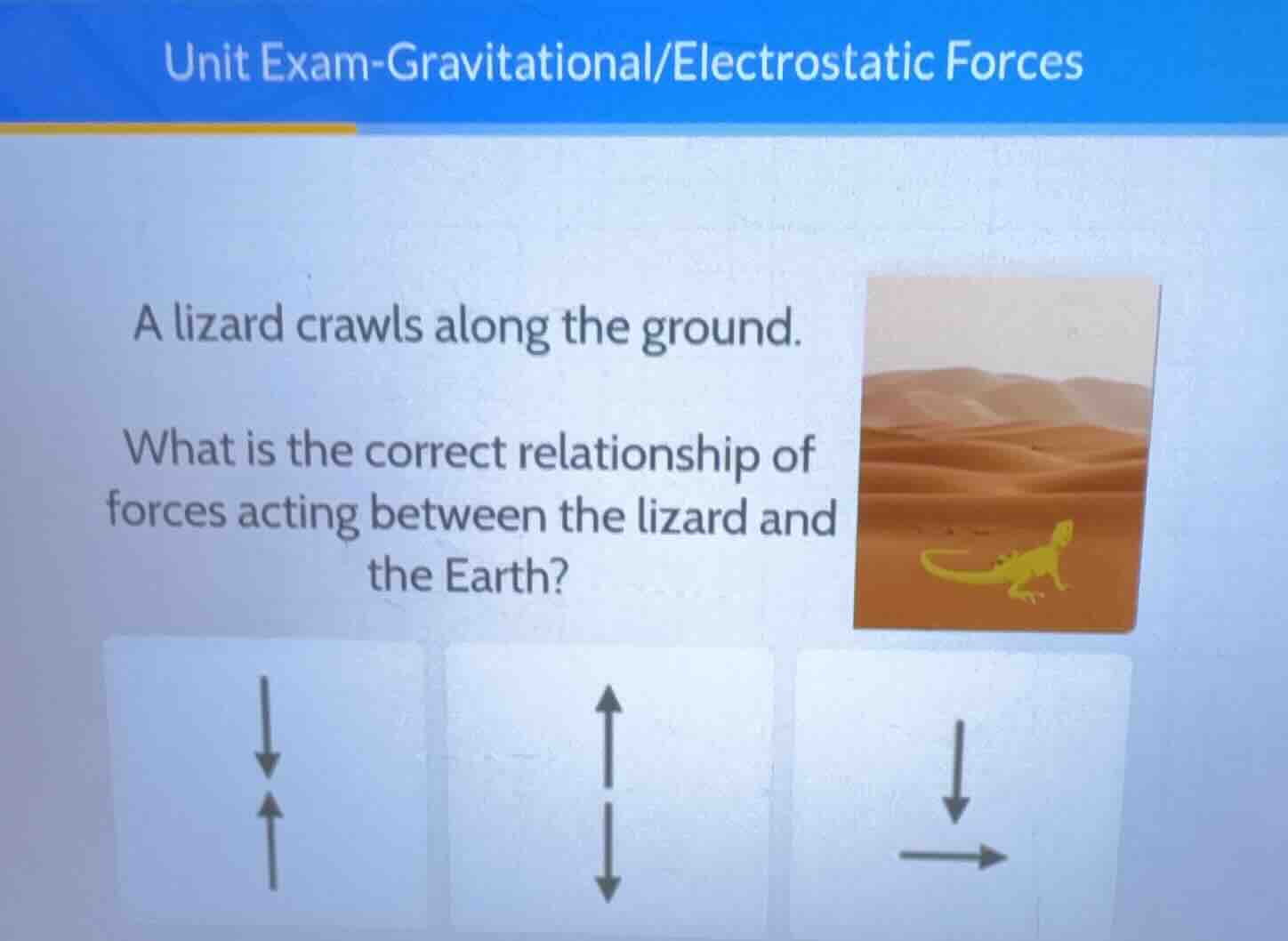
a lizard crawls along the ground.
what is the correct relationship of forces acting between the lizard and the earth?
To determine the force relationship between the lizard and the Earth, we use Newton's third law (action - reaction pairs) and consider gravitational and normal forces. The Earth exerts a gravitational force (weight) on the lizard downward. By Newton's third law, the lizard exerts an equal - magnitude gravitational force on the Earth upward. Also, the normal force from the ground on the lizard (upward) and the force the lizard exerts on the ground (downward) are action - reaction, but for the lizard - Earth pair, the gravitational forces are equal in magnitude and opposite in direction. So the forces between the lizard and Earth (gravitational) are equal in magnitude and opposite in direction, represented by two arrows of equal length pointing in opposite directions (like the first or second option with equal - length opposite arrows; assuming the first option has the Earth's force on lizard down and lizard's force on Earth up, or vice - versa with equal length).

Snap & solve any problem in the app
Get step-by-step solutions on Sovi AI
Photo-based solutions with guided steps
Explore more problems and detailed explanations
Assuming the options are (let's define them as per typical force - pair representations):
A. $\downarrow$ (Earth on lizard) and $\uparrow$ (lizard on Earth) with equal - length arrows
B. $\uparrow$ (Earth on lizard) and $\downarrow$ (lizard on Earth) with equal - length arrows
C. $\downarrow$ (Earth on lizard) and $
ightarrow$ (lizard on Earth)
The correct answer is either A or B (depending on labeling, but the key is equal magnitude, opposite direction). If we take the standard that Earth pulls lizard down (gravity) and lizard pulls Earth up (Newton's third law), and the arrows are equal in length, then the answer is the option with two equal - length arrows pointing in opposite vertical directions (e.g., A or B as defined above).