QUESTION IMAGE
Question
unit exam-gravitational/electrostatic forces
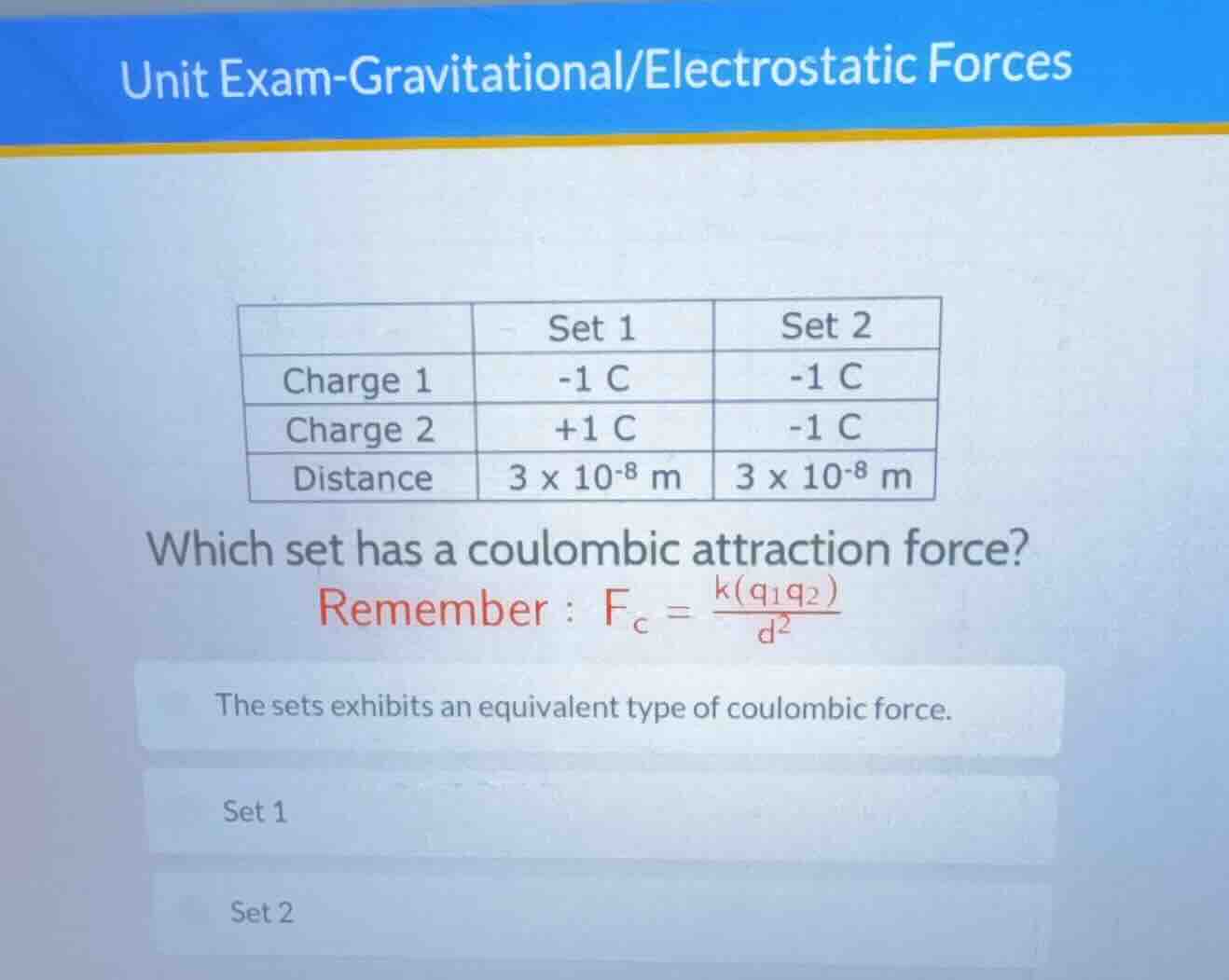
| set 1 | set 2 | |
| charge 1 | -1 c | -1 c |
| charge 2 | +1 c | -1 c |
| distance | 3 × 10⁻⁸ m | 3 × 10⁻⁸ m |
which set has a coulombic attraction force?
remember : $f_c = \frac{k(q_1q_2)}{d^2}$
the sets exhibits an equivalent type of coulombic force.
set 1
set 2
Step1: Recall Coulomb's Law Sign Rule
Coulombic attraction occurs between opposite charges (one positive, one negative), repulsion between like charges (both positive or both negative). The sign of the force (from \( F_c = \frac{k(q_1q_2)}{d^2} \)) depends on \( q_1q_2 \): negative for attraction (opposite charges), positive for repulsion (like charges).
Step2: Analyze Set 1
For Set 1: \( q_1 = -1\ \text{C} \), \( q_2 = +1\ \text{C} \).
Calculate \( q_1q_2 = (-1)(+1) = -1 \).
Since \( q_1q_2 < 0 \), the force is attractive (negative sign indicates attraction in Coulomb's law context).
Step3: Analyze Set 2
For Set 2: \( q_1 = -1\ \text{C} \), \( q_2 = -1\ \text{C} \).
Calculate \( q_1q_2 = (-1)(-1) = +1 \).
Since \( q_1q_2 > 0 \), the force is repulsive (positive sign indicates repulsion).

Snap & solve any problem in the app
Get step-by-step solutions on Sovi AI
Photo-based solutions with guided steps
Explore more problems and detailed explanations
Set 1