QUESTION IMAGE
Question
unit 4: functions assignment
answer all questions to the best of your ability, and be sure to show all work.
- function ( r ) gives the amount of rain measured by a rain gauge ( t ) hours since it started raining. the amount of rain is measured in millimeters. answer the following questions.
a. what does the following equation represent in this situation?
i. ( r(0.5) = 14 )
b. use function notation to represent the following statement.
i. six hours after it started raining, the amount of rain measured was 37 millimeters.
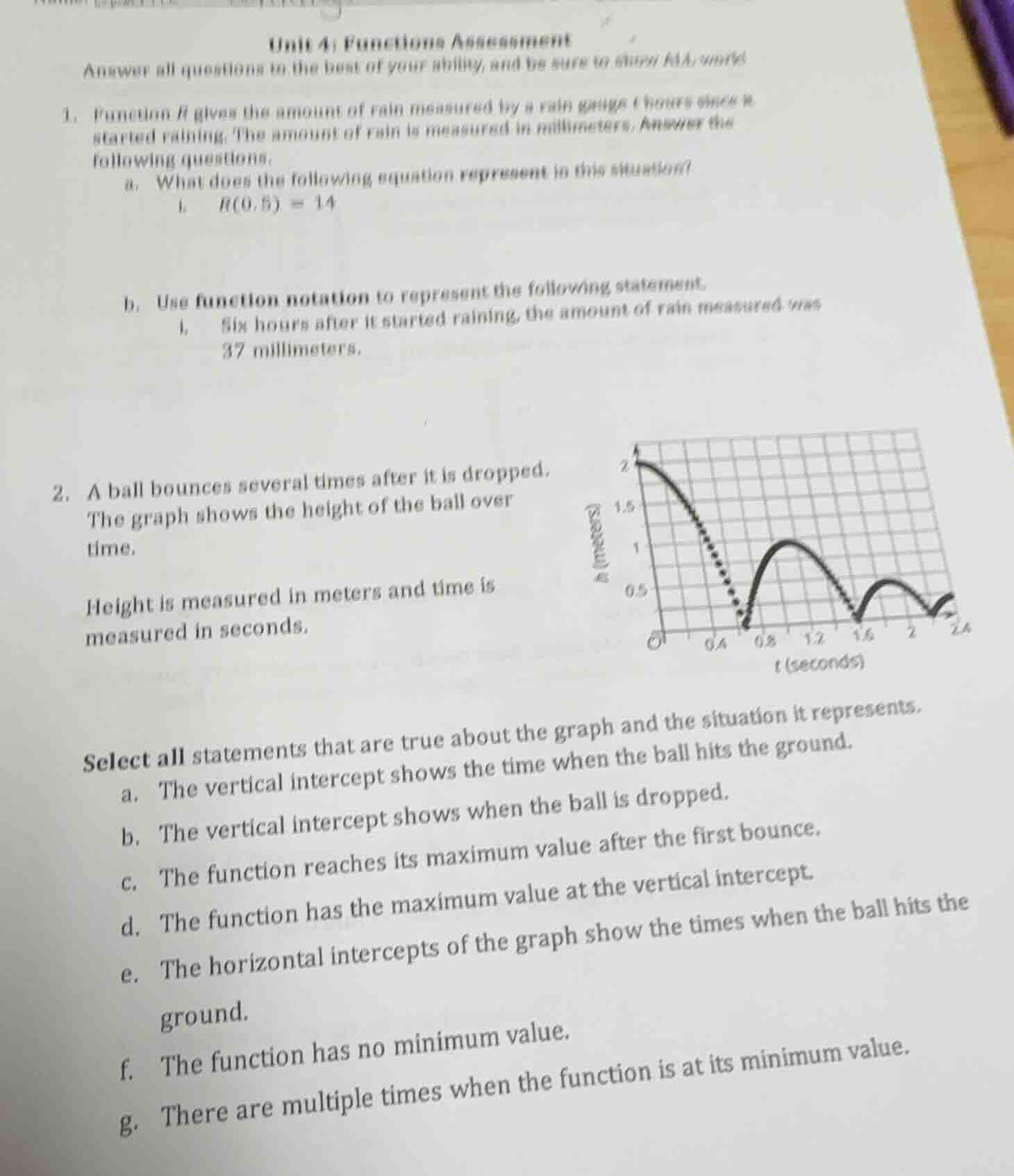
- a ball bounces several times after it is dropped.
the graph shows the height of the ball over time.
height is measured in meters and time is measured in seconds.
select all statements that are true about the graph and the situation it represents.
a. the vertical intercept shows the time when the ball hits the ground.
b. the vertical intercept shows when the ball is dropped.
c. the function reaches its maximum value after the first bounce.
d. the function has the maximum value at the vertical intercept.
e. the horizontal intercepts of the graph show the times when the ball hits the ground.
f. the function has no minimum value.
g. there are multiple times when the function is at its minimum value.
Question 1a i
Function \( R(t) \) gives rain (mm) at \( t \) hours after rain starts. \( R(0.5) = 14 \) means at \( t = 0.5 \) hours (30 minutes) after raining starts, the rain gauge measures 14 millimeters of rain.
We need to represent "6 hours after it started raining, the amount of rain measured was 37 millimeters" using function notation. The function is \( R(t) \) where \( t \) is hours after rain starts and \( R(t) \) is rain in mm. So substitute \( t = 6 \) and \( R(6)=37 \).
- Option a: Vertical intercept is at \( t = 0 \), height when ball is dropped, not when it hits ground (height 0). So a is false.
- Option b: At \( t = 0 \) (vertical intercept), the ball is dropped (initial time). So b is true.
- Option c: After first bounce, height is less than initial height (vertical intercept). So maximum is at vertical intercept, not after first bounce. c is false.
- Option d: Vertical intercept is \( t = 0 \), height is maximum (2 meters) as seen in graph. So d is true.
- Option e: Horizontal intercepts are where \( h = 0 \) (height 0), which is when ball hits ground. So e is true.
- Option f: The ball hits ground (height 0) multiple times, so minimum value (0) exists. f is false.
- Option g: The ball hits ground (height 0) at multiple times (horizontal intercepts), so function is at minimum (0) multiple times. g is true.

Snap & solve any problem in the app
Get step-by-step solutions on Sovi AI
Photo-based solutions with guided steps
Explore more problems and detailed explanations
\( R(0.5) = 14 \) represents that 0.5 hours (or 30 minutes) after it started raining, the amount of rain measured by the rain gauge is 14 millimeters.