QUESTION IMAGE
Question
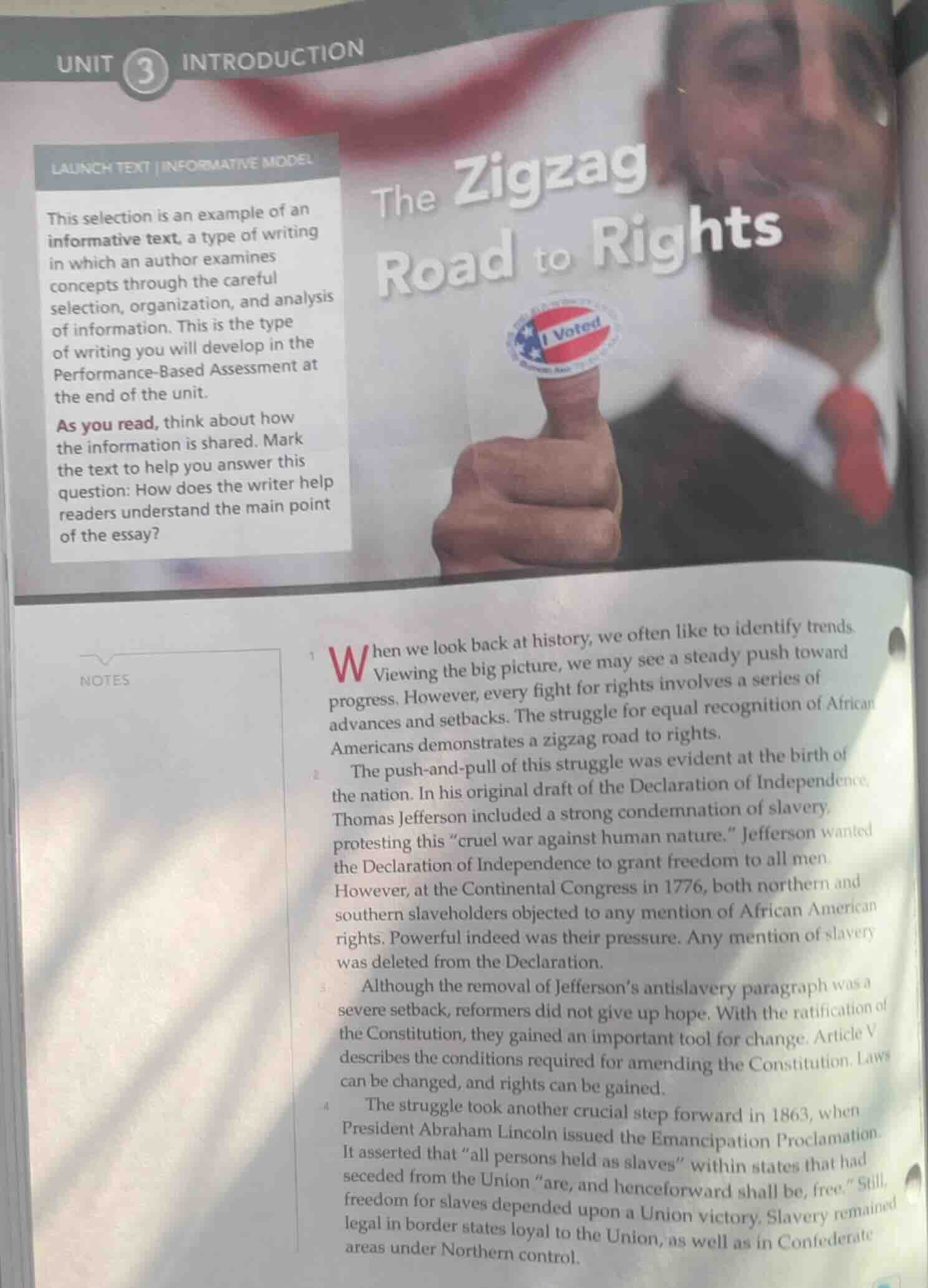
unit 3 introduction launch text | informative model this selection is an example of an informative text, a type of writing in which an author examines concepts through the careful selection, organization, and analysis of information. this is the type of writing you will develop in the performance - based assessment at the end of the unit. as you read, think about how the information is shared. mark the text to help you answer this question: how does the writer help readers understand the main point of the essay? the zigzag road to rights 1 when we look back at history, we often like to identify trends. viewing the big picture, we may see a steady push toward progress. however, every fight for rights involves a series of advances and setbacks. the struggle for equal recognition of african americans demonstrates a zigzag road to rights. 2 the push - and - pull of this struggle was evident at the birth of the nation. in his original draft of the declaration of independence, thomas jefferson included a strong condemnation of slavery, protesting this “cruel war against human nature.” jefferson wanted the declaration of independence to grant freedom to all men. however, at the continental congress in 1776, both northern and southern slaveholders objected to any mention of african american rights. powerful indeed was their pressure. any mention of slavery was deleted from the declaration. 3 although the removal of jefferson’s antislavery paragraph was a severe setback, reformers did not give up hope. with the ratification of the constitution, they gained an important tool for change. article v describes the conditions required for amending the constitution. laws can be changed, and rights can be gained. 4 the struggle took another crucial step forward in 1863, when president abraham lincoln issued the emancipation proclamation. it asserted that “all persons held as slaves” within states that had seceded from the union “are, and henceforward shall be, free.” still, freedom for slaves depended upon a union victory. slavery remained legal in border states loyal to the union, as well as in confederate areas under northern control.
To answer the question "How does the writer help readers understand the main point of the essay?", we analyze the text:
Step 1: Identify the Main Point
The essay’s main point is that the fight for African American rights was a “zigzag road” (filled with advances and setbacks).
Step 2: Analyze the Writer’s Methods
- Structure: The writer uses a chronological structure, tracing the struggle from the Declaration of Independence (1776) to the Emancipation Proclamation (1863). This helps readers follow the “zigzag” of progress (e.g., Jefferson’s draft vs. Congress’s rejection, then the Constitution as a tool, then the Emancipation Proclamation).
- Examples/Evidence: Specific historical events (e.g., Jefferson’s deleted antislavery clause, the Constitution’s Article V, the Emancipation Proclamation) are used to illustrate advances and setbacks.
- Contrast: The writer highlights contrasts (e.g., Jefferson’s ideal vs. slaveholders’ opposition, the Emancipation Proclamation’s limits) to emphasize the uneven path to rights.
The writer helps readers understand the main point (the “zigzag road” to rights) by organizing the text chronologically (tracing key events in the fight for African American rights), providing specific historical examples/evidence (e.g., Jefferson’s draft, the Emancipation Proclamation), and using contrast (e.g., advances vs. setbacks) to clarify the uneven nature of progress.
(Note: Since the full essay isn’t visible, this analysis is based on the provided excerpt. For a complete answer, the entire text’s structure, evidence, and rhetorical choices would be fully examined.)

Snap & solve any problem in the app
Get step-by-step solutions on Sovi AI
Photo-based solutions with guided steps
Explore more problems and detailed explanations
To answer the question "How does the writer help readers understand the main point of the essay?", we analyze the text:
Step 1: Identify the Main Point
The essay’s main point is that the fight for African American rights was a “zigzag road” (filled with advances and setbacks).
Step 2: Analyze the Writer’s Methods
- Structure: The writer uses a chronological structure, tracing the struggle from the Declaration of Independence (1776) to the Emancipation Proclamation (1863). This helps readers follow the “zigzag” of progress (e.g., Jefferson’s draft vs. Congress’s rejection, then the Constitution as a tool, then the Emancipation Proclamation).
- Examples/Evidence: Specific historical events (e.g., Jefferson’s deleted antislavery clause, the Constitution’s Article V, the Emancipation Proclamation) are used to illustrate advances and setbacks.
- Contrast: The writer highlights contrasts (e.g., Jefferson’s ideal vs. slaveholders’ opposition, the Emancipation Proclamation’s limits) to emphasize the uneven path to rights.
The writer helps readers understand the main point (the “zigzag road” to rights) by organizing the text chronologically (tracing key events in the fight for African American rights), providing specific historical examples/evidence (e.g., Jefferson’s draft, the Emancipation Proclamation), and using contrast (e.g., advances vs. setbacks) to clarify the uneven nature of progress.
(Note: Since the full essay isn’t visible, this analysis is based on the provided excerpt. For a complete answer, the entire text’s structure, evidence, and rhetorical choices would be fully examined.)