QUESTION IMAGE
Question
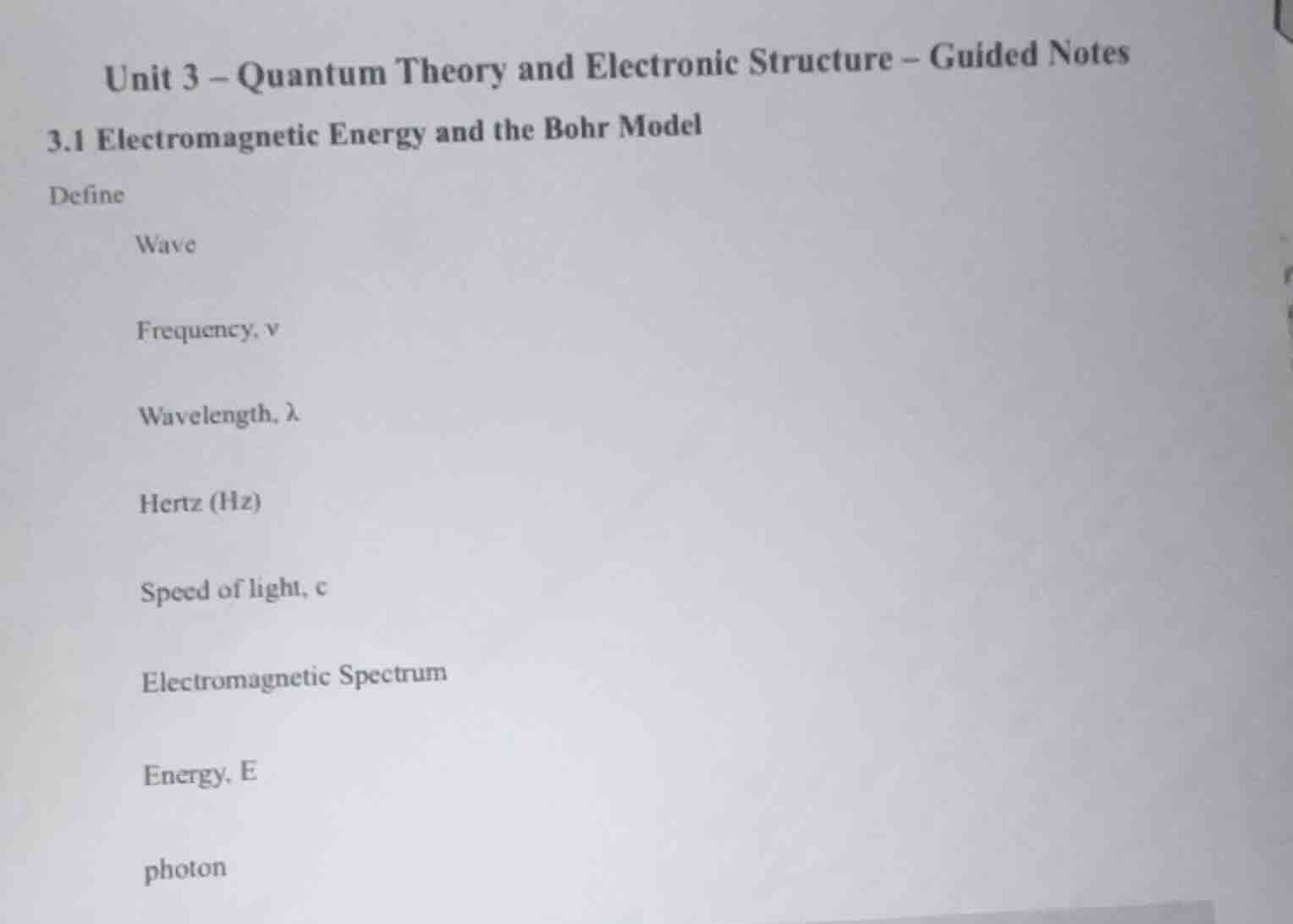
unit 3 – quantum theory and electronic structure – guided notes
3.1 electromagnetic energy and the bohr model
define
wave
frequency, ν
wavelength, λ
hertz (hz)
speed of light, c
electromagnetic spectrum
energy, e
photon
Brief Explanations
- Wave: A periodic disturbance that transfers energy through a medium or vacuum.
- **Frequency, $
u$**: The number of wave cycles passing a point per unit time.
- Wavelength, $\lambda$: The distance between two identical points on adjacent waves.
- Hertz (Hz): The SI unit of frequency, equal to 1 cycle per second ($\text{Hz} = \text{s}^{-1}$).
- Speed of light, $c$: The constant speed of electromagnetic radiation in a vacuum, $c = 3.00 \times 10^8 \, \text{m/s}$.
- Electromagnetic Spectrum: The full range of all frequencies/wavelengths of electromagnetic radiation (from radio waves to gamma rays).
- Energy, $E$ (of light): The quantized energy carried by electromagnetic radiation, related to frequency via $E = h
u$ (where $h$ is Planck's constant).
- Photon: A discrete, massless particle (quantum) of electromagnetic radiation that carries a specific amount of energy.

Snap & solve any problem in the app
Get step-by-step solutions on Sovi AI
Photo-based solutions with guided steps
Explore more problems and detailed explanations
- Wave: A periodic energy-transferring disturbance.
- Frequency, $
u$: Wave cycles per unit time.
- Wavelength, $\lambda$: Distance between identical wave points.
- Hertz (Hz): SI unit of frequency ($\text{s}^{-1}$).
- Speed of light, $c$: $3.00 \times 10^8 \, \text{m/s}$ (vacuum constant).
- Electromagnetic Spectrum: Full range of EM radiation frequencies/wavelengths.
- Energy, $E$: Quantized energy of EM radiation, $E=h
u$.
- Photon: Massless quantum of electromagnetic radiation.