QUESTION IMAGE
Question
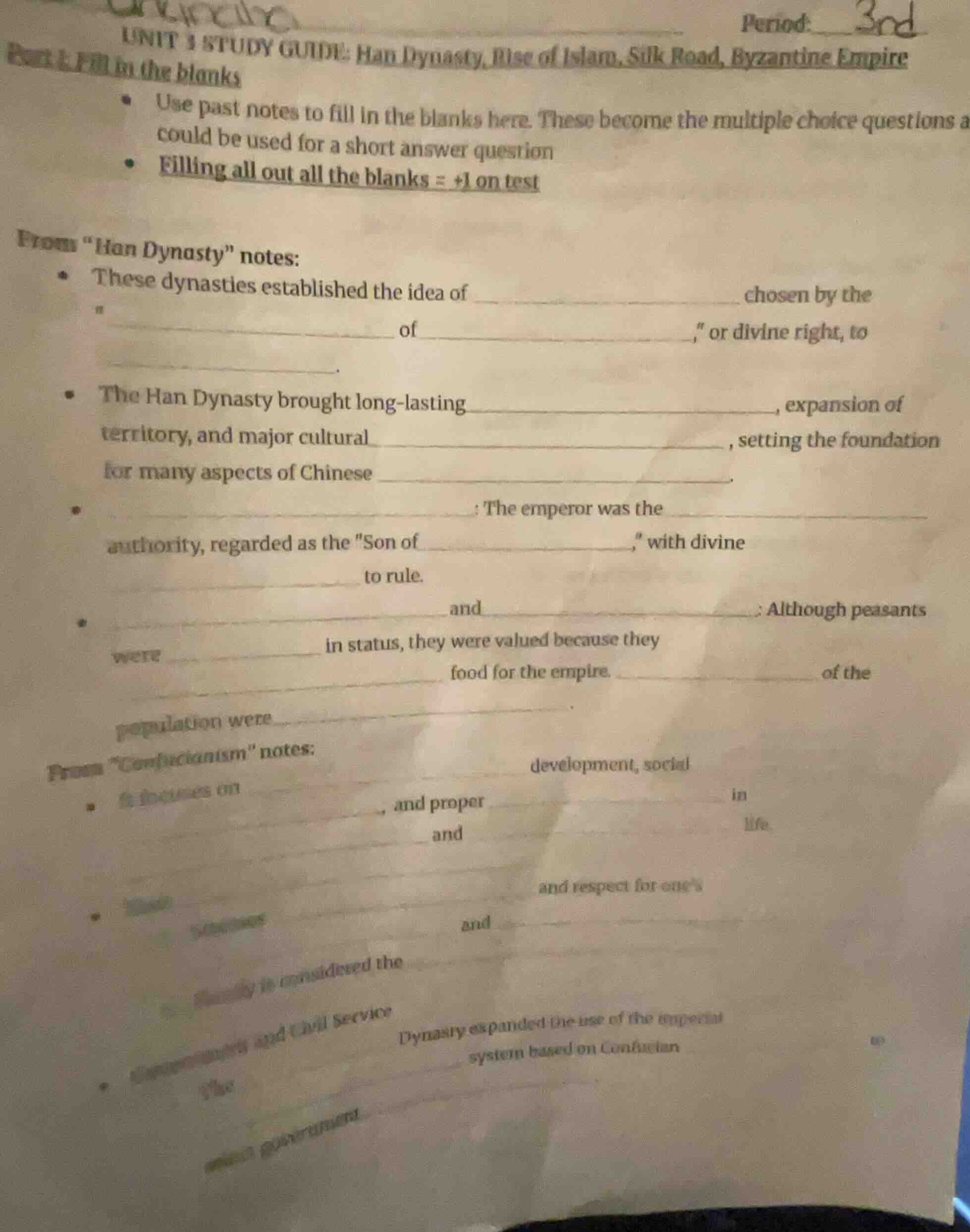
unit 1 study guide: han dynasty, rise of islam, silk road, byzantine empire
part 1: fill in the blanks
- use past notes to fill in the blanks here. these become the multiple choice questions and could be used for a short answer question
- filling all out all the blanks = +1 on test
from \han dynasty\ notes:
- these dynasties established the idea of __________________ chosen by the ________________ of ________________,\ or divine right, to __________________.
- the han dynasty brought long - lasting __________________, expansion of territory, and major cultural ________________, setting the foundation for many aspects of chinese __________________.
- __________________: the emperor was the ________________ authority, regarded as the \son of ________________,\ with divine __________________ to rule.
- __________________ and ________________: although peasants were ________________ in status, they were valued because they ________________ food for the empire. ________________ of the population were __________________.
from \confucianism\ notes:
- it focuses on __________________ development, social ________________, and proper ________________ in ________________ and __________________ life.
- __________________ and respect for ones ________________, ________________, and __________________.
- __________________ is considered the __________________.
- ____________________ and civil service
- the __________________ dynasty expanded the use of the imperial ________________ system based on confucian __________________.
- ____________________ government
This is a study guide for a history - related unit (Han Dynasty, Rise of Islam, etc.). To fill in the blanks, we rely on historical knowledge:
- For the Han Dynasty's divine right - related blank: The Han and preceding dynasties established the idea of a ruler chosen by the "Mandate of Heaven", or divine right, to rule. So the first set of blanks: "a ruler", "Mandate", "Heaven", "rule".
- The Han Dynasty brought long - lasting peace/stability, expansion of territory, and major cultural achievements, setting the foundation for many aspects of Chinese civilization. So the blanks here: "peace (or stability)", "achievements", "civilization".
- Regarding the emperor's authority: The emperor was the supreme authority, regarded as the "Son of Heaven", with divine authority to rule. So blanks: "Emperor's Authority", "supreme", "Heaven", "authority".
- For the social classes (peasants and others): Peasants and artisans (or merchants) - Although peasants were low in status, they were valued because they produced food for the empire. Most of the population were peasants. So blanks: "Peasants", "Artisans (or Merchants)", "low", "produced", "Most", "peasants".
For the Confucianism part (though some text is unclear), Confucianism focuses on moral development, social harmony, and proper conduct in personal and public life. It emphasizes filial piety and respect for one's elders and ancestors. The Han Dynasty expanded the use of the imperial examination system based on Confucian teachings.

Snap & solve any problem in the app
Get step-by-step solutions on Sovi AI
Photo-based solutions with guided steps
Explore more problems and detailed explanations
s:
- From "Han Dynasty" notes:
- These dynasties established the idea of \underline{a ruler} chosen by the \underline{Mandate} of \underline{Heaven}, " or divine right, to \underline{rule}.
- The Han Dynasty brought long - lasting \underline{peace (or stability)}, expansion of territory, and major cultural \underline{achievements}, setting the foundation for many aspects of Chinese \underline{civilization}.
- \underline{Emperor's Authority}: The emperor was the \underline{supreme} authority, regarded as the "Son of \underline{Heaven}", with divine \underline{authority} to rule.
- \underline{Peasants} and \underline{Artisans (or Merchants)}: Although peasants were \underline{low} in status, they were valued because they \underline{produced} food for the empire. \underline{Most} of the population were \underline{peasants}.
- From "Confucianism" notes (partial answers based on context):
- It focuses on \underline{moral} development, social \underline{harmony}, and proper \underline{conduct} in \underline{personal} and \underline{public} life.
- It emphasizes \underline{filial piety} and respect for one's \underline{elders (or ancestors)}.
- The \underline{Han} Dynasty expanded the use of the imperial \underline{examination} system based on Confucian \underline{teachings}.