QUESTION IMAGE
Question
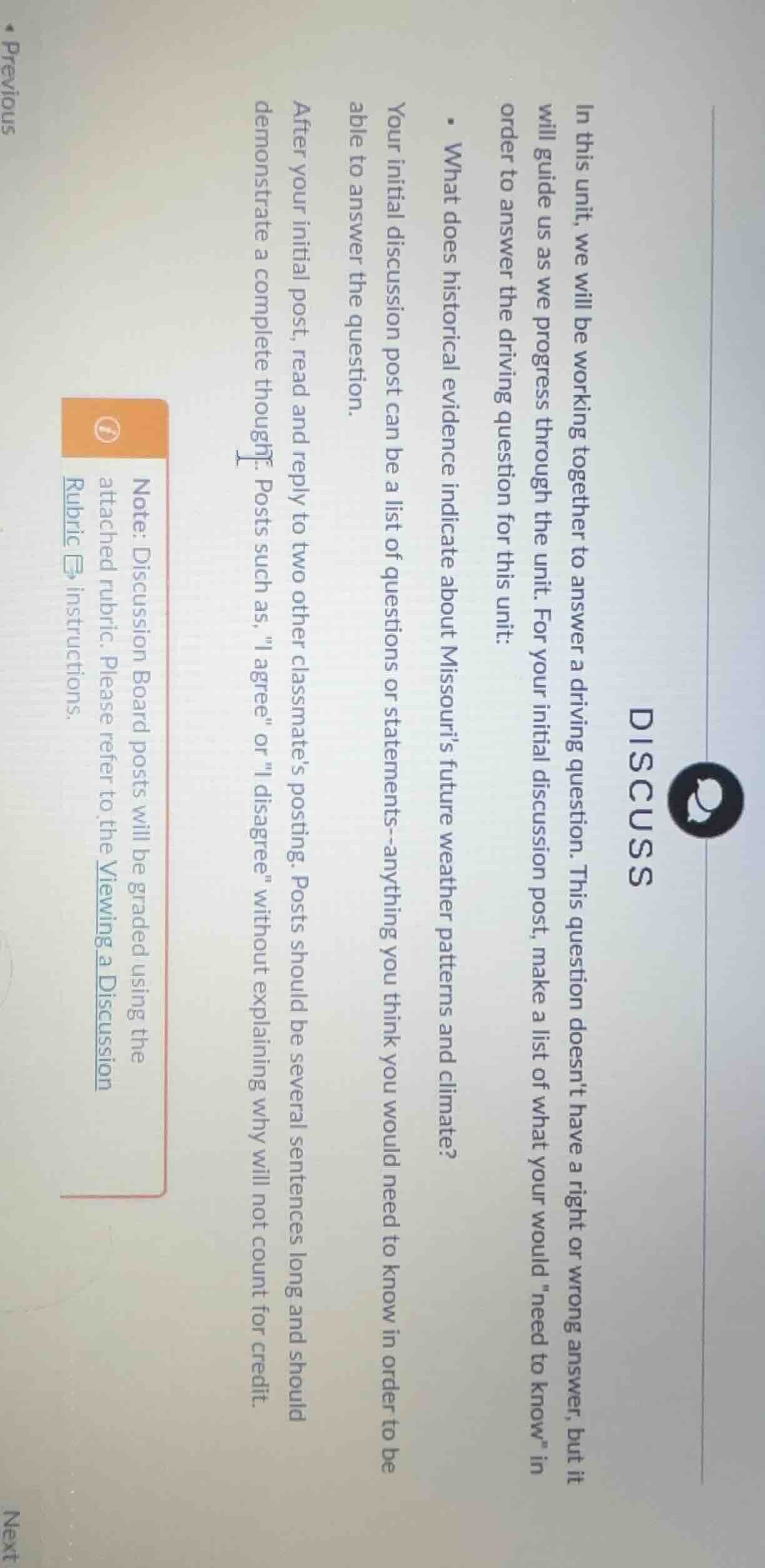
in this unit, we will be working together to answer a driving question. this question doesnt have a right or wrong answer, but it will guide us as we progress through the unit. for your initial discussion post, make a list of what you would
eed to know\ in order to answer the driving question for this unit: - what does historical evidence indicate about missouris future weather patterns and climate? your initial discussion post can be a list of questions or statements--anything you think you would need to know in order to be able to answer the question. after your initial post, read and reply to two other classmates posting. posts should be several sentences long and should demonstrate a complete thought. posts such as, \i agree\ or \i disagree\ without explaining why will not count for credit. note: discussion board posts will be graded using the attached rubric. please refer to the viewing a discussion rubric instructions.
To answer the question about what historical evidence indicates Missouri’s future weather patterns and climate, here's a list of what we'd need to know:
1. Historical Climate Data
- Temperature Records: Long - term (decades to centuries) data on average, maximum, and minimum temperatures in different regions of Missouri. This helps identify trends like warming or cooling over time.
- Precipitation Data: Records of rainfall, snowfall, and other forms of precipitation. It can show if there are trends in wetter or drier periods.
- Extreme Weather Events: Information on past occurrences of hurricanes, tornadoes, droughts, floods, and heatwaves. The frequency and intensity of these events can hint at future risks.
2. Geological and Paleoclimatic Evidence
- Ice Cores (if applicable): Although Missouri isn't a polar region, ice cores from nearby areas can provide information about past atmospheric conditions that may have affected Missouri's climate.
- Tree Rings: Tree rings can be used to reconstruct past climate conditions. Wider rings may indicate wetter years, while narrower rings may indicate drier years.
- Sediment Layers: Sediment layers in lakes, rivers, or soil can contain information about past environmental conditions, such as the presence of droughts or floods.
3. Ecological and Biological Indicators
- Species Distribution Changes: How the ranges of plant and animal species in Missouri have changed over time. For example, if species typically found in warmer climates are moving into Missouri, it may suggest a warming trend.
- Phenology: The timing of biological events like plant flowering, bird migration, and insect emergence. Changes in these timings can be related to climate change.
4. Human - Induced Climate Change Factors
- Greenhouse Gas Emissions: The historical levels of greenhouse gases (like CO₂, methane) and their sources (industrial, agricultural) in and around Missouri. Higher emissions can contribute to climate change.
- Land - Use Changes: How human activities like deforestation, urbanization, and agriculture have changed the landscape of Missouri over time. These changes can impact local climate, for example, urban heat islands.
5. Climate Models and Projections
- Past Model Performance: How well climate models have predicted past climate changes in Missouri. If a model accurately predicted past trends, it may be more reliable for future projections.
- Model Inputs: The data and assumptions used in climate models for Missouri, such as sea - surface temperatures, atmospheric circulation patterns, and land - use scenarios.
6. Regional and Global Climate Patterns
- El Niño - Southern Oscillation (ENSO): The history of ENSO events and their impact on Missouri's climate. ENSO can cause variations in temperature and precipitation.
- North Atlantic Oscillation (NAO): Similar to ENSO, the NAO can influence weather patterns in the region, including Missouri. Understanding its historical impact is important.
- Global Warming Trends: The overall global warming trend and how Missouri fits into this larger picture. Global climate change often has regional manifestations.
By analyzing these types of historical evidence, we can start to piece together patterns and trends that can help us make inferences about Missouri's future weather patterns and climate.

Snap & solve any problem in the app
Get step-by-step solutions on Sovi AI
Photo-based solutions with guided steps
Explore more problems and detailed explanations
To answer the question about what historical evidence indicates Missouri’s future weather patterns and climate, here's a list of what we'd need to know:
1. Historical Climate Data
- Temperature Records: Long - term (decades to centuries) data on average, maximum, and minimum temperatures in different regions of Missouri. This helps identify trends like warming or cooling over time.
- Precipitation Data: Records of rainfall, snowfall, and other forms of precipitation. It can show if there are trends in wetter or drier periods.
- Extreme Weather Events: Information on past occurrences of hurricanes, tornadoes, droughts, floods, and heatwaves. The frequency and intensity of these events can hint at future risks.
2. Geological and Paleoclimatic Evidence
- Ice Cores (if applicable): Although Missouri isn't a polar region, ice cores from nearby areas can provide information about past atmospheric conditions that may have affected Missouri's climate.
- Tree Rings: Tree rings can be used to reconstruct past climate conditions. Wider rings may indicate wetter years, while narrower rings may indicate drier years.
- Sediment Layers: Sediment layers in lakes, rivers, or soil can contain information about past environmental conditions, such as the presence of droughts or floods.
3. Ecological and Biological Indicators
- Species Distribution Changes: How the ranges of plant and animal species in Missouri have changed over time. For example, if species typically found in warmer climates are moving into Missouri, it may suggest a warming trend.
- Phenology: The timing of biological events like plant flowering, bird migration, and insect emergence. Changes in these timings can be related to climate change.
4. Human - Induced Climate Change Factors
- Greenhouse Gas Emissions: The historical levels of greenhouse gases (like CO₂, methane) and their sources (industrial, agricultural) in and around Missouri. Higher emissions can contribute to climate change.
- Land - Use Changes: How human activities like deforestation, urbanization, and agriculture have changed the landscape of Missouri over time. These changes can impact local climate, for example, urban heat islands.
5. Climate Models and Projections
- Past Model Performance: How well climate models have predicted past climate changes in Missouri. If a model accurately predicted past trends, it may be more reliable for future projections.
- Model Inputs: The data and assumptions used in climate models for Missouri, such as sea - surface temperatures, atmospheric circulation patterns, and land - use scenarios.
6. Regional and Global Climate Patterns
- El Niño - Southern Oscillation (ENSO): The history of ENSO events and their impact on Missouri's climate. ENSO can cause variations in temperature and precipitation.
- North Atlantic Oscillation (NAO): Similar to ENSO, the NAO can influence weather patterns in the region, including Missouri. Understanding its historical impact is important.
- Global Warming Trends: The overall global warming trend and how Missouri fits into this larger picture. Global climate change often has regional manifestations.
By analyzing these types of historical evidence, we can start to piece together patterns and trends that can help us make inferences about Missouri's future weather patterns and climate.