QUESTION IMAGE
Question
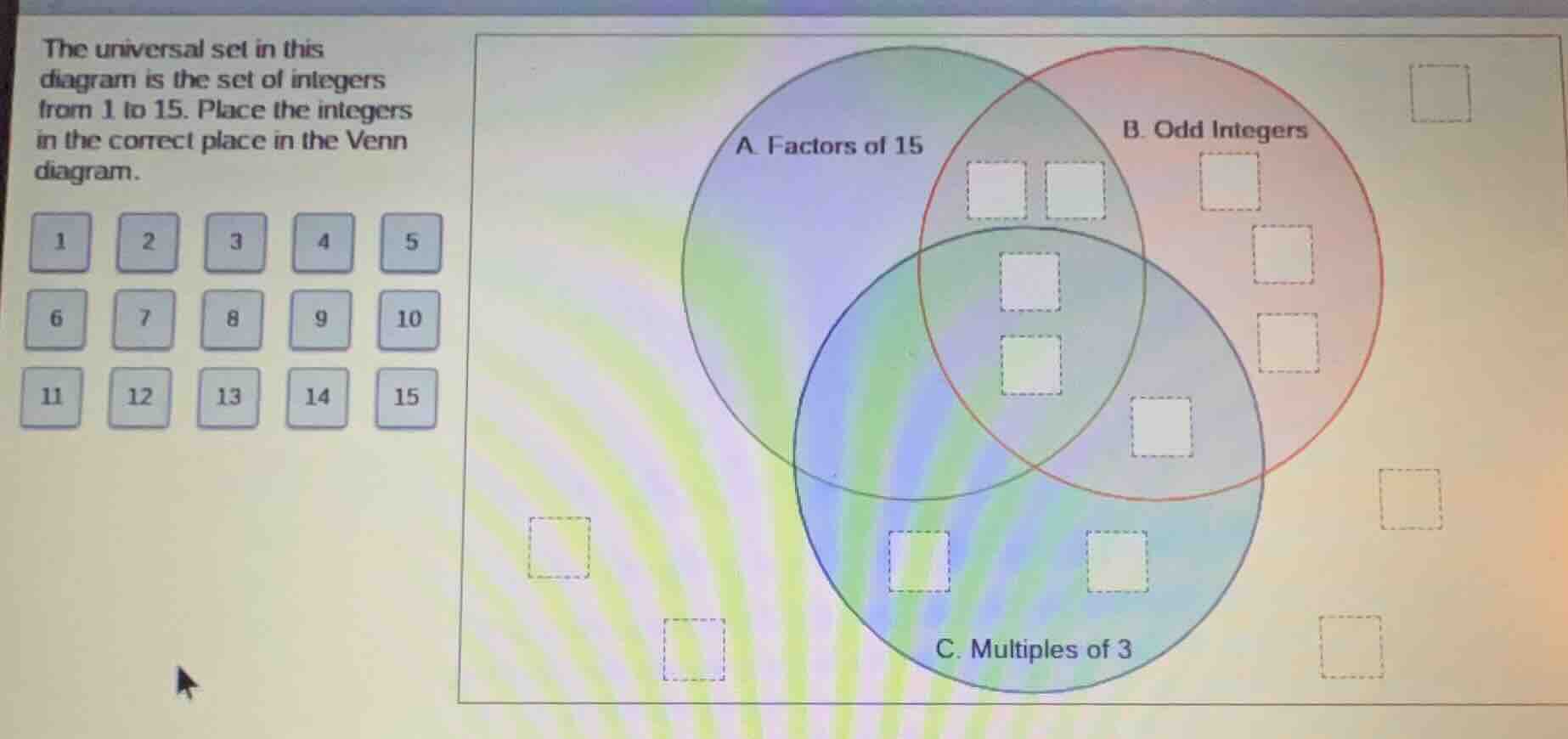
the universal set in this diagram is the set of integers from 1 to 15. place the integers in the correct place in the venn diagram. 1 2 3 4 5 6 7 8 9 10 11 12 13 14 15 a factors of 15 b. odd integers c. multiples of 3
Step1: Identify set A (Factors of 15)
Factors of 15 are numbers that divide 15 without remainder. \(15\div1 = 15\), \(15\div3 = 5\), \(15\div5 = 3\), \(15\div15 = 1\). So set A: \(\{1, 3, 5, 15\}\).
Step2: Identify set B (Odd Integers from 1 - 15)
Odd numbers are not divisible by 2. So set B: \(\{1, 3, 5, 7, 9, 11, 13, 15\}\).
Step3: Identify set C (Multiples of 3 from 1 - 15)
Multiples of 3: \(3\times1 = 3\), \(3\times2 = 6\), \(3\times3 = 9\), \(3\times4 = 12\), \(3\times5 = 15\). So set C: \(\{3, 6, 9, 12, 15\}\).
Step4: Find intersections
- \(A\cap B\) (Factors of 15 and Odd): Common in A and B: \(\{1, 3, 5, 15\}\) (since all factors of 15 here are odd).
- \(A\cap C\) (Factors of 15 and Multiples of 3): Common in A and C: \(\{3, 15\}\) (3 and 15 are factors of 15 and multiples of 3).
- \(B\cap C\) (Odd and Multiples of 3): Common in B and C: \(\{3, 9, 15\}\) (3, 9, 15 are odd and multiples of 3).
- \(A\cap B\cap C\) (All three sets): Common in A, B, C: \(\{3, 15\}\) (3 and 15 are in all three).
- Only A: Numbers in A but not B or C: None, since all A elements are in B (odd) or C (multiples of 3? Wait, 1: 1 is in A and B, not in C (1 is not a multiple of 3). Wait, 1: in A (factor of 15), in B (odd), not in C (not multiple of 3). So only A: \(\{1\}\)? Wait no, 1: A (yes), B (yes), C (no). So \(A - (B\cup C)\): 1. Wait, earlier mistake: 1 is a factor of 15 (A), odd (B), but not a multiple of 3 (C). So \(A\cap B - C\): \(\{1, 5\}\) (1 and 5 are in A and B, not in C). \(A\cap C - B\): None, since 3 and 15 are in B. \(B - (A\cup C)\): Numbers in B but not A or C: \(\{7, 11, 13\}\) (7, 11, 13 are odd, not factors of 15, not multiples of 3). \(C - (A\cup B)\): Numbers in C but not A or B: \(\{6, 12\}\) (6 and 12 are multiples of 3, even (so not in B), not factors of 15 (6: 15÷6=2.5; 12: 15÷12=1.25)).
- Only B: \(\{7, 11, 13\}\)
- Only C: \(\{6, 12\}\)
- Outside all: Numbers not in A, B, or C: \(\{2, 4, 8, 10, 14\}\) (even, not factors of 15, not multiples of 3).
Now place numbers:
- Only A: 1 (wait, 1 is in A and B, so no. Wait, re - evaluate:
- \(A\) only: Numbers in A, not in B or C. But all A elements (1,3,5,15) are in B (odd). So \(A\) only: empty? Wait 1: in A (yes), B (yes), C (no). So \(A\cap B - C\): 1, 5 (1 and 5 are in A and B, not in C). \(A\cap C - B\): none (3 and 15 are in B). \(B\cap C - A\): 9 (9 is in B (odd) and C (multiple of 3), but not in A (9 is not a factor of 15)). Wait, 9: 15÷9 = 1.666..., so 9 is not a factor of 15. So \(B\cap C\) is \(\{3, 9, 15\}\), \(A\cap B\cap C\) is \(\{3, 15\}\), so \(B\cap C - A\) is \{9\}.
Let's re - list:
- Only A: None (since 1,3,5,15 are in B or C)
- \(A\cap B\) (not C): 1, 5 (1 and 5 are in A and B, not in C)
- \(A\cap C\) (not B): None (3 and 15 are in B)
- \(A\cap B\cap C\): 3, 15 (in all three)
- \(B\cap C\) (not A): 9 (in B and C, not A)
- Only B: 7, 11, 13 (in B, not A or C)
- \(A\cap C\) (not B): None
- Only C: 6, 12 (in C, not A or B)
- Outside all: 2, 4, 8, 10, 14 (not in A, B, or C)
Now place in Venn:
- \(A\cap B\) (top middle, A and B only): 1, 5
- \(A\cap B\cap C\) (center, all three): 3, 15
- \(B\cap C\) (middle right, B and C only): 9
- Only B (right, B only): 7, 11, 13
- Only C (bottom, C only): 6, 12
- Only A (left, A only): Wait, 1 is in A and B, so no. Wait, maybe my initial factor list was wrong? Wait 1: factor of 15 (yes), odd (yes), not multiple of 3 (yes). So 1 is in A and B, not C. 5: factor of 15 (yes), odd (yes), not multiple of 3 (yes). So \(A\cap B - C\): 1, 5. \(A\cap C - B\): none. \(B\cap C - A\): 9. \(A\cap B\cap C\): 3, 15. Only B:…

Snap & solve any problem in the app
Get step-by-step solutions on Sovi AI
Photo-based solutions with guided steps
Explore more problems and detailed explanations
- Only A (left square): None (or if the diagram's left square is for A only, maybe the problem expects 1? Wait, re - checking factors of 15: 1,3,5,15. Odd integers: 1,3,5,7,9,11,13,15. Multiples of 3: 3,6,9,12,15. So 1 is in A and B, not C. So A∩B: 1,5. A∩B∩C: 3,15. B∩C: 9. Only B:7,11,13. Only C:6,12. Outside:2,4,8,10,14. Only A: None (since 1 is in B). So the placement is:
- A (Factors of 15) only: None (or the left square can be empty, but maybe the problem has a square for A only, so 1? Wait, maybe my factor list was wrong. Wait 1 is a factor of every number, including 15. 3: 15÷3 = 5. 5:15÷5 = 3. 15:15÷15 = 1. So factors of 15 are 1,3,5,15. Correct.
So final placement:
- A only (left square): 1 (wait, 1 is in B, so no. I think the diagram's labels:
- A (blue) only: numbers in A not in B or C: none, so empty.
- A∩B (top middle, between A and B): 1, 5
- A∩B∩C (center, all three): 3, 15
- B∩C (middle right, between B and C): 9
- Only B (right circle, B only): 7, 11, 13
- Only C (bottom circle, C only): 6, 12
- Outside all (squares outside): 2, 4, 8, 10, 14
- A∩C (middle left, between A and C): 3, 15 (but they are in B too, so part of A∩B∩C)
So the integers are placed as:
- A only: None (or the left square is empty)
- A∩B: 1, 5
- A∩B∩C: 3, 15
- B∩C: 9
- Only B: 7, 11, 13
- Only C: 6, 12
- Outside: 2, 4, 8, 10, 14