QUESTION IMAGE
Question
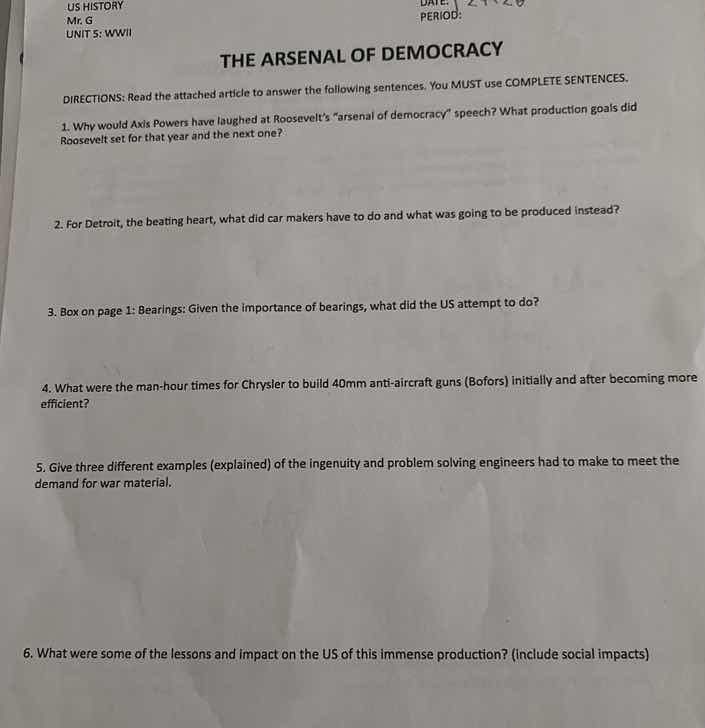
us history
mr. g
unit 5: wwii
the arsenal of democracy
directions: read the attached article to answer the following sentences. you must use complete sentences.
- why would axis powers have laughed at roosevelt’s “arsenal of democracy” speech? what production goals did roosevelt set for that year and the next one?
- for detroit, the beating heart, what did car makers have to do and what was going to be produced instead?
- box on page 1: bearings: given the importance of bearings, what did the us attempt to do?
- what were the man - hour times for chrysler to build 40mm anti - aircraft guns (bofors) initially and after becoming more efficient?
- give three different examples (explained) of the ingenuity and problem solving engineers had to make to meet the demand for war material.
- what were some of the lessons and impact on the us of this immense production? (include social impacts)
To answer these questions, you would need to refer to the attached article titled "The Arsenal of Democracy." Since the article isn't provided here, I can give you general guidance on how to approach each question based on historical knowledge about the "arsenal of democracy" concept (Roosevelt's pledge to supply Allied nations with war materials) and WWII industrial production:
1. Why would Axis Powers have laughed at Roosevelt’s “arsenal of democracy” speech? What production goals did Roosevelt set for that year and the next one?
- Axis Laughter Reason: In 1940–1941, the US was still largely neutral and had limited wartime production capacity. Axis powers (Germany, Italy, Japan) likely saw the US as ill - prepared for large - scale military production, with a peacetime economy and little immediate ability to match Axis war output.
- Production Goals: Roosevelt aimed to rapidly scale up production of war materials like planes, tanks, and ships. For example, goals might have included producing thousands of aircraft (e.g., 50,000 planes in a year) and increasing munitions output to supply Allied forces.
2. For Detroit, the beating heart, what did car makers have to do and what was going to be produced instead?
- Car Makers’ Actions: Detroit’s auto manufacturers (Ford, GM, Chrysler) had to convert their factories from producing civilian cars to wartime machinery. This meant retooling assembly lines, retraining workers, and shifting supply chains.
- Production Shift: Instead of cars, they produced military vehicles (tanks, jeeps), aircraft engines, guns, and other war supplies.
3. Box on page 1: Bearings: Given the importance of bearings, what did the US attempt to do?
- Bearings are critical for machinery (engines, guns, vehicles). The US likely attempted to increase bearing production, find alternative materials (if metal shortages arose), improve manufacturing efficiency, and secure domestic or Allied supply chains to ensure enough bearings for war production. This could involve government - led production programs, incentivizing factories to switch to bearing production, or developing new bearing - making technologies.
4. What were the man - hour times for Chrysler to build 40mm anti - aircraft guns (Bofors) initially and after becoming more efficient?
- Without the article, we can infer: Initially, Chrysler (new to gun production) would have had high man - hours per gun (e.g., 1,000 + man - hours) due to learning curves, unfamiliarity with the product, and unoptimized processes. After efficiency improvements (standardized production, better training, assembly - line tweaks), man - hours would drop (e.g., to 200–300 man - hours per gun).
5. Give three different examples (explained) of the ingenuity and problem solving engineers had to make to meet the demand for war material.
- Example 1: Liberty Ships: Engineers simplified ship design to mass - produce cargo ships quickly. Using prefabricated parts and standardized designs, they reduced construction time from months to weeks, enabling rapid supply of Allied forces.
- Example 2: Jeep Design: Engineers created a lightweight, versatile military vehicle (the jeep) by combining off - road capability with simplicity. They used existing auto - industry knowledge to design a vehicle that could be produced quickly and perform in diverse combat environments.
- Example 3: Synthetic Rubber: With natural rubber supplies cut off by Japan’s conquests in Southeast Asia, engineers developed synthetic rubber production methods. This involved chemi…

Snap & solve any problem in the app
Get step-by-step solutions on Sovi AI
Photo-based solutions with guided steps
Explore more problems and detailed explanations
To answer these questions, you would need to refer to the attached article titled "The Arsenal of Democracy." Since the article isn't provided here, I can give you general guidance on how to approach each question based on historical knowledge about the "arsenal of democracy" concept (Roosevelt's pledge to supply Allied nations with war materials) and WWII industrial production:
1. Why would Axis Powers have laughed at Roosevelt’s “arsenal of democracy” speech? What production goals did Roosevelt set for that year and the next one?
- Axis Laughter Reason: In 1940–1941, the US was still largely neutral and had limited wartime production capacity. Axis powers (Germany, Italy, Japan) likely saw the US as ill - prepared for large - scale military production, with a peacetime economy and little immediate ability to match Axis war output.
- Production Goals: Roosevelt aimed to rapidly scale up production of war materials like planes, tanks, and ships. For example, goals might have included producing thousands of aircraft (e.g., 50,000 planes in a year) and increasing munitions output to supply Allied forces.
2. For Detroit, the beating heart, what did car makers have to do and what was going to be produced instead?
- Car Makers’ Actions: Detroit’s auto manufacturers (Ford, GM, Chrysler) had to convert their factories from producing civilian cars to wartime machinery. This meant retooling assembly lines, retraining workers, and shifting supply chains.
- Production Shift: Instead of cars, they produced military vehicles (tanks, jeeps), aircraft engines, guns, and other war supplies.
3. Box on page 1: Bearings: Given the importance of bearings, what did the US attempt to do?
- Bearings are critical for machinery (engines, guns, vehicles). The US likely attempted to increase bearing production, find alternative materials (if metal shortages arose), improve manufacturing efficiency, and secure domestic or Allied supply chains to ensure enough bearings for war production. This could involve government - led production programs, incentivizing factories to switch to bearing production, or developing new bearing - making technologies.
4. What were the man - hour times for Chrysler to build 40mm anti - aircraft guns (Bofors) initially and after becoming more efficient?
- Without the article, we can infer: Initially, Chrysler (new to gun production) would have had high man - hours per gun (e.g., 1,000 + man - hours) due to learning curves, unfamiliarity with the product, and unoptimized processes. After efficiency improvements (standardized production, better training, assembly - line tweaks), man - hours would drop (e.g., to 200–300 man - hours per gun).
5. Give three different examples (explained) of the ingenuity and problem solving engineers had to make to meet the demand for war material.
- Example 1: Liberty Ships: Engineers simplified ship design to mass - produce cargo ships quickly. Using prefabricated parts and standardized designs, they reduced construction time from months to weeks, enabling rapid supply of Allied forces.
- Example 2: Jeep Design: Engineers created a lightweight, versatile military vehicle (the jeep) by combining off - road capability with simplicity. They used existing auto - industry knowledge to design a vehicle that could be produced quickly and perform in diverse combat environments.
- Example 3: Synthetic Rubber: With natural rubber supplies cut off by Japan’s conquests in Southeast Asia, engineers developed synthetic rubber production methods. This involved chemical processes to create rubber substitutes for tires, seals, and other critical uses.
6. What were some of the lessons and impact on the US of this immense production? (include social impacts)
- Economic Lessons/Impacts: The US learned the power of industrial mobilization. The wartime economy ended the Great Depression, as government spending and production created jobs. It also spurred innovation in manufacturing (e.g., assembly - line efficiency, mass production techniques).
- Social Impacts:
- Employment: Women entered the workforce in large numbers (Rosie the Riveter - style jobs) to fill factory positions, breaking gender barriers in employment.
- Migration: Workers migrated to industrial centers (like Detroit, Los Angeles) for war jobs, leading to population shifts and cultural changes.
- Racial Dynamics: African Americans and other minorities gained more industrial jobs, though discrimination still existed, and the war effort contributed to later civil rights momentum.
6. What were some of the lessons and impact on the US of this immense production? (include social impacts)
- Economic Lessons/Impacts: The US learned the power of industrial mobilization. The wartime economy ended the Great Depression, as government spending and production created jobs. It also spurred innovation in manufacturing (e.g., assembly - line efficiency, mass production techniques).
- Social Impacts:
- Employment: Women entered the workforce in large numbers (Rosie the Riveter - style jobs) to fill factory positions, breaking gender barriers in employment.
- Migration: Workers migrated to industrial centers (like Detroit, Los Angeles) for war jobs, leading to population shifts and cultural changes.
- Racial Dynamics: African Americans and other minorities gained more industrial jobs, though discrimination still existed, and the war effort contributed to later civil rights momentum.
To get precise answers, you must refer to the specific details in the attached article, as the above is general historical context.