QUESTION IMAGE
Question
use the best answers.
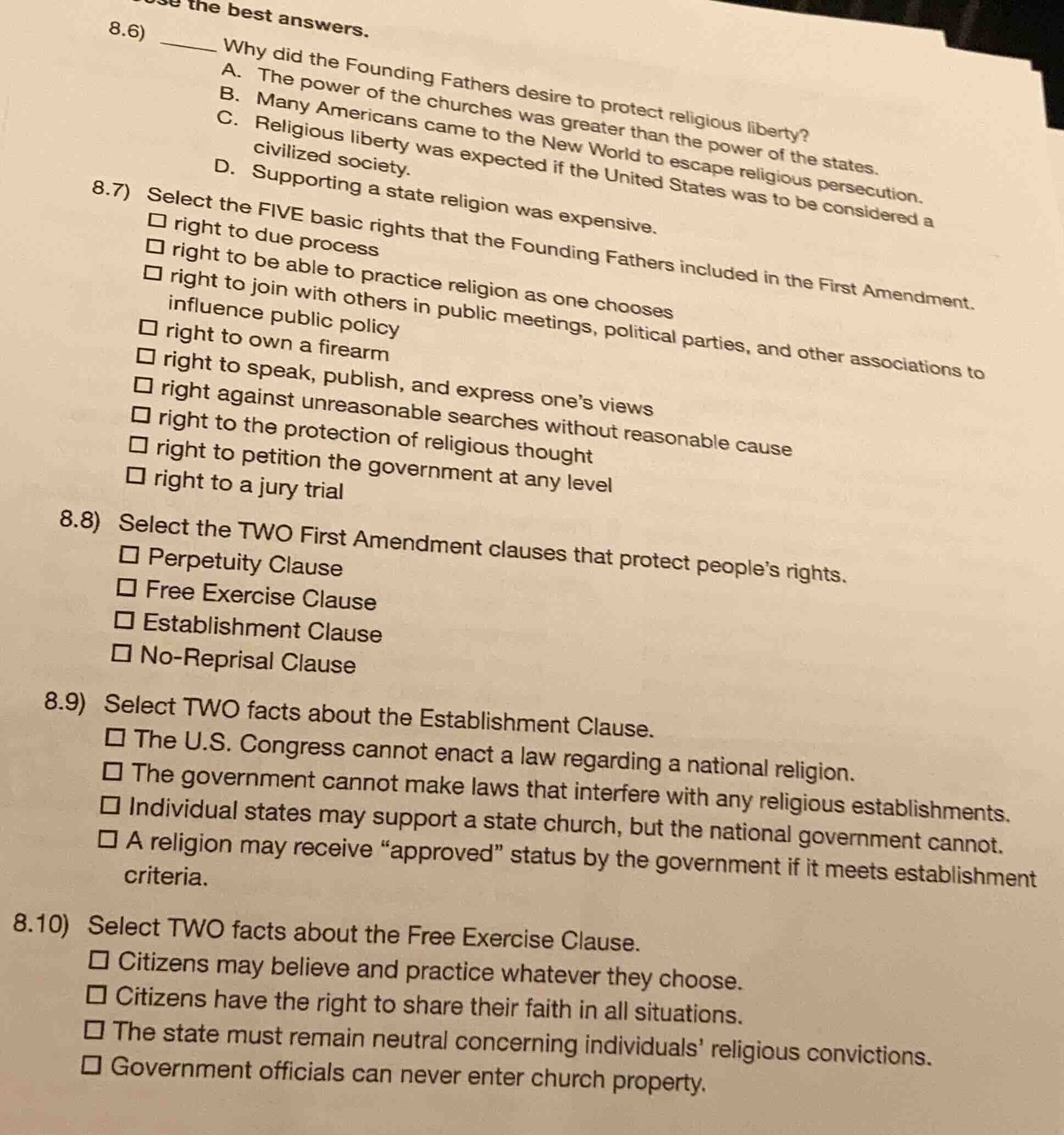
8.6) ______ why did the founding fathers desire to protect religious liberty?
a. the power of the churches was greater than the power of the states.
b. many americans came to the new world to escape religious persecution.
c. religious liberty was expected if the united states was to be considered a civilized society.
d. supporting a state religion was expensive.
8.7) select the five basic rights that the founding fathers included in the first amendment.
□ right to due process
□ right to be able to practice religion as one chooses
□ right to join with others in public meetings, political parties, and other associations to influence public policy
□ right to own a firearm
□ right to speak, publish, and express one’s views
□ right against unreasonable searches without reasonable cause
□ right to the protection of religious thought
□ right to petition the government at any level
□ right to a jury trial
8.8) select the two first amendment clauses that protect people’s rights.
□ perpetuity clause
□ free exercise clause
□ establishment clause
□ no-reprisal clause
8.9) select two facts about the establishment clause.
□ the u.s. congress cannot enact a law regarding a national religion.
□ the government cannot make laws that interfere with any religious establishments.
□ individual states may support a state church, but the national government cannot.
□ a religion may receive “approved” status by the government if it meets establishment criteria.
8.10) select two facts about the free exercise clause.
□ citizens may believe and practice whatever they choose.
□ citizens have the right to share their faith in all situations.
□ the state must remain neutral concerning individuals’ religious convictions.
□ government officials can never enter church property.
8.6)
To determine why the Founding Fathers desired to protect religious liberty, we analyze each option:
- Option A: The power of churches being greater than states is not the main reason for protecting religious liberty.
- Option B: Many Americans came to the New World to escape religious persecution, so protecting religious liberty was important to avoid repeating such persecution. This is a key reason.
- Option C: The idea that religious liberty was expected for a civilized society is not the primary historical reason tied to the Founding Fathers' motivation (the escape from persecution is more direct).
- Option D: Cost of supporting a state religion is not a primary reason for protecting religious liberty.
The First Amendment (part of the Bill of Rights) includes five basic rights related to freedom of religion, speech, press, assembly, and petition. Let's identify them:
- Right to due process: Not a First Amendment right (related to legal proceedings, e.g., 5th/14th Amendments).
- Right to practice religion as one chooses: Part of Free Exercise Clause (religious freedom).
- Right to join with others in public meetings, etc., to influence policy: Freedom of Assembly.
- Right to own a firearm: Second Amendment (not First).
- Right to speak, publish, express views: Freedom of Speech.
- Right against unreasonable searches: Fourth Amendment (not First).
- Right to protection of religious thought: Part of religious freedom (related to Free Exercise/Establishment).
- Right to petition the government: Freedom of Petition.
- Right to a jury trial: Sixth Amendment (not First).
So the five are: right to practice religion as one chooses, right to join with others in public meetings... to influence policy, right to speak, publish, express views, right to protection of religious thought, right to petition the government.
The First Amendment has two main clauses related to religious rights:
- Free Exercise Clause: Protects the right to practice one's religion.
- Establishment Clause: Prohibits the government from establishing a national religion or favoring one religion over another.
- Perpetuity Clause: Not a First Amendment clause.
- No - Reprisal Clause: Not a First Amendment clause.

Snap & solve any problem in the app
Get step-by-step solutions on Sovi AI
Photo-based solutions with guided steps
Explore more problems and detailed explanations
B. Many Americans came to the New World to escape religious persecution.