QUESTION IMAGE
Question
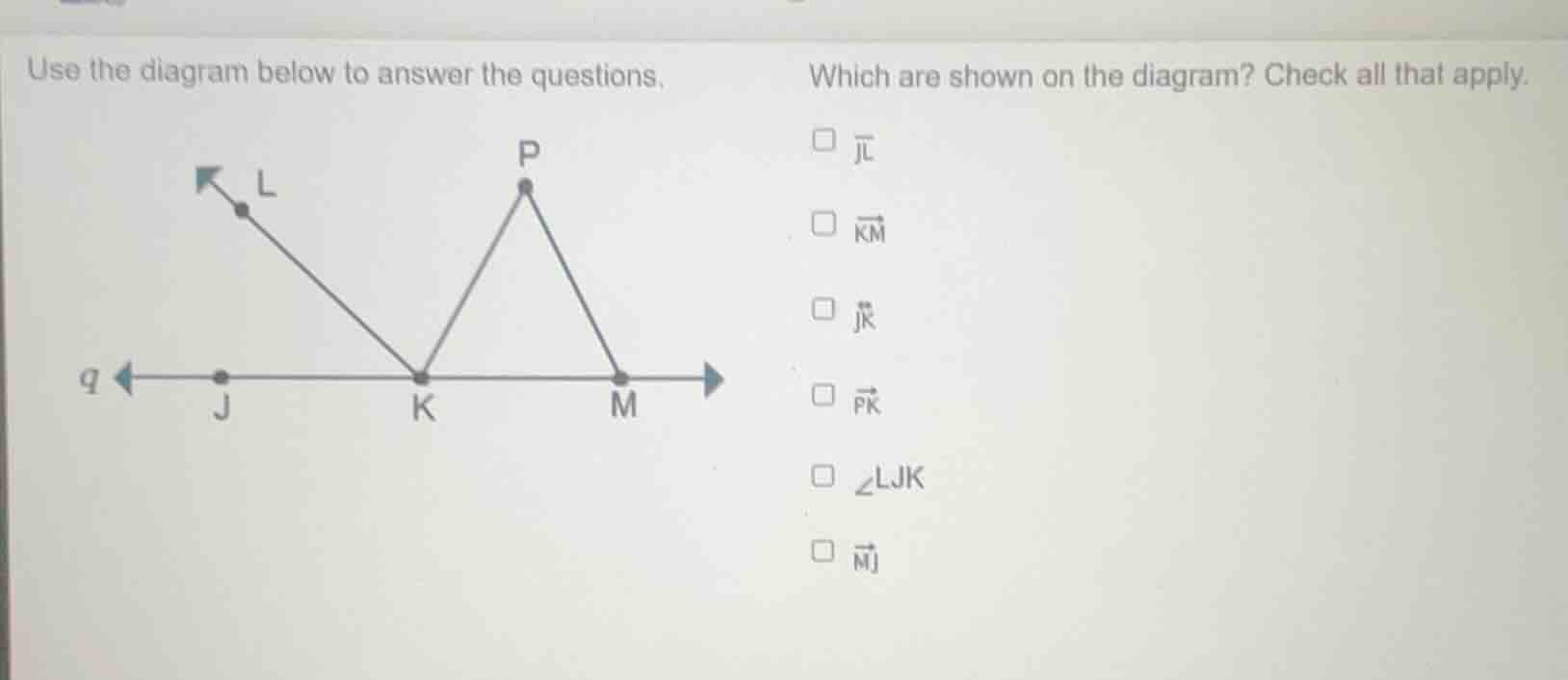
use the diagram below to answer the questions. which are shown on the diagram? check all that apply. \\(\overline{jc}\\) \\(\overrightarrow{km}\\) \\(\overleftrightarrow{jk}\\) \\(\overrightarrow{pk}\\) \\(\angle ljk\\) \\(\overrightarrow{mj}\\)
Brief Explanations
- Analyze \(\overrightarrow{JL}\): There is no segment or ray from \(J\) to \(L\) shown, so this is not present.
- Analyze \(\overrightarrow{KM}\): The ray starts at \(K\) and goes through \(M\) (since \(K\) to \(M\) is on the line with \(K\) as start and \(M\) in the direction of the ray), so this is shown.
- Analyze \(\overrightarrow{JK}\): The ray starts at \(J\) and goes through \(K\) (as \(J\) to \(K\) is on the line with \(J\) as start and \(K\) in the direction), so this is shown.
- Analyze \(\overrightarrow{PK}\): The segment (ray - like in the diagram) from \(P\) to \(K\) is part of the triangle, so this is shown.
- Analyze \(\angle LJK\): The angle at \(J\) between \(LJ\) (or \(JL\) direction) and \(JK\) is formed by the lines, so this angle is shown.
- Analyze \(\overrightarrow{MJ}\): The ray would start at \(M\) and go towards \(J\), but the line at \(M\) is going to the right, not towards \(J\), so this is not shown.

Snap & solve any problem in the app
Get step-by-step solutions on Sovi AI
Photo-based solutions with guided steps
Explore more problems and detailed explanations
\(\boldsymbol{\overrightarrow{KM}}\), \(\boldsymbol{\overrightarrow{JK}}\), \(\boldsymbol{\overrightarrow{PK}}\), \(\boldsymbol{\angle LJK}\)