QUESTION IMAGE
Question
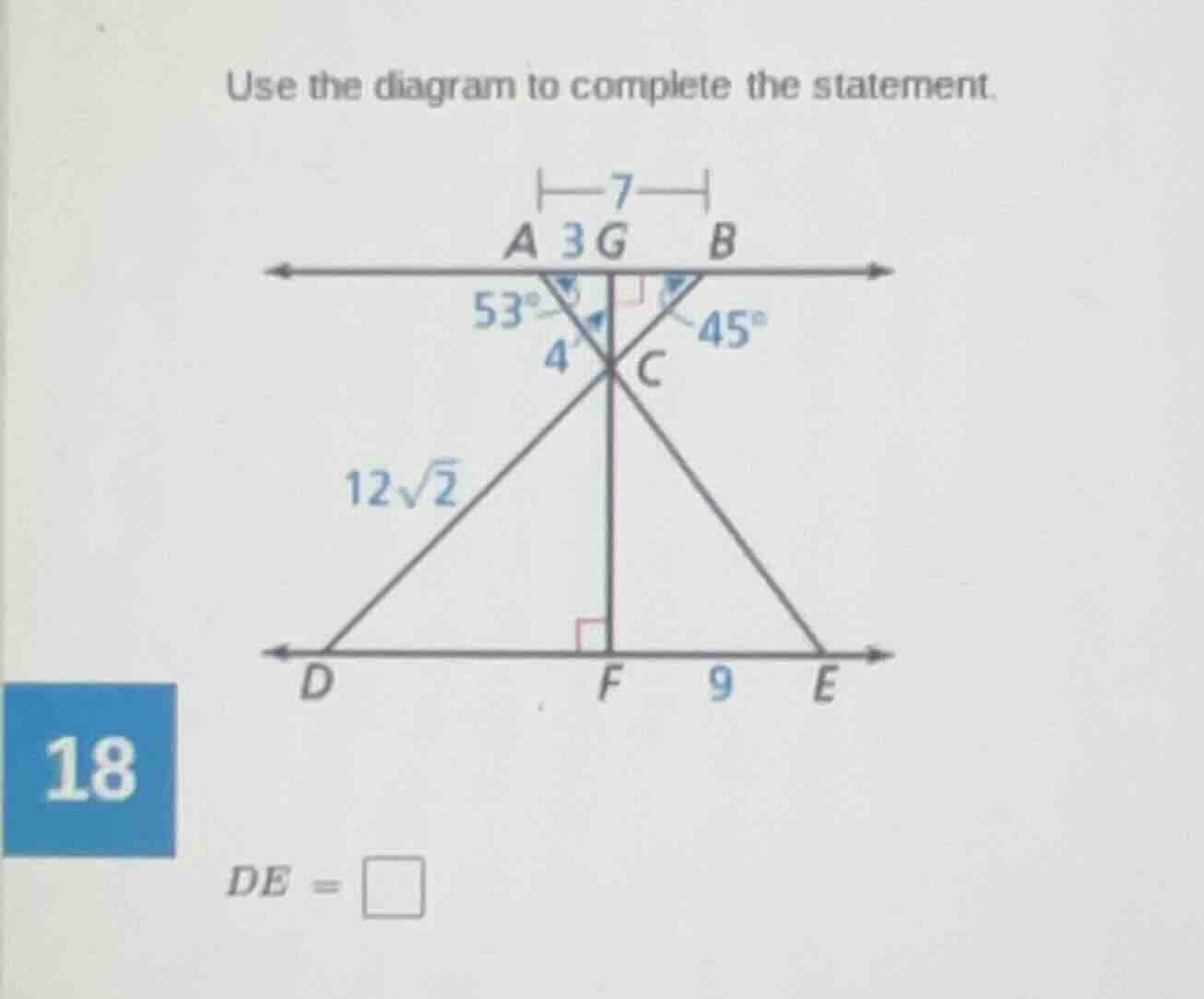
use the diagram to complete the statement.
de = \square
Step1: Find DF using triangle CDF
In right triangle CDF, we know CD = \(12\sqrt{2}\) and angle at C (or related angle) - wait, actually, looking at triangle CFE? Wait, no, triangle CFE: angle at B is 45 degrees, and CF is perpendicular to DE, so triangle CFE is a right triangle with angle 45 degrees, so it's an isosceles right triangle. Wait, FE is 9, so CF should be 9? Wait, no, let's check triangle CDF. Wait, CD is \(12\sqrt{2}\), and if we consider triangle CDF, which is a right triangle (since CF is perpendicular to DE). Wait, maybe triangle CDF is also an isosceles right triangle? Wait, no, angle at A is 53 degrees, but maybe triangle CDF: if CD is \(12\sqrt{2}\), and if it's a right isosceles triangle, then DF = CF. Wait, but let's see FE is 9, and triangle CFE: angle at B is 45 degrees, so angle at C (in triangle CFE) is 45 degrees, so CF = FE = 9? Wait, no, FE is 9, so if triangle CFE is isosceles right-angled, then CF = FE = 9? Wait, no, FE is 9, so CF = 9? Then in triangle CDF, CD is \(12\sqrt{2}\), and if it's a right isosceles triangle, then DF = CF = 9? Wait, no, that can't be. Wait, maybe I made a mistake. Wait, DE is DF + FE. We know FE is 9, so we need to find DF. Let's look at triangle CDF: CD is \(12\sqrt{2}\), and angle at D? Wait, no, maybe triangle CDF is a right triangle with legs DF and CF, and hypotenuse CD. If angle at C (angle 4) - wait, maybe angle at A is 53 degrees, but maybe triangle AGC? No, let's think again. Wait, the diagram has CF perpendicular to DE, so angle DFC is 90 degrees. Also, AB is parallel to DE (since both have perpendiculars from C? Wait, CG is perpendicular to AB, and CF is perpendicular to DE, so CG and CF are the same line? So CG = CF. Wait, AB is a line with AG = 3, GB = 7 - 3 = 4? Wait, no, AB is length 7? Wait, AG is 3, GB is 4? Wait, maybe not. Wait, the key is that triangle CDF: CD is \(12\sqrt{2}\), and if it's a right isosceles triangle, then DF = CF. Wait, but FE is 9, and triangle CFE: angle at B is 45 degrees, so angle E is 45 degrees, so triangle CFE is isosceles right-angled, so CF = FE = 9. Then in triangle CDF, CD is \(12\sqrt{2}\), and if DF = CF = 9, then by Pythagoras, \(DF^2 + CF^2 = CD^2\). Let's check: \(9^2 + 9^2 = 81 + 81 = 162\), and \((12\sqrt{2})^2 = 144 2 = 288\). No, that's not equal. So my mistake. Wait, maybe triangle CDF is not isosceles. Wait, maybe angle at A is 53 degrees, so angle 3 is 90 - 53 = 37 degrees? No, maybe not. Wait, the problem is to find DE. DE = DF + FE. FE is 9, so we need DF. Let's look at triangle CDF: CD = \(12\sqrt{2}\), and CF is equal to what? Wait, maybe AG is 3, GB is 4, and CG is perpendicular to AB, so triangle AGC: angle at A is 53 degrees, so CG = AG tan(53°)? Wait, AG is 3, tan(53°) is about 4/3, so CG = 3(4/3) = 4? No, that doesn't match. Wait, maybe I'm overcomplicating. Wait, the answer is DE = DF + FE. We know FE is 9. Let's find DF. In triangle CDF, CD = \(12\sqrt{2}\), and if it's a right triangle with legs DF and CF, and if CF = 9 (from triangle CFE, since FE = 9 and it's isosceles right-angled), then DF can be found by Pythagoras: \(DF = \sqrt{CD^2 - CF^2} = \sqrt{(12\sqrt{2})^2 - 9^2} = \sqrt{288 - 81} = \sqrt{207}\)? No, that's not right. Wait, maybe the triangle CDF is isosceles right-angled, so CD = DF\(\sqrt{2}\), so DF = CD / \(\sqrt{2}\) = \(12\sqrt{2}\) / \(\sqrt{2}\) = 12. Ah! That makes sense. So DF = 12, because in a right isosceles triangle, hypotenuse = leg \(\sqrt{2}\), so leg = hypotenuse / \(\sqrt{2}\). So DF = \(12\sqrt{2}\) / \(\sqrt{2}\) = 12. Then DE = DF + FE = 12 + 9 = 21.
Step2: C…

Snap & solve any problem in the app
Get step-by-step solutions on Sovi AI
Photo-based solutions with guided steps
Explore more problems and detailed explanations
21