QUESTION IMAGE
Question
use the diagram to complete the statements.
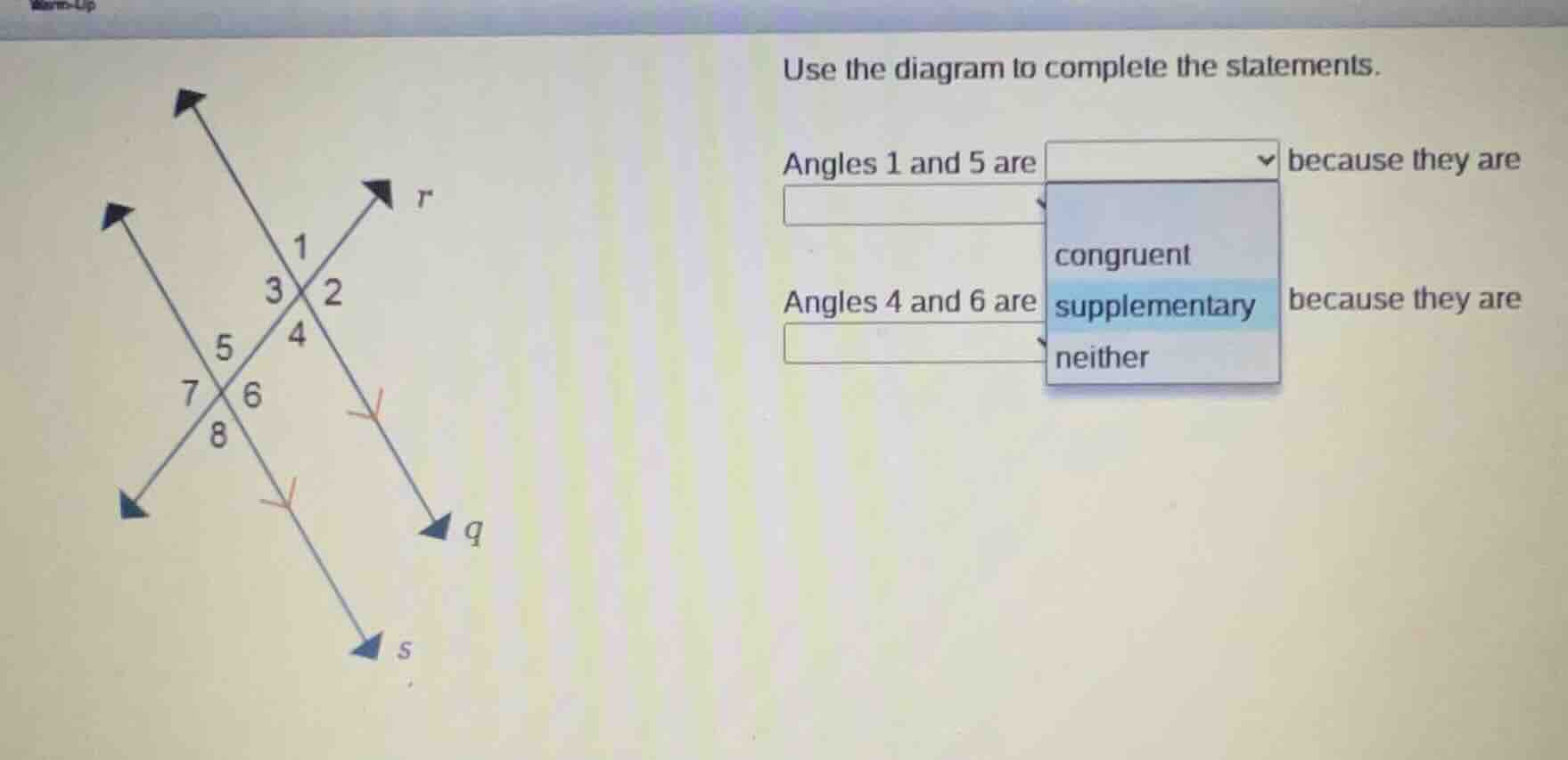
angles 1 and 5 are because they are
angles 4 and 6 are because they are
(diagram shows intersecting lines with angles labeled 1,2,3,4,5,6,7,8 and lines r, q, s)
For Angles 1 and 5:
Step1: Recall Corresponding Angles
When two parallel lines are cut by a transversal, corresponding angles are congruent. Here, lines \( q \) and \( s \) seem parallel (marked with same arrow), and transversal \( r \) cuts them. Angles 1 and 5 are corresponding angles.
Step2: Determine Relationship
Corresponding angles are congruent, so angles 1 and 5 are congruent.
For Angles 4 and 6:
Step1: Recall Alternate Interior Angles
When two parallel lines are cut by a transversal, alternate interior angles are congruent? Wait, no—wait, angles 4 and 6: let's check. Wait, lines \( q \) and \( s \) are parallel, transversal is the other line. Angles 4 and 6: actually, they are same - side interior? No, wait, angle 4 and 6: let's see the positions. Wait, angle 4 and 6: when two lines are cut by a transversal, consecutive interior angles (same - side interior) are supplementary. Wait, no, let's re - examine. The two parallel lines (with the arrow marks) are cut by a transversal. Angle 4 and angle 6: angle 4 is adjacent to angle 5, angle 6 is adjacent to angle 5. Wait, actually, angle 4 and angle 6: let's look at the diagram. The lines \( q \) and \( s \) are parallel, and the transversal is the line that creates angles 3,2,4, etc. Wait, angle 4 and angle 6: they are same - side interior angles? Wait, no, angle 4 and angle 6: when you have two parallel lines (the ones with the red marks) cut by a transversal (the line with angles 5,6,7,8), angle 4 and angle 6: actually, angle 4 and angle 6 are same - side interior angles? Wait, no, let's think about the properties. Same - side interior angles are supplementary. Wait, angle 4 and angle 6: let's see, angle 4 + angle 5 = 180 (linear pair), angle 5 + angle 6 = 180? No, angle 5 and angle 6 are linear pair? Wait, no, angle 5 and angle 6 are adjacent and form a linear pair? Wait, no, in the diagram, angle 5,6,7,8: angle 5 and 6 are adjacent, angle 6 and 8 are adjacent, etc. Wait, angle 4 and angle 6: let's see the lines. The line \( r \) and the other non - parallel line? Wait, no, the two lines with the red marks (let's say line \( q \) and line \( s \)) are parallel. The transversal is the line that intersects them, creating angles 5,6,7,8 and angles 1,2,3,4. So angle 4 and angle 6: angle 4 is on line \( q \), angle 6 is on line \( s \), and the transversal is the line with angles 5,6,7,8. So angle 4 and angle 6: they are same - side interior angles, which are supplementary. So angle 4 and angle 6 are supplementary because they are same - side interior angles (consecutive interior angles) formed by two parallel lines cut by a transversal.

Snap & solve any problem in the app
Get step-by-step solutions on Sovi AI
Photo-based solutions with guided steps
Explore more problems and detailed explanations
s:
- Angles 1 and 5 are \(\boldsymbol{congruent}\) because they are corresponding angles (formed by two parallel lines cut by a transversal).
- Angles 4 and 6 are \(\boldsymbol{supplementary}\) because they are same - side interior angles (formed by two parallel lines cut by a transversal).