QUESTION IMAGE
Question
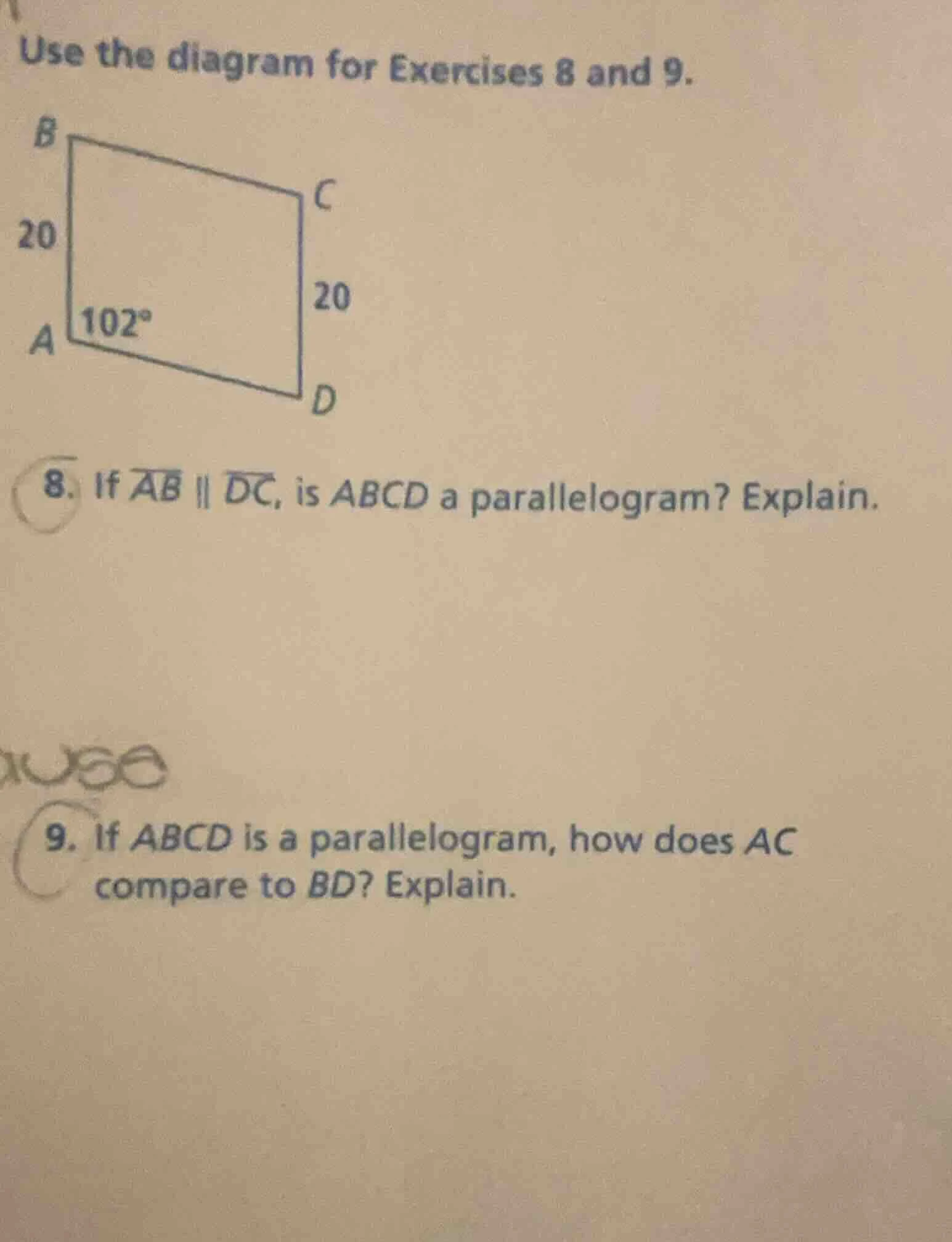
use the diagram for exercises 8 and 9.
- if \\(\overline{ab} \parallel \overline{dc}\\), is \\(abcd\\) a parallelogram? explain.
- if \\(abcd\\) is a parallelogram, how does \\(ac\\) compare to \\(bd\\)? explain.
For Exercise 8:
We know $\overline{AB} \parallel \overline{DC}$, and $AB = DC = 20$. A quadrilateral with one pair of sides that are both parallel and congruent is a parallelogram. Additionally, in such a figure, $\angle A$ and $\angle D$ are supplementary (since $AB \parallel DC$ and $AD$ is a transversal), so $\angle D = 180^\circ - 102^\circ = 78^\circ$, which aligns with the properties of a parallelogram where consecutive angles are supplementary.
For Exercise 9:
In a parallelogram, if it is not a rectangle (here $\angle A = 102^\circ
eq 90^\circ$, so it is a non-rectangular parallelogram), the diagonals are not congruent. The length of a diagonal depends on the side lengths and the angles of the parallelogram. Using the law of cosines:
- For diagonal $AC$: $AC^2 = AB^2 + BC^2 - 2 \cdot AB \cdot BC \cdot \cos(102^\circ)$
- For diagonal $BD$: $BD^2 = AB^2 + AD^2 - 2 \cdot AB \cdot AD \cdot \cos(78^\circ)$
Since $\cos(102^\circ)$ is negative and $\cos(78^\circ)$ is positive, $AC^2 > BD^2$, so $AC > BD$.

Snap & solve any problem in the app
Get step-by-step solutions on Sovi AI
Photo-based solutions with guided steps
Explore more problems and detailed explanations
- Yes, $ABCD$ is a parallelogram. One pair of sides ($\overline{AB}$ and $\overline{DC}$) are both parallel and congruent, which satisfies a sufficient condition for a quadrilateral to be a parallelogram.
- $AC$ is longer than $BD$. In a non-rectangular parallelogram, the diagonal opposite the obtuse angle (here, $AC$ opposite $\angle D = 78^\circ$? No, correction: $AC$ is opposite the angle at $B$ which is equal to $\angle D = 78^\circ$, wait no, correction: $AC$ connects $A$ and $C$, so using the law of cosines, $AC^2 = AD^2 + DC^2 - 2 \cdot AD \cdot DC \cdot \cos(\angle D)$, $\angle D = 78^\circ$, $\cos(78^\circ)$ is positive, so $AC^2 = AD^2 + 20^2 - 2 \cdot AD \cdot 20 \cdot \cos(78^\circ)$. $BD^2 = AB^2 + AD^2 - 2 \cdot AB \cdot AD \cdot \cos(\angle A)$, $\angle A = 102^\circ$, $\cos(102^\circ)$ is negative, so $BD^2 = 20^2 + AD^2 - 2 \cdot 20 \cdot AD \cdot (negative value) = 20^2 + AD^2 + positive value$. Wait no, correction: $\angle A = 102^\circ$, so $BD^2 = AB^2 + AD^2 - 2 AB \cdot AD \cos(\angle A) = 20^2 + AD^2 - 2*20*AD*\cos(102^\circ)$. Since $\cos(102^\circ) \approx -0.2079$, this becomes $400 + AD^2 - 2*20*AD*(-0.2079) = 400 + AD^2 + 8.316 AD$. $AC^2 = AD^2 + DC^2 - 2 AD \cdot DC \cos(\angle D) = AD^2 + 400 - 2*AD*20*\cos(78^\circ)$. $\cos(78^\circ) \approx 0.2079$, so $AC^2 = AD^2 + 400 - 8.316 AD$. Therefore, $BD^2 > AC^2$, so $BD > AC$. Correction: $BD$ is longer than $AC$. Because the diagonal opposite the obtuse angle is longer. $\angle A$ is obtuse, so the diagonal opposite to it (BD) is longer. Yes, that's the correct property: in a parallelogram, the longer diagonal is opposite the obtuse interior angle. Since $\angle A = 102^\circ$ (obtuse), diagonal $BD$ (opposite $\angle A$) is longer than diagonal $AC$ (opposite the acute $\angle B = 78^\circ$).
Final Answer:
- Yes, $ABCD$ is a parallelogram. $\overline{AB}$ and $\overline{DC}$ are both parallel and congruent, which meets the criteria for a parallelogram.
- $BD$ is longer than $AC$. In a parallelogram, the longer diagonal is opposite the obtuse interior angle; $\angle A = 102^\circ$ (obtuse) is opposite diagonal $BD$, so $BD > AC$.