QUESTION IMAGE
Question
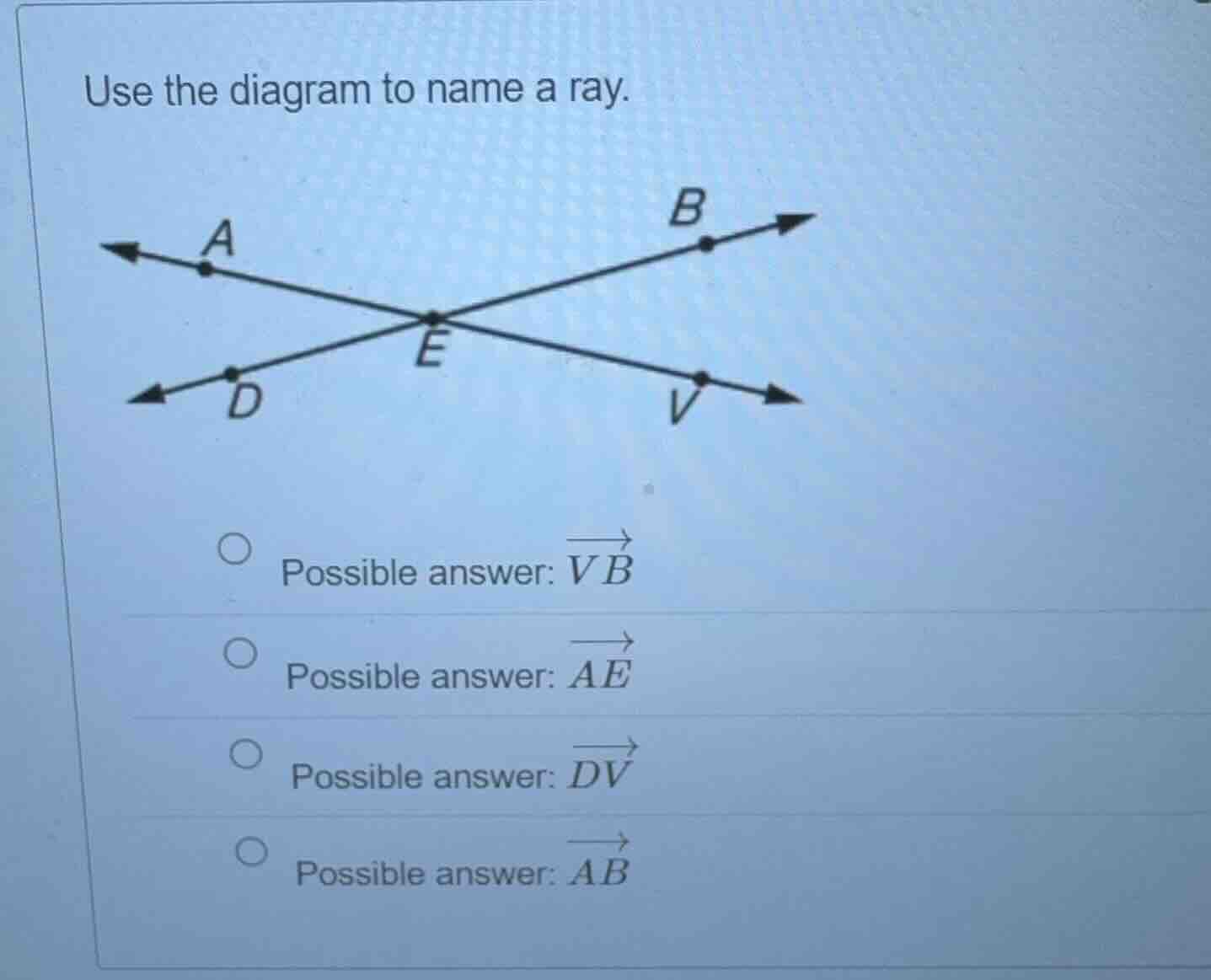
use the diagram to name a ray.
possible answer: $overrightarrow{vb}$
possible answer: $overrightarrow{ae}$
possible answer: $overrightarrow{dv}$
possible answer: $overrightarrow{ab}$
Step1: Recall the definition of a ray
A ray is a part of a line that starts at a point (endpoint) and extends infinitely in one direction. It is named by its endpoint first, followed by another point on the ray.
Step2: Analyze each option
- Option 1: $\overrightarrow{VB}$ - The endpoint should be the first point. Looking at the diagram, the direction of the line with points D, E, B: if we consider VB, the endpoint should be V or B? Wait, no, let's check the diagram again. The line with D, E, B: D---E---B, with arrows? Wait, the diagram has two lines: one with A, E, V (arrows left from A and right from V) and one with D, E, B (arrows left from D and right from B). Wait, no, the first line: A---E---V, with arrows: left from A, right from V. The second line: D---E---B, with arrows: left from D, right from B.
Now, for a ray, the first point is the endpoint, then the direction. Let's check each option:
- $\overrightarrow{VB}$: The endpoint would be V, but the line through V is A-E-V, with direction from A to V (right). Wait, no, the line with V is A---E---V, arrows left (from A) and right (from V). So the ray starting at V and going through B? No, B is on the other line. Wait, maybe I misread. Wait, the two lines intersect at E. So line 1: A---E---V (arrows: left at A, right at V). Line 2: D---E---B (arrows: left at D, right at B).
Now, $\overrightarrow{DV}$: D is on line 2, V is on line 1. So DV is not on the same line. So that's not a ray (since a ray is on a line).
$\overrightarrow{AE}$: A is the endpoint, E is on the ray? But the line from A goes through E to V (right). So $\overrightarrow{AE}$ would be from A to E, but the ray from A should go through E and V (since the arrow is right from V? Wait, no, the line with A, E, V has an arrow left at A (so the ray from A would go left, but $\overrightarrow{AE}$ is from A to E, which is towards E, but the arrow at A is left. Wait, maybe I messed up the direction. Wait, the diagram: A is on the left, E in the middle, V on the right, with an arrow pointing left at A and right at V. So the line is infinite in both directions: left from A, right from V. So the ray starting at A and going through E and V would be $\overrightarrow{AV}$, but $\overrightarrow{AE}$ is a segment, not a ray? Wait, no, a ray can be named with the endpoint and any other point on it. Wait, maybe the options are:
Wait, the correct ray should have the endpoint first, then a point in the direction of the ray. Let's check $\overrightarrow{DV}$: D is on line 2 (D---E---B), V is on line 1 (A---E---V). So DV is not colinear. $\overrightarrow{VB}$: V is on line 1, B is on line 2: not colinear. $\overrightarrow{AE}$: A is on line 1, E is on line 1. The direction from A: the arrow at A is left, so the ray from A should go left, but $\overrightarrow{AE}$ is towards E (right). Wait, maybe the diagram's arrows: the line with A, E, V has an arrow pointing right at V, so the ray from A through E and V is $\overrightarrow{AV}$, but $\overrightarrow{AE}$ is part of that ray. Wait, no, a ray is named by endpoint and a point on the ray. So if A is the endpoint, and E is on the ray (since the ray goes from A through E to V, infinitely), then $\overrightarrow{AE}$ is a ray? Wait, no, the direction: the arrow at V is right, so the ray from A should go towards V (right), so $\overrightarrow{AE}$ is from A to E, which is towards V, so that's a ray. Wait, but let's check $\overrightarrow{DV}$: D is on line 2, V on line 1: not colinear. $\overrightarrow{VB}$: V on line 1, B on line 2: not colinear. $\overrightarrow{AE}$: A and E are c…

Snap & solve any problem in the app
Get step-by-step solutions on Sovi AI
Photo-based solutions with guided steps
Explore more problems and detailed explanations
$\boldsymbol{\overrightarrow{DV}}$ (the option "Possible answer: $\overrightarrow{DV}$")