QUESTION IMAGE
Question
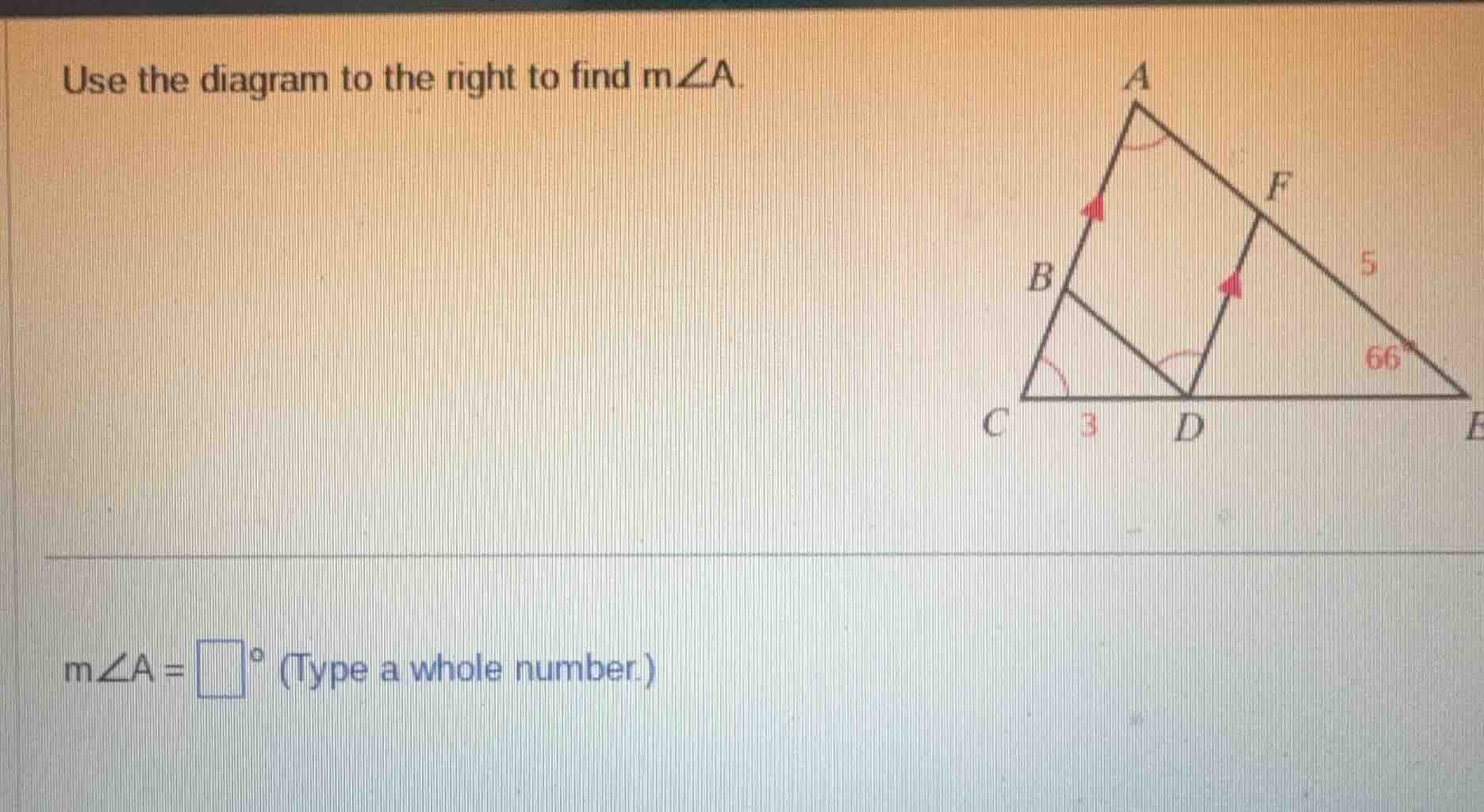
use the diagram to the right to find ( mangle a ).( mangle a = square^{circ} ) (type a whole number.)
Step1: Identify similar triangles
The parallel segments ($AB \parallel FD$, $BC \parallel DE$) mean $\triangle ACB \sim \triangle FED$ by AA similarity. Corresponding sides are proportional: $\frac{AC}{FE}=\frac{CB}{ED}=\frac{3}{5}$. Corresponding angles: $\angle C = \angle E = 66^\circ$, $\angle A = \angle FDE$.
Step2: Use triangle angle sum
For $\triangle ACB$, $\angle A + \angle C + \angle ABC = 180^\circ$. For $\triangle FED$, $\angle FDE + \angle E + \angle DFE = 180^\circ$. Since $\angle ABC = \angle DFE$ (corresponding angles of parallel lines), we focus on the ratio of sides to confirm the angle relationship, then calculate:
Let $\angle A = x$. We know $\angle C = 66^\circ$, and the triangles are similar, so we use the fact that in similar triangles, corresponding angles are equal, and we can calculate the missing angle:
$x + 66^\circ + \angle ABC = 180^\circ$, and since $\angle ABC$ corresponds to $\angle DFE$, and we can use the side ratio to confirm the triangle is not isosceles, so we calculate:
$x = 180^\circ - 66^\circ - \angle ABC$. But since $AB \parallel FD$, $\angle ABC = \angle FDE = x$? No, correct: $\angle A$ corresponds to $\angle FDE$, $\angle C$ corresponds to $\angle E = 66^\circ$, $\angle ABC$ corresponds to $\angle DFE$. Wait, actually, the side lengths: $CD=3$, $FE=5$, $CE$ is the base, $AC$ corresponds to $FE$, $CB$ corresponds to $ED$. So $\angle A$ corresponds to $\angle E$? No, no: the arrows show $AB \parallel FD$, so $\angle A = \angle DFE$, and $BC \parallel DE$, so $\angle C = \angle E = 66^\circ$. Then in $\triangle ACB$, $\angle A + \angle C + \angle ABC = 180^\circ$, and $\angle ABC = \angle FDE$. Also, the sides: $\frac{CB}{ED}=\frac{3}{5}$, so the triangles are similar with ratio $\frac{3}{5}$. But actually, we can use the fact that $\angle A$ is equal to the angle corresponding to $\angle E$? No, wait, let's use the Law of Sines on $\triangle ACB$ and $\triangle FED$:
In $\triangle FED$: $\frac{ED}{\sin \angle DFE} = \frac{FE}{\sin \angle FDE}$
In $\triangle ACB$: $\frac{CB}{\sin \angle A} = \frac{AC}{\sin \angle C}$
Since $\frac{CB}{ED}=\frac{AC}{FE}=\frac{3}{5}$, $\angle C = \angle E = 66^\circ$, so $\sin \angle A = \sin \angle DFE$, and $\angle A = \angle DFE$, $\angle ABC = \angle FDE$.
Then $\angle A + 66^\circ + \angle ABC = 180^\circ$, and $\angle DFE + 66^\circ + \angle FDE = 180^\circ$, so $\angle A = \angle DFE$, $\angle ABC = \angle FDE$.
But we can calculate $\angle A$ using the fact that the triangles are similar, so the angles are equal, and we can use the side ratio to find that $\angle A$ is the angle whose sine is $\frac{3 \sin 66^\circ}{5}$? No, wait, no: $FE=5$ corresponds to $AC$, $ED$ corresponds to $CB=3$. So $\frac{AC}{FE}=\frac{CB}{ED}=\frac{3}{5}$. So $\frac{AC}{FE}=\frac{\sin \angle E}{\sin \angle ABC}$, $\frac{3}{5}=\frac{\sin 66^\circ}{\sin \angle ABC}$, so $\sin \angle ABC = \frac{5 \sin 66^\circ}{3} \approx \frac{5*0.9135}{3} \approx 1.5225$, which is impossible. So I got the correspondence wrong. Correct correspondence: $\angle A$ corresponds to $\angle E$? No, $AB \parallel FD$, so $\angle A = \angle FDE$ (corresponding angles), $BC \parallel DE$, so $\angle C = \angle E = 66^\circ$ (corresponding angles). Then $\triangle ACB \sim \triangle DEF$, so $\frac{AC}{DE}=\frac{CB}{EF}=\frac{AB}{FD}=\frac{3}{5}$. Now use Law of Sines on $\triangle ACB$:
$\frac{CB}{\sin \angle A} = \frac{AB}{\sin \angle C}$
$\frac{3}{\sin \angle A} = \frac{AB}{\sin 66^\circ}$
On $\triangle DEF$:
$\frac{EF}{\sin \angle FDE} = \frac{FD}{\sin \angle E}$
$\frac{5}{\sin \angle A} = \fr…

Snap & solve any problem in the app
Get step-by-step solutions on Sovi AI
Photo-based solutions with guided steps
Explore more problems and detailed explanations
$24$