QUESTION IMAGE
Question
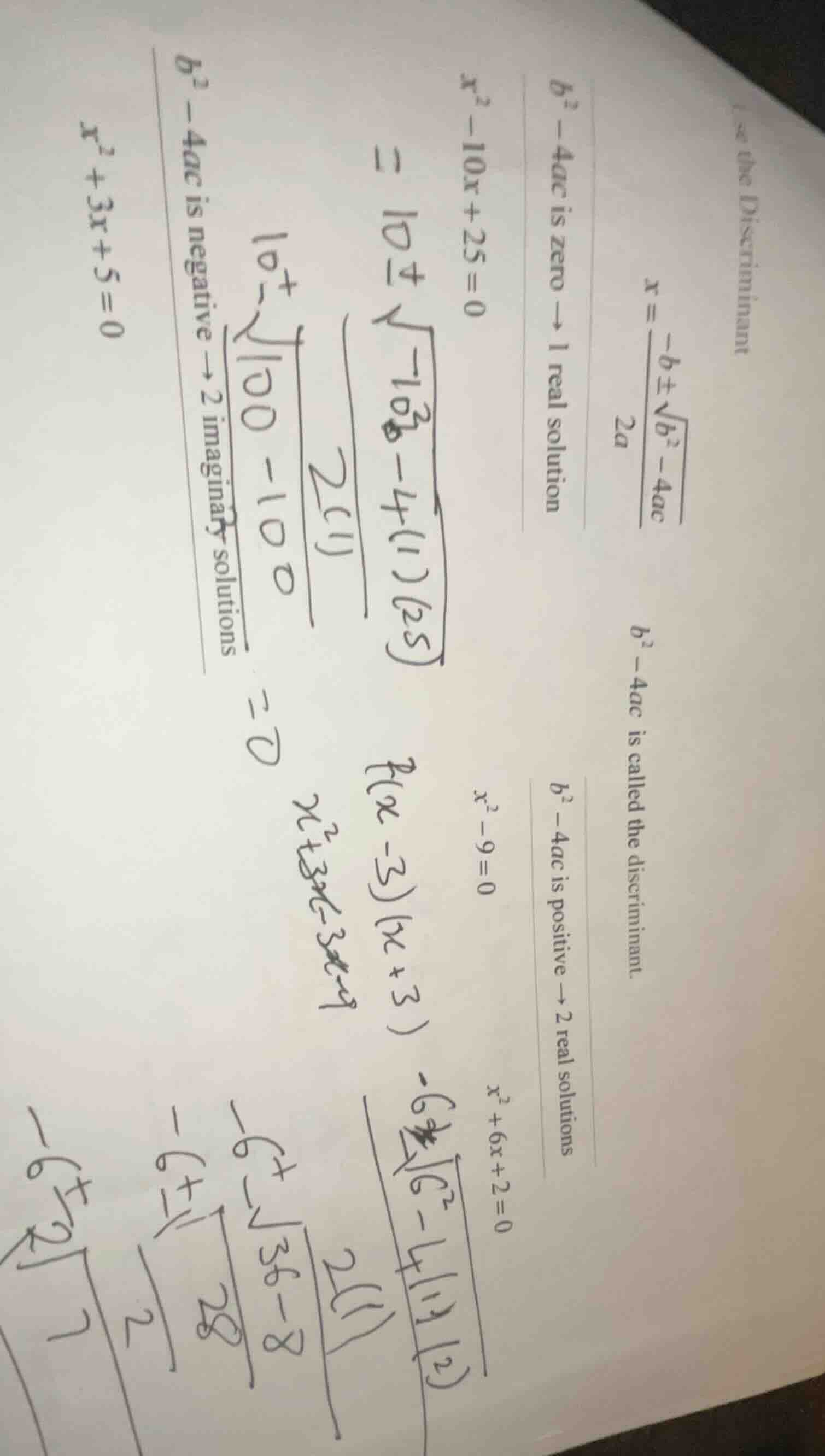
use the discriminant
$x = \frac{-b \pm \sqrt{b^2 - 4ac}}{2a}$
$b^2 - 4ac$ is called the discriminant.
- $b^2 - 4ac$ is zero $\
ightarrow$ 1 real solution
- $b^2 - 4ac$ is positive $\
ightarrow$ 2 real solutions
- $b^2 - 4ac$ is negative $\
ightarrow$ 2 imaginary solutions
equations:
- $x^2 - 10x + 25 = 0$
- $x^2 - 9 = 0$
- $x^2 + 6x + 2 = 0$
- $x^2 + 3x + 5 = 0$
handwritten calculations (partial):
- for $x^2 - 10x + 25 = 0$: $\frac{10 \pm \sqrt{10^2 - 4(1)(25)}}{2(1)} = \frac{10 \pm 0}{2} = 5$
- for $x^2 - 9 = 0$: factored as $(x - 3)(x + 3)$
- for $x^2 + 6x + 2 = 0$: $\frac{-6 \pm \sqrt{6^2 - 4(1)(2)}}{2(1)} = \frac{-6 \pm \sqrt{36 - 8}}{2} = \frac{-6 \pm \sqrt{28}}{2} = \frac{-6 \pm 2\sqrt{7}}{2} = -3 \pm \sqrt{7}$
- for $x^2 + 3x + 5 = 0$: $\frac{-3 \pm \sqrt{3^2 - 4(1)(5)}}{2(1)} = \frac{-3 \pm \sqrt{9 - 20}}{2} = \frac{-3 \pm \sqrt{-11}}{2}$ (imaginary solutions)
To analyze the quadratic equations using the discriminant \( D = b^2 - 4ac \), we follow these steps for each equation:
1. Equation: \( \boldsymbol{x^2 - 10x + 25 = 0} \)
Step 1: Identify \( a, b, c \)
For \( ax^2 + bx + c = 0 \), here \( a = 1 \), \( b = -10 \), \( c = 25 \).
Step 2: Calculate discriminant \( D \)
\( D = b^2 - 4ac = (-10)^2 - 4(1)(25) \)
\( D = 100 - 100 = 0 \)
Step 3: Determine solutions
If \( D = 0 \), there is 1 real solution (a repeated root).
Using the quadratic formula \( x = \frac{-b \pm \sqrt{D}}{2a} \):
\( x = \frac{-(-10) \pm \sqrt{0}}{2(1)} = \frac{10}{2} = 5 \)
2. Equation: \( \boldsymbol{x^2 - 9 = 0} \)
Step 1: Identify \( a, b, c \)
Rewrite as \( x^2 + 0x - 9 = 0 \), so \( a = 1 \), \( b = 0 \), \( c = -9 \).
Step 2: Calculate discriminant \( D \)
\( D = 0^2 - 4(1)(-9) = 0 + 36 = 36 \)
Step 3: Determine solutions
If \( D > 0 \), there are 2 real solutions.
Using the quadratic formula:
\( x = \frac{-0 \pm \sqrt{36}}{2(1)} = \frac{\pm 6}{2} \)
Thus, \( x = 3 \) or \( x = -3 \) (or factor as \( (x - 3)(x + 3) = 0 \)).
3. Equation: \( \boldsymbol{x^2 + 6x + 2 = 0} \)
Step 1: Identify \( a, b, c \)
Here \( a = 1 \), \( b = 6 \), \( c = 2 \).
Step 2: Calculate discriminant \( D \)
\( D = 6^2 - 4(1)(2) = 36 - 8 = 28 \)
Step 3: Determine solutions
If \( D > 0 \), there are 2 real (irrational) solutions.
Using the quadratic formula:
\( x = \frac{-6 \pm \sqrt{28}}{2(1)} = \frac{-6 \pm 2\sqrt{7}}{2} = -3 \pm \sqrt{7} \)
4. Equation: \( \boldsymbol{x^2 + 3x + 5 = 0} \)
Step 1: Identify \( a, b, c \)
Here \( a = 1 \), \( b = 3 \), \( c = 5 \).
Step 2: Calculate discriminant \( D \)
\( D = 3^2 - 4(1)(5) = 9 - 20 = -11 \)
Step 3: Determine solutions
If \( D < 0 \), there are 2 complex (imaginary) solutions.
Using the quadratic formula (with \( \sqrt{-11} = i\sqrt{11} \)):
\( x = \frac{-3 \pm i\sqrt{11}}{2} \)
Summary of Results:
| Equation | \( a \) | \( b \) | \( c \) | Discriminant (\( D \)) | Number of Solutions | Solutions (if real) |
|---|---|---|---|---|---|---|
| \( x^2 - 9 = 0 \) | 1 | 0 | -9 | 36 | 2 real | \( x = 3, -3 \) |
| \( x^2 + 6x + 2 = 0 \) | 1 | 6 | 2 | 28 | 2 real (irrational) | \( x = -3 \pm \sqrt{7} \) |
| \( x^2 + 3x + 5 = 0 \) | 1 | 3 | 5 | -11 | 2 imaginary | \( x = \frac{-3 \pm i\sqrt{11}}{2} \) |
The discriminant determines the nature of the roots:
- \( D > 0 \): 2 distinct real roots.
- \( D = 0 \): 1 real (repeated) root.
- \( D < 0 \): 2 complex (imaginary) roots.

Snap & solve any problem in the app
Get step-by-step solutions on Sovi AI
Photo-based solutions with guided steps
Explore more problems and detailed explanations
To analyze the quadratic equations using the discriminant \( D = b^2 - 4ac \), we follow these steps for each equation:
1. Equation: \( \boldsymbol{x^2 - 10x + 25 = 0} \)
Step 1: Identify \( a, b, c \)
For \( ax^2 + bx + c = 0 \), here \( a = 1 \), \( b = -10 \), \( c = 25 \).
Step 2: Calculate discriminant \( D \)
\( D = b^2 - 4ac = (-10)^2 - 4(1)(25) \)
\( D = 100 - 100 = 0 \)
Step 3: Determine solutions
If \( D = 0 \), there is 1 real solution (a repeated root).
Using the quadratic formula \( x = \frac{-b \pm \sqrt{D}}{2a} \):
\( x = \frac{-(-10) \pm \sqrt{0}}{2(1)} = \frac{10}{2} = 5 \)
2. Equation: \( \boldsymbol{x^2 - 9 = 0} \)
Step 1: Identify \( a, b, c \)
Rewrite as \( x^2 + 0x - 9 = 0 \), so \( a = 1 \), \( b = 0 \), \( c = -9 \).
Step 2: Calculate discriminant \( D \)
\( D = 0^2 - 4(1)(-9) = 0 + 36 = 36 \)
Step 3: Determine solutions
If \( D > 0 \), there are 2 real solutions.
Using the quadratic formula:
\( x = \frac{-0 \pm \sqrt{36}}{2(1)} = \frac{\pm 6}{2} \)
Thus, \( x = 3 \) or \( x = -3 \) (or factor as \( (x - 3)(x + 3) = 0 \)).
3. Equation: \( \boldsymbol{x^2 + 6x + 2 = 0} \)
Step 1: Identify \( a, b, c \)
Here \( a = 1 \), \( b = 6 \), \( c = 2 \).
Step 2: Calculate discriminant \( D \)
\( D = 6^2 - 4(1)(2) = 36 - 8 = 28 \)
Step 3: Determine solutions
If \( D > 0 \), there are 2 real (irrational) solutions.
Using the quadratic formula:
\( x = \frac{-6 \pm \sqrt{28}}{2(1)} = \frac{-6 \pm 2\sqrt{7}}{2} = -3 \pm \sqrt{7} \)
4. Equation: \( \boldsymbol{x^2 + 3x + 5 = 0} \)
Step 1: Identify \( a, b, c \)
Here \( a = 1 \), \( b = 3 \), \( c = 5 \).
Step 2: Calculate discriminant \( D \)
\( D = 3^2 - 4(1)(5) = 9 - 20 = -11 \)
Step 3: Determine solutions
If \( D < 0 \), there are 2 complex (imaginary) solutions.
Using the quadratic formula (with \( \sqrt{-11} = i\sqrt{11} \)):
\( x = \frac{-3 \pm i\sqrt{11}}{2} \)
Summary of Results:
| Equation | \( a \) | \( b \) | \( c \) | Discriminant (\( D \)) | Number of Solutions | Solutions (if real) |
|---|---|---|---|---|---|---|
| \( x^2 - 9 = 0 \) | 1 | 0 | -9 | 36 | 2 real | \( x = 3, -3 \) |
| \( x^2 + 6x + 2 = 0 \) | 1 | 6 | 2 | 28 | 2 real (irrational) | \( x = -3 \pm \sqrt{7} \) |
| \( x^2 + 3x + 5 = 0 \) | 1 | 3 | 5 | -11 | 2 imaginary | \( x = \frac{-3 \pm i\sqrt{11}}{2} \) |
The discriminant determines the nature of the roots:
- \( D > 0 \): 2 distinct real roots.
- \( D = 0 \): 1 real (repeated) root.
- \( D < 0 \): 2 complex (imaginary) roots.