QUESTION IMAGE
Question
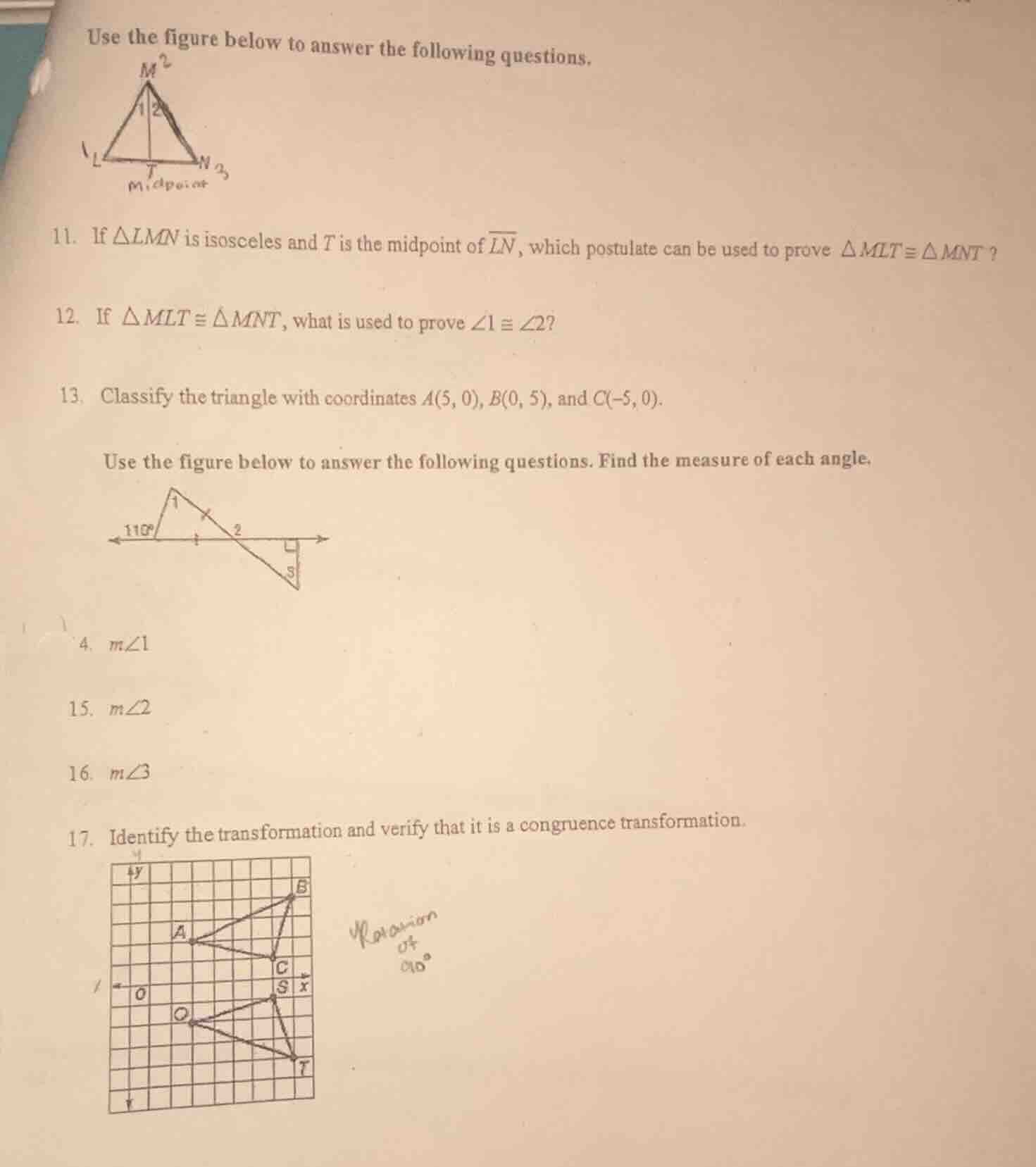
use the figure below to answer the following questions.
- if $\triangle lmn$ is isosceles and $t$ is the midpoint of $\overline{ln}$, which postulate can be used to prove $\triangle mlt \cong \triangle mnt$?
- if $\triangle mlt \cong \triangle mnt$, what is used to prove $\angle 1 \cong \angle 2$
- classify the triangle with coordinates $a(5, 0)$, $b(0, 5)$, and $c(-5, 0)$.
use the figure below to answer the following questions. find the measure of each angle.
- $m\angle 1$
- $m\angle 2$
- $m\angle 3$
- identify the transformation and verify that it is a congruence transformation.
Question 11
Step1: Analyze given information
$\triangle LMN$ is isosceles, so $ML = MN$ (legs of isosceles triangle). $T$ is the midpoint of $\overline{LN}$, so $LT = NT$. Also, $\overline{MT}$ is common to both $\triangle MLT$ and $\triangle MNT$.
Step2: Identify congruence postulate
We have three sides: $ML = MN$, $LT = NT$, and $MT = MT$. So the SSS (Side - Side - Side) postulate can be used to prove $\triangle MLT\cong\triangle MNT$.
Step1: Recall properties of congruent triangles
If $\triangle MLT\cong\triangle MNT$, then corresponding parts of congruent triangles are congruent (CPCTC). $\angle1$ and $\angle2$ are corresponding angles of the congruent triangles $\triangle MLT$ and $\triangle MNT$.
Step2: Apply CPCTC
By the CPCTC (Corresponding Parts of Congruent Triangles are Congruent) theorem, since $\triangle MLT\cong\triangle MNT$, $\angle1\cong\angle2$.
Step1: Calculate the lengths of the sides
The distance formula between two points $(x_1,y_1)$ and $(x_2,y_2)$ is $d=\sqrt{(x_2 - x_1)^2+(y_2 - y_1)^2}$.
- For $AB$: $A(5,0)$ and $B(0,5)$
$AB=\sqrt{(0 - 5)^2+(5 - 0)^2}=\sqrt{(- 5)^2+5^2}=\sqrt{25 + 25}=\sqrt{50}=5\sqrt{2}$
- For $BC$: $B(0,5)$ and $C(-5,0)$
$BC=\sqrt{(-5 - 0)^2+(0 - 5)^2}=\sqrt{(-5)^2+(-5)^2}=\sqrt{25 + 25}=\sqrt{50}=5\sqrt{2}$
- For $AC$: $A(5,0)$ and $C(-5,0)$
$AC=\sqrt{(-5 - 5)^2+(0 - 0)^2}=\sqrt{(-10)^2+0^2}=\sqrt{100}=10$
Step2: Classify the triangle
Since $AB = BC=5\sqrt{2}$ and $AC = 10$, and we can check the Pythagorean theorem: $(5\sqrt{2})^2+(5\sqrt{2})^2=50 + 50 = 100=10^2$. So it is an isosceles right triangle (two sides equal and satisfies Pythagorean theorem for right triangle).

Snap & solve any problem in the app
Get step-by-step solutions on Sovi AI
Photo-based solutions with guided steps
Explore more problems and detailed explanations
SSS (Side - Side - Side) postulate