QUESTION IMAGE
Question
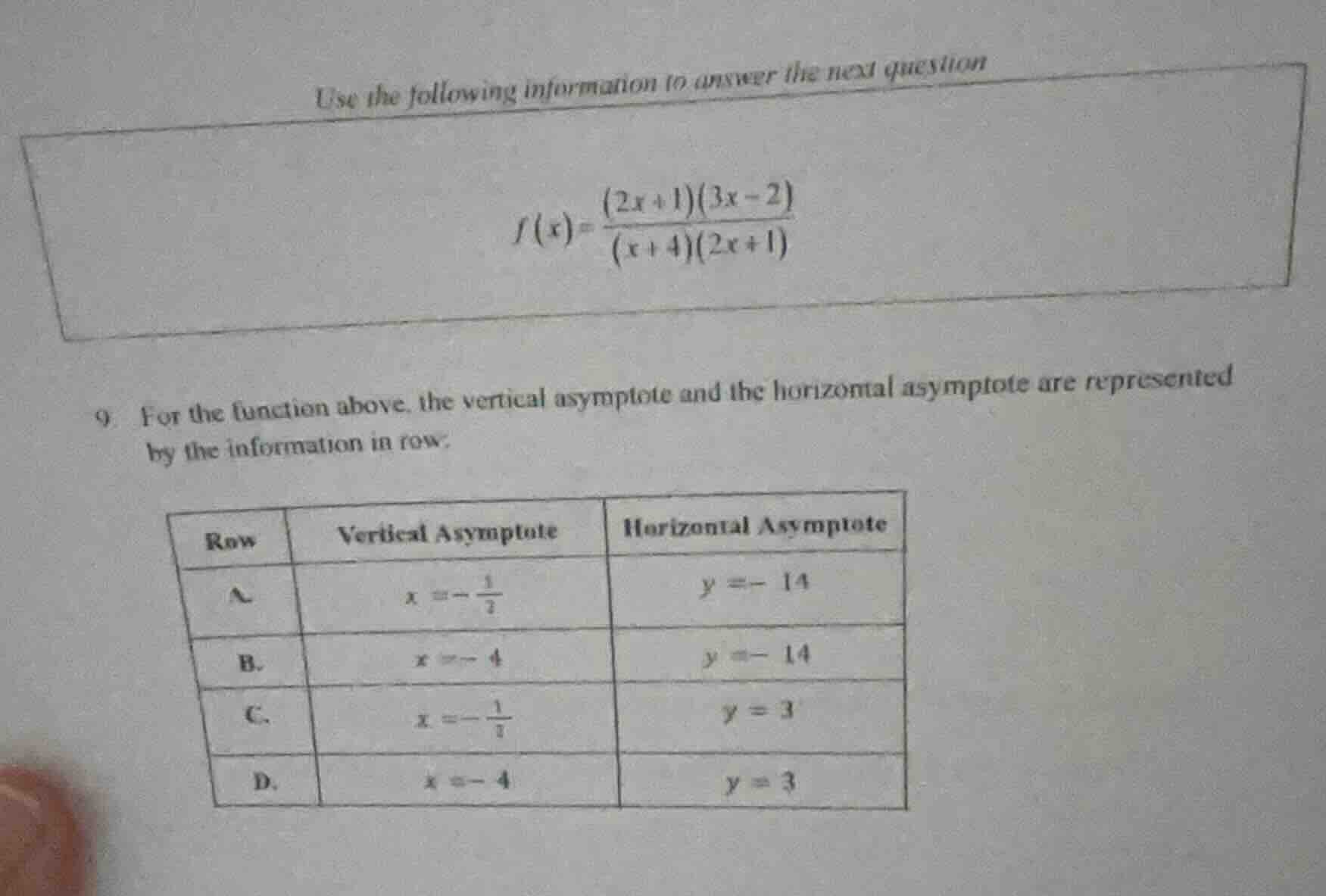
use the following information to answer the next question
$f(x)=\frac{(2x + 1)(3x - 2)}{(x + 4)(2x + 1)}$
- for the function above, the vertical asymptote and the horizontal asymptote are represented by the information in row.
| row | vertical asymptote | horizontal asymptote |
|---|---|---|
| b | $x = -4$ | $y = -14$ |
| c | $x = -\frac{1}{2}$ | $y = 3$ |
| d | $x = -4$ | $y = 3$ |
Step1: Simplify the rational function
First, cancel the common non-zero factor $(2x+1)$ from numerator and denominator (note $2x+1
eq0$, so $x
eq-\frac{1}{2}$ is a hole, not an asymptote):
$$f(x)=\frac{3x-2}{x+4}, \quad x
eq-\frac{1}{2}$$
Step2: Find vertical asymptote
Vertical asymptotes occur where the simplified denominator is 0:
$$x+4=0 \implies x=-4$$
Step3: Find horizontal asymptote
For rational functions, compare degrees of numerator and denominator (both degree 1). The horizontal asymptote is the ratio of leading coefficients:
$$y=\frac{3}{1}=3$$

Snap & solve any problem in the app
Get step-by-step solutions on Sovi AI
Photo-based solutions with guided steps
Explore more problems and detailed explanations
D. Vertical Asymptote $x=-4$, Horizontal Asymptote $y=3$