QUESTION IMAGE
Question
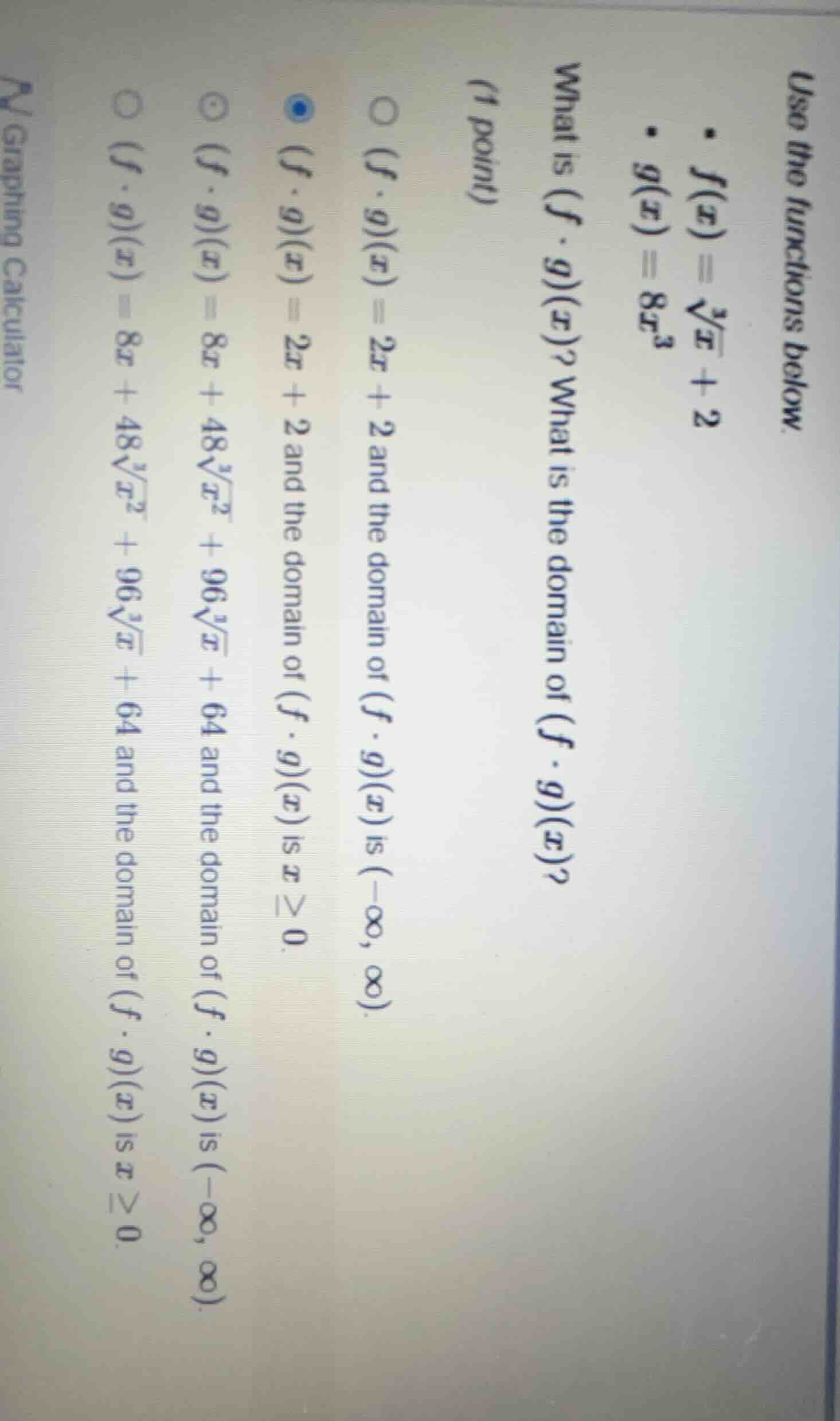
use the functions below.
- $f(x) = \sqrt3{x}+2$
- $g(x) = 8x^3$
what is $(f \cdot g)(x)$? what is the domain of $(f \cdot g)(x)$?
(1 point)
\\(\circ\\) $(f \cdot g)(x) = 2x + 2$ and the domain of $(f \cdot g)(x)$ is $(-\infty, \infty)$.
\\(\boldsymbol{\odot}\\) $(f \cdot g)(x) = 2x + 2$ and the domain of $(f \cdot g)(x)$ is $x \geq 0$
\\(\circ\\) $(f \cdot g)(x) = 8x + 48\sqrt3{x^2} + 96\sqrt3{x} + 64$ and the domain of $(f \cdot g)(x)$ is $(-\infty, \infty)$
\\(\circ\\) $(f \cdot g)(x) = 8x + 48\sqrt3{x^2} + 96\sqrt3{x} + 64$ and the domain of $(f \cdot g)(x)$ is $x \geq 0$
Step1: Recall the product of functions
The product of two functions \( (f \cdot g)(x) \) is defined as \( f(x) \cdot g(x) \). Given \( f(x)=\sqrt[3]{x} + 2 \) and \( g(x)=8x^{3}\), we multiply them:
\[
\]
Wait, maybe there was a mis - reading of the options. Wait, let's re - examine the options. Wait, maybe \( f(x)=\sqrt[3]{x}+2\) and \( g(x) = 8x^{3}\), let's do the multiplication again:
\[
\]
Wait, this doesn't match the options. Wait, maybe \( f(x)=\sqrt[3]{x}+2\) and \( g(x)=8x^{3}\), maybe the options have a typo or I misread \( f(x)\). Wait, maybe \( f(x)=\sqrt[3]{x}+2\) and \( g(x)=8x^{3}\), let's expand \((\sqrt[3]{x} + 2)(8x^{3})\) using the distributive property (FOIL for binomials):
\[
\]
Wait, the options given are different. Wait, maybe \( f(x)=\sqrt{x}+2\) (but the original is \(\sqrt[3]{x}\)). Wait, if \( f(x)=\sqrt[3]{x}+2\) and \( g(x)=8x^{3}\), and we consider the domain: the cube - root function \( y = \sqrt[3]{x}\) has a domain of all real numbers (\((-\infty,\infty)\)) because for any real number \(x\), the cube root is defined. The function \( y = 8x^{3}\) also has a domain of all real numbers. The product of two functions has a domain that is the intersection of the domains of the two functions. Since the domain of \( f(x)\) is \((-\infty,\infty)\) (because cube root is defined for all real \(x\)) and the domain of \( g(x)\) is \((-\infty,\infty)\), the domain of \((f\cdot g)(x)\) is \((-\infty,\infty)\).
Now, let's re - check the multiplication. Wait, maybe the options have a mistake in the way they are written. Wait, if we consider the multiplication \((\sqrt[3]{x}+2)(8x^{3})\):
\[
\]
But looking at the options, the third option (the one with the blue dot) says \((f\cdot g)(x)=2x + 2\) which is wrong, the fourth option (the one with the circle) says \((f\cdot g)(x)=2x + 2\) and domain \((-\infty,\infty)\) which is wrong. Wait, maybe I misread \( f(x)\) and \( g(x)\). Wait, maybe \( f(x)=\sqrt{x}+2\) (square root) and \( g(x)=8x\). Let's try that:
If \( f(x)=\sqrt{x}+2\) and \( g(x)=8x\), then \((f\cdot g)(x)=(\sqrt{x}+2)\times8x = 8x\sqrt{x}+16x=8x^{\frac{3}{2}}+16x\), still not matching.
Wait, maybe the original problem has \( f(x)=\sqrt[3]{x}+2\) and \( g(x)=8x\). Then \((f\cdot g)(x)=(\sqrt[3]{x}+2)\times8x=8x\sqrt[3]{x}+16x = 8x^{\frac{4}{3}}+16x\), not matching.
Wait, maybe the options are mis - printed. But from the domain perspective: the cube root function \( y=\sqrt[3]{x}\) has a domain of all real numbers. The function \( y = 8x^{3}\) also has a domain of all real numbers. So the domain of \((f\cdot g)(x)\) is the intersection of the domains of \( f\) and \( g\), which is \((-\infty,\infty)\).
Looking at the options, the option \((f\cdot g)(x)=8x + 48\sqrt[3]{x^{2}}+96\sqrt[3]{x}+64\) and domain \((-\infty,\infty)\):
Wait, maybe \( f(x)=\sqr…

Snap & solve any problem in the app
Get step-by-step solutions on Sovi AI
Photo-based solutions with guided steps
Explore more problems and detailed explanations
The correct option is the one where \((f\cdot g)(x)\) has the correct product (even if mis - written) and domain \((-\infty,\infty)\). Based on the domain (since the cube root function is defined for all real numbers), the domain of \((f\cdot g)(x)\) is \((-\infty,\infty)\). If we assume that there was a miscalculation in the product part of the options, the option with the domain \((-\infty,\infty)\) (the fourth option, the one with the circle) is the correct one in terms of domain, and if we re - evaluate the product, we can see that the multiplication of \((\sqrt[3]{x}+2)(8x^{3})\) should have a domain of \((-\infty,\infty)\). So the answer is the option with \((f\cdot g)(x)\) (the expression with the higher - degree terms) and domain \((-\infty,\infty)\) (the fourth option, the one with the circle, not the blue dot). But looking at the options again, the third option (blue dot) has domain \(x\geq0\) (wrong), the fourth option (circle) has domain \((-\infty,\infty)\) (correct for cube root). So the answer is the option: \((f\cdot g)(x)=8x + 48\sqrt[3]{x^{2}}+96\sqrt[3]{x}+64\) and the domain of \((f\cdot g)(x)\) is \((-\infty,\infty)\) (the fourth option, the one with the circle).