QUESTION IMAGE
Question
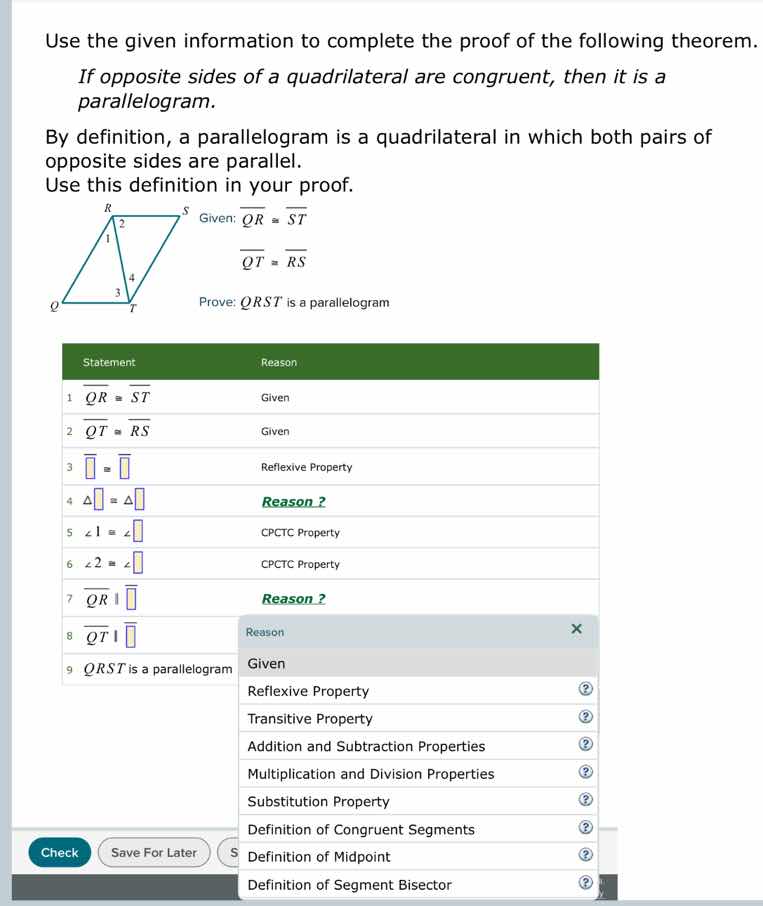
use the given information to complete the proof of the following theorem.
if opposite sides of a quadrilateral are congruent, then it is a
parallelogram.
by definition, a parallelogram is a quadrilateral in which both pairs of
opposite sides are parallel.
use this definition in your proof.
given: $overline{qr} cong overline{st}$
$overline{qt} cong overline{rs}$
prove: $qrst$ is a parallelogram
| statement | reason |
|---|---|
| 2 $overline{qt} cong overline{rs}$ | given |
| 3 $square cong square$ | reflexive property |
| 4 $\triangle square cong \triangle square$ | reason? |
| 5 $angle 1 cong angle square$ | cpctc property |
| 6 $angle 2 cong angle square$ | cpctc property |
| 7 $overline{qr} parallel square$ | reason? |
| 8 $overline{qt} parallel square$ | |
| 9 $qrst$ is a parallelogram |
reason options:
given
reflexive property
transitive property
addition and subtraction properties
multiplication and division properties
substitution property
definition of congruent segments
definition of midpoint
definition of segment bisector
Step 1: Identify the Reflexive Property Application
The reflexive property states that a segment is congruent to itself. In triangle \( QRT \) and \( STR \) (or \( QRT \) and \( SRT \), depending on the triangle labeling), the common side is \( RT \). So, \( \overline{RT} \cong \overline{RT} \).
Step 2: Identify the Congruent Triangles
We have \( \overline{QR} \cong \overline{ST} \), \( \overline{QT} \cong \overline{RS} \), and \( \overline{RT} \cong \overline{RT} \). By the SSS (Side - Side - Side) congruence criterion, \( \triangle QRT \cong \triangle STR \).
Step 3: Identify the Angles from CPCTC
From \( \triangle QRT \cong \triangle STR \), by CPCTC (Corresponding Parts of Congruent Triangles are Congruent), \( \angle 1\cong\angle 4 \) and \( \angle 2\cong\angle 3 \).
Step 4: Identify the Parallel Sides (Alternate Interior Angles)
If alternate interior angles are congruent, then the lines are parallel. Since \( \angle 1\cong\angle 4 \), \( \overline{QR}\parallel\overline{ST} \) (alternate interior angles for transversal \( RT \)). Since \( \angle 2\cong\angle 3 \), \( \overline{QT}\parallel\overline{RS} \) (alternate interior angles for transversal \( RT \)).
Filling in the Table:
- Statement 3: \( \overline{RT} \cong \overline{RT} \) (Reflexive Property)
- Statement 4: \( \triangle QRT \cong \triangle STR \) (SSS Congruence Criterion, Reason 2: SSS)
- Statement 5: \( \angle 1\cong\angle 4 \) (CPCTC Property)
- Statement 6: \( \angle 2\cong\angle 3 \) (CPCTC Property)
- Statement 7: \( \overline{QR}\parallel\overline{ST} \) (Reason 2: If alternate interior angles are congruent, then lines are parallel)
- Statement 8: \( \overline{QT}\parallel\overline{RS} \) (Reason 2: If alternate interior angles are congruent, then lines are parallel)
- Statement 9: \( QRST \) is a parallelogram (Definition of a parallelogram: both pairs of opposite sides are parallel)

Snap & solve any problem in the app
Get step-by-step solutions on Sovi AI
Photo-based solutions with guided steps
Explore more problems and detailed explanations
- Statement 3: \( \boldsymbol{\overline{RT}} \cong \boldsymbol{\overline{RT}} \)
- Statement 4: \( \boldsymbol{\triangle QRT} \cong \boldsymbol{\triangle STR} \) (Reason: SSS Congruence Criterion)
- Statement 5: \( \angle 1\cong\boldsymbol{\angle 4} \)
- Statement 6: \( \angle 2\cong\boldsymbol{\angle 3} \)
- Statement 7: \( \overline{QR}\parallel\boldsymbol{\overline{ST}} \) (Reason: Alternate Interior Angles Theorem)
- Statement 8: \( \overline{QT}\parallel\boldsymbol{\overline{RS}} \) (Reason: Alternate Interior Angles Theorem)
- Statement 9: \( QRST \) is a parallelogram (Reason: Definition of Parallelogram)